Anteya Research
What Are PBB and NJOP in Bali? Annual Land Tax Basics for Owners (2026)
June 20, 2026

PBB stands for Pajak Bumi dan Bangunan, the annual land-and-building tax every property in Bali carries. NJOP stands for Nilai Jual Objek Pajak, the government-assessed taxable value the local tax office assigns to your land and building, and it is the figure PBB is calculated from. Together, PBB and NJOP are the recurring property tax a Bali owner settles once a year. The bill is small against the purchase price, but it never disappears, and the same NJOP quietly shapes your transfer taxes too.
!(/images/pbb-sppt-notice.jpg)
What PBB and NJOP actually are
PBB is Indonesia's recurring tax on holding land and a building. Urban and rural property tax (PBB-P2) is administered by the regency your property sits in, so a villa in Badung or Gianyar is assessed by that regency's revenue agency (Bapenda), not a national office.
NJOP is the tax base. Each year the regency sets an NJOP per square metre for land and a separate one for buildings, by location, road access, and construction type. Your total NJOP is land plus building, and can differ sharply between neighbours.
How PBB is calculated from NJOP
In plain terms: the regency takes your NJOP, subtracts a small non-taxable allowance, applies an assessment ratio, then a low percentage rate. Only that last percentage is the "tax rate" people picture, and it is genuinely low. Under the current regional-tax framework, PBB-P2 rates are set by each regency by local regulation (Perda) and sit at typically well under 0.5% of assessed value. Rates and tables vary by regency, so the only honest number is the one on your own assessment notice.
"Are the quoted returns gross or net, and what assumptions are used (occupancy percentage, management fees, maintenance, taxes)?"
Buyer inquiry, Anteya CRM, 2025
Annual PBB belongs in the "net" column of any yield model, even if it is the smallest line.
Anteya observation: In the large majority of buyer conversations we log, the annual PBB bill almost never comes up before signing; it typically surfaces only after handover.
Why NJOP also matters beyond the annual bill
NJOP is not only the base for yearly PBB. At transfer, the buyer's acquisition tax, BPHTB (Bea Perolehan Hak atas Tanah dan Bangunan), is generally 5% on the higher of the transaction value or NJOP. Because BPHTB treats NJOP as a floor, a low declared price does not automatically produce a low transfer tax. The seller carries a separate final income tax.
"The price 850+ 11% VAT?"
Buyer inquiry, Anteya CRM, 2025
That is VAT on new-build sales, a different tax, but the reflex holds: ask which taxes sit on top of the headline price. Our fuller breakdown is in Bali property taxes and closing costs. NJOP also serves as a rough sanity check: it sits below market value, so a price far above the area's NJOP band is worth questioning.
Who pays PBB: leasehold vs company-held property
Read the contract, not the assumption. On a title held directly, such as a building-right certificate held through a PT PMA structure, the registered holder is the taxpayer and receives the notice.
On a leasehold (Hak Sewa), the underlying land title, and therefore the registered PBB taxpayer, commonly remains the Indonesian landowner. In most leasehold deals we see, the contract then assigns the PBB obligation to the lessee, so the foreign leaseholder effectively pays it even though the bill is not in their name. If your contract is silent on PBB, close that gap before signing.
"How much is lease extension for 25 additional years"
Buyer inquiry, Anteya CRM, 2025
Extension is a separate line, but the discipline is the same: map every recurring cost. Operating costs are covered in Bali villa running costs for foreign owners.
!(/images/bapenda-pbb-payment.jpg)
How and where to pay PBB
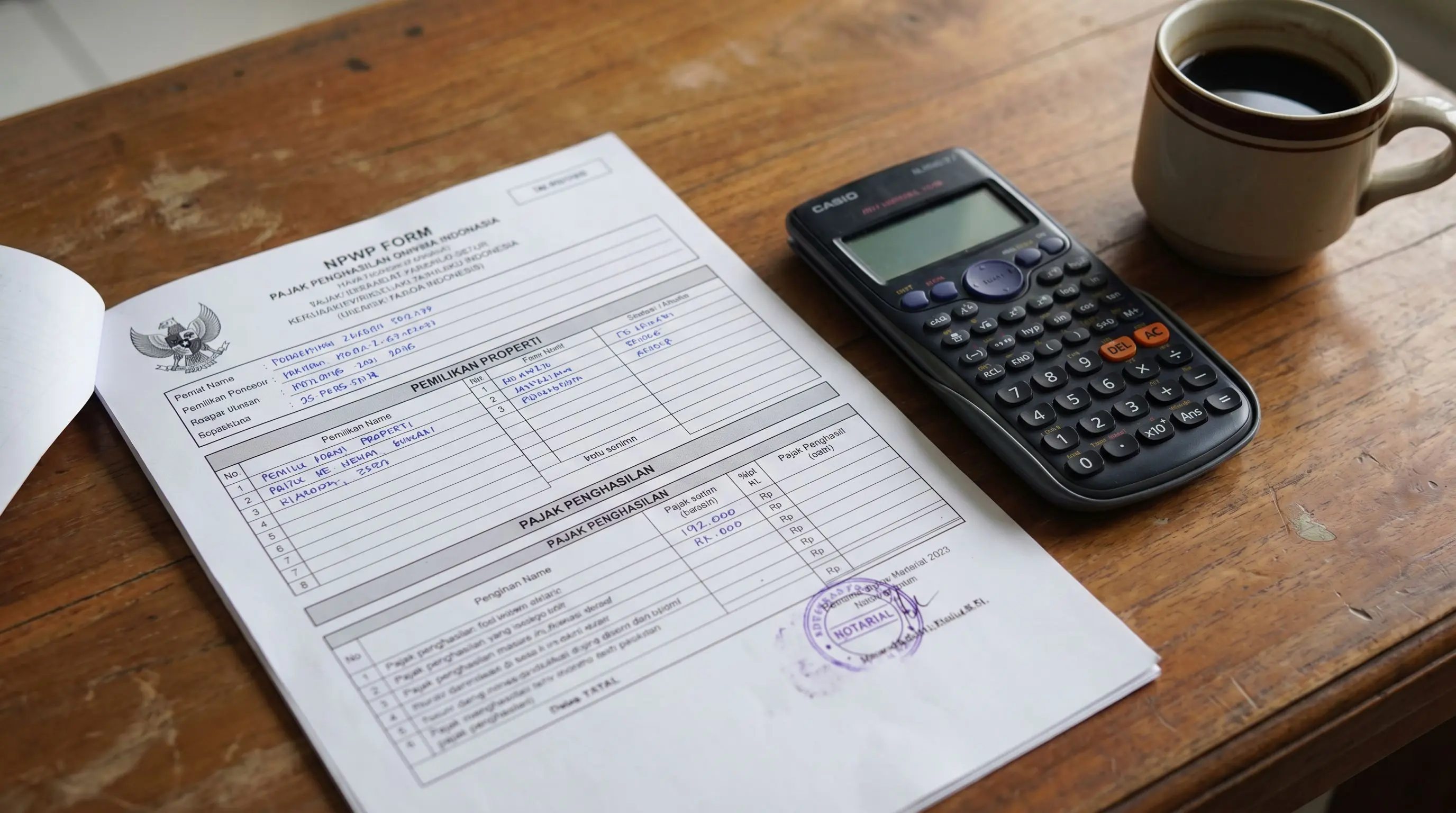
Each year the regency issues an assessment notice (SPPT PBB) stating your NJOP, the amount due, and a deadline. Payment runs through the revenue agency's channels: partner banks, ATMs, and, increasingly, online portals. For leaseholders whose bill is in the landowner's name, agree in writing who pays, so a deadline is not missed. Late payment attracts penalties and can complicate a future resale.
For current rates, thresholds, and deadlines, the authoritative sources are Indonesia's regional-tax law (UU No. 1 Tahun 2022, on peraturan.go.id), the Directorate General of Taxes (pajak.go.id), and your regency's Bapenda portal (Badung: bapenda.badungkab.go.id).
Common mistakes owners make
Four recur: leaving PBB out of the cost model, when it is small but annual; assuming a leasehold carries no property tax, when the contract usually pushes it onto you; ignoring NJOP when estimating BPHTB; and treating one quoted rate as gospel, when your real number lives on your own regency assessment.
FAQ
What is PBB in Bali?
PBB (Pajak Bumi dan Bangunan) is Indonesia's annual land-and-building tax. In Bali the regency the property sits in, such as Badung or Gianyar, assesses and collects it once a year on the government-assessed value.
What does NJOP mean?
NJOP (Nilai Jual Objek Pajak) is the government-assessed taxable value the regency sets for your land and building each year, per square metre by zone. It is the base your PBB is calculated from, and usually sits below market price.
How is PBB calculated from NJOP?
The regency subtracts a small allowance from your NJOP, applies an assessment ratio, then a low rate set by local regulation, typically well under 0.5%. Your exact figure is on the annual notice (SPPT PBB).
Do I pay PBB on a leasehold property in Bali?
The notice usually stays in the Indonesian landowner's name, since they hold the land title. But most leasehold contracts pass the PBB obligation to the lessee, so a foreign buyer typically pays it. Check your contract.
Why does NJOP matter for buying, not just the annual tax?
NJOP is also the reference for BPHTB, the buyer's acquisition tax, generally 5% on the higher of price or NJOP. So a low declared price will not automatically cut the transfer tax, and NJOP works as a rough price floor.
Anteya Research is the editorial function of Anteya Real Estate, a Bali-based investment property advisory. This article reflects patterns across 5,308 buyer conversations logged in the Anteya CRM between 2023 and 2026, supplemented by first-hand observations from our Bali-based team.
This article is general information, not legal or tax advice. Indonesian real-estate rules change and individual situations vary; consult a licensed Indonesian notaris (notary) or tax adviser for your specific purchase.