Anteya Research
Can a Foreigner Buy Property in Bali? 2026 Rules on KITAS, PT PMA, and Hak Pakai
April 22, 2026
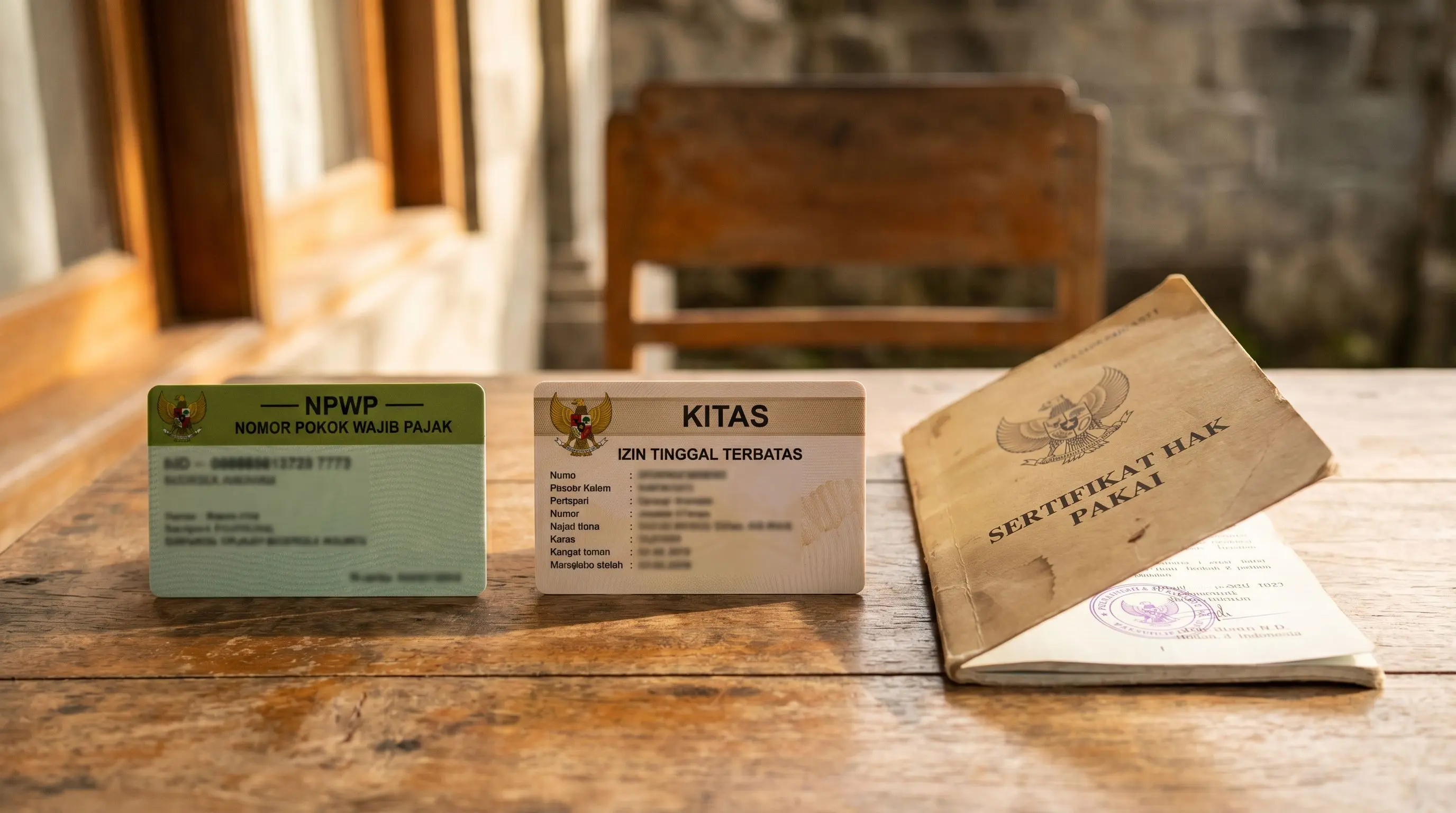
Across Anteya's buyer conversations between 2023 and 2026, only a small share directly ask about visa, PT PMA, or ownership-structure mechanics. The number is small because most qualifying buyers arrive pre-informed, but the topic is foundational for everyone. This article maps the actual legal structures foreigners use to own Bali property in 2026: Hak Pakai, Leasehold, and PT PMA holding Hak Guna Bangunan.
Anteya observation: In our Q1 2026 dataset, roughly 91% of declared project capacity is leasehold or leasehold-with-freehold-option. Freehold-only stock, relevant primarily to PT PMA structures, is a small minority of supply. The statistical reality: most foreign buyers end up on some form of leasehold. Anteya tracks ~60-70% of the primary market; figures are directional within that sample.
The four structures foreigners actually use
Indonesian agrarian law reserves Hak Milik (freehold) for Indonesian nationals. Foreigners cannot directly hold Hak Milik. The available pathways:
- Leasehold (Hak Sewa): the most common structure. You lease the land from an Indonesian landowner for a defined term (commonly 25-30 years) with a contractual right to extend. Simplest structure; no corporate overhead; straightforward tax treatment.
- Hak Pakai (right-to-use): a restricted ownership-type right granted to foreigners with a KITAS (limited-stay permit) or KITAP (permanent-stay permit). Initial term 30 years, with an extension of 20 years and a further renewal of 30 years (composite up to 80 years). Less common than leasehold because it requires residency permit status.
- PT PMA holding Hak Guna Bangunan (HGB): a foreign-owned Indonesian limited-liability company holds HGB (right-to-build). Statutory frame is 30 years initial + 20 years extension + 30 years renewal, up to 80 years composite. Corporate structure, ongoing compliance, but carries quasi-freehold economics for the PT's shareholders.
- Nominee arrangement: Indonesian national holds Hak Milik on paper; private agreements with the foreign buyer grant economic rights. Indonesian agrarian law does not recognise the foreigner's underlying ownership, and Indonesian courts have repeatedly ruled such arrangements void when tested. Widely discussed, widely used historically, materially risky. Not recommended despite its prevalence in marketing.
"I have Kitas and maybe will open PT pma (I have already PT)."
Buyer inquiry, Anteya CRM, 2025
That's a sophisticated buyer: KITAS already in place, existing PT, considering adding a PT PMA structure. It's also the minority case in our CRM; most buyers arrive with none of the above and need the structure built before purchase.
Leasehold: how it actually works
- Contract term: typically 25-30 years on the primary lease plus a contractual extension right. Indonesian law does not fix a maximum; durations are contractual.
- Extension: most leases carry a contractual extension right. These are not automatic. They are contractual and require payment of extension fees to the landowner. Courts have upheld reasonable extension-right enforcement but outcomes depend on specific clause wording.
- Transfer: leases can be assigned to new buyers via Akta Pengoperan Hak Sewa. Landowner consent typically required per original lease terms.
- Tax: rental income on leasehold-held property taxed as Indonesian-sourced rental income (PPh). Capital gain on lease assignment: 2.5% PPh at sale.
Leasehold is the default structure for most foreign villa buyers because it's simple, low-compliance, and doesn't require residency permit status.
"Are these villas completed or off-plan, and if off-plan, what buyer protections are in place?"
Buyer inquiry, Anteya CRM, 2025
A buyer asking that question on a leasehold-held villa is asking the right thing. The structure (leasehold, Hak Pakai, or PT PMA) sits alongside, not instead of, PPJB-level buyer protections. A clean leasehold structure with a weak PPJB carries more risk than a slightly less-elegant structure with strong PPJB mechanics.
Hak Pakai: the overlooked right-to-use structure
Hak Pakai is the "quiet" ownership structure for foreigners with a KITAS or KITAP. It is a direct land-use right (not a lease) with specific characteristics:
- Term: 30 years initial, with a 20-year extension and a further 30-year renewal. Composite duration up to 80 years, which matches or exceeds typical leasehold frames.
- Land class: Hak Pakai is available on land not allocated for agriculture, protected forest, or other restricted categories. Most tourism and residential zones qualify.
- Residency requirement: the foreign buyer must hold a KITAS, KITAP, or equivalent residency permit during the ownership period. This is the feature that makes Hak Pakai less common than leasehold for investor-class buyers who don't want the residency overhead.
- Tax and transfer: similar treatment to other foreign-ownership structures; transfer on resale triggers BPHTB and PPh.
For foreign buyers who are actually relocating (family-living, semi-retirement), Hak Pakai is worth evaluating alongside leasehold. Sometimes a stronger legal position, sometimes similar, but always worth the conversation.
PT PMA: the corporate pathway to quasi-freehold
A PT PMA (Perseroan Terbatas Penanaman Modal Asing, foreign-owned limited-liability company) can hold Hak Guna Bangunan (HGB) on Indonesian land. Structurally:
- Setup: PT PMA registration, minimum paid-up capital (IDR 10B / ~$650K on paper per current BKPM guidance, verify at engagement), BKPM investment licensing. A PT PMA for property investment is a one-time setup that then serves multiple transactions.
- Ownership economics: the PT owns HGB; foreign shareholders own the PT. Shareholders realise property value through PT equity ownership rather than direct land title.
- Tax: corporate income tax on the PT; dividends to foreign shareholders per Indonesian tax treaty.
- Use case: serial property investors, family investment vehicles, businesses that need property operational. Less common for single-villa owner-occupier buyers due to setup and compliance overhead.
"Do you want to know the requirements for obtaining citizenship or permanent residency in Dubai or Bali, Indonesia?"
Buyer inquiry, Anteya CRM, 2025
The residency-alongside-ownership question comes up frequently in cross-market comparisons. Bali does not offer golden-visa equivalents in the Dubai or Portugal sense, but it offers real residency pathways (KITAS, Second Home Visa) that intersect with ownership structures in specific ways.
KITAS and Second Home Visa: the residency layer
- KITAS (Kartu Izin Tinggal Terbatas, limited-stay permit): the standard residency permit. Multiple types: investor, working, retirement (age 55+), second-home, and family. Duration typically 1-5 years, renewable. Enables Hak Pakai property ownership.
- Second Home Visa: a 5-10 year residency permit introduced in recent years. Requires a deposit or asset threshold (currently around IDR 2B / ~$130K guideline, verify current). Does not itself confer property-ownership rights. It enables Hak Pakai.
- Investor KITAS via PT PMA: granted to the foreign shareholder of a registered PT PMA. Common path for business-oriented Bali residents.
- KITAP (permanent-stay permit): available after three consecutive years of KITAS status. Extends Hak Pakai eligibility without annual permit renewal.
Property ownership and residency are adjacent but distinct. A KITAS does not automatically grant ownership; ownership structures are separate legal instruments.
Supply-side, the structures show up differently by sub-market, but the right structure for a given buyer depends on residency status, intended use, and holding horizon, not on which sub-market is in play.
FAQ
Can a foreigner buy property in Bali?
Yes, through leasehold (Hak Sewa), Hak Pakai (right-to-use, requires KITAS/KITAP), or PT PMA holding Hak Guna Bangunan. Indonesian agrarian law reserves Hak Milik (freehold) for Indonesian nationals, so direct foreigner-held freehold is not available. Nominee arrangements (Indonesian national holds title on paper) are widely used but Indonesian courts have repeatedly ruled such arrangements void when tested.
What's the difference between Hak Pakai and Leasehold?
Hak Pakai is a direct use-right granted by the Indonesian state to foreigners with residency permits (KITAS/KITAP). Initial term 30 years, with a 20-year extension and a 30-year renewal possible (composite up to 80 years). Leasehold (Hak Sewa) is a contractual lease from an Indonesian landowner, typically 25-30 years with contractual extension rights. Hak Pakai has a stronger legal character but requires residency; Leasehold is simpler but contractual rather than rights-based.
Do I need a KITAS to own property in Bali?
For Hak Pakai: yes, KITAS or KITAP required. For Leasehold: no KITAS requirement. For PT PMA/HGB: no personal KITAS needed (the PT owns the property), though Investor KITAS is typically granted to shareholders. Most off-island foreign buyers own via leasehold and do not need KITAS.
What is PT PMA and when should I use it?
PT PMA is a foreign-owned Indonesian limited-liability company. It can hold Hak Guna Bangunan (HGB) on land, giving foreign shareholders quasi-freehold economics. Best use cases: serial property investors, family investment vehicles, operating businesses requiring property. Setup cost and ongoing compliance overhead make it less efficient for single-villa owner-occupier buyers.
Is a nominee arrangement legal in Bali?
Indonesian agrarian law does not recognise the foreigner's underlying ownership in a nominee arrangement. Indonesian courts have repeatedly ruled such arrangements void when tested. Despite widespread historical use, the material legal risk (the nominee can legally revoke, exit, or die, with limited recourse) makes this structure not recommended by competent Indonesian legal counsel.
What's the Second Home Visa?
A 5-10 year Indonesian residency permit introduced in recent years. Requires a deposit or asset threshold (currently around IDR 2B / ~$130K guideline, verify current). It enables Hak Pakai property ownership but does not itself grant ownership rights.
How long does it take to set up a PT PMA?
Typical timeline 6-12 weeks from engagement of an Indonesian corporate-law firm to operational PT PMA with bank account, tax registration, and BKPM licensing. Professional setup fees typically run in the low four-to-five-figure USD range, on top of the paid-up capital requirement. A PT PMA for property investment is a one-time setup that then serves multiple transactions.
Anteya Research is the editorial function of Anteya Real Estate, a Bali-based investment property advisory.
Browse Bali projects → Contact Anteya →
This article is general information, not legal advice. Indonesian property-ownership, visa, and corporate rules change and individual situations vary. Anteya scopes which structure fits before introducing you to a notaris and corporate-law firm where needed.