Anteya Research
Paying for Bali Property in USDT, Crypto, or International Wire (2026)
April 22, 2026
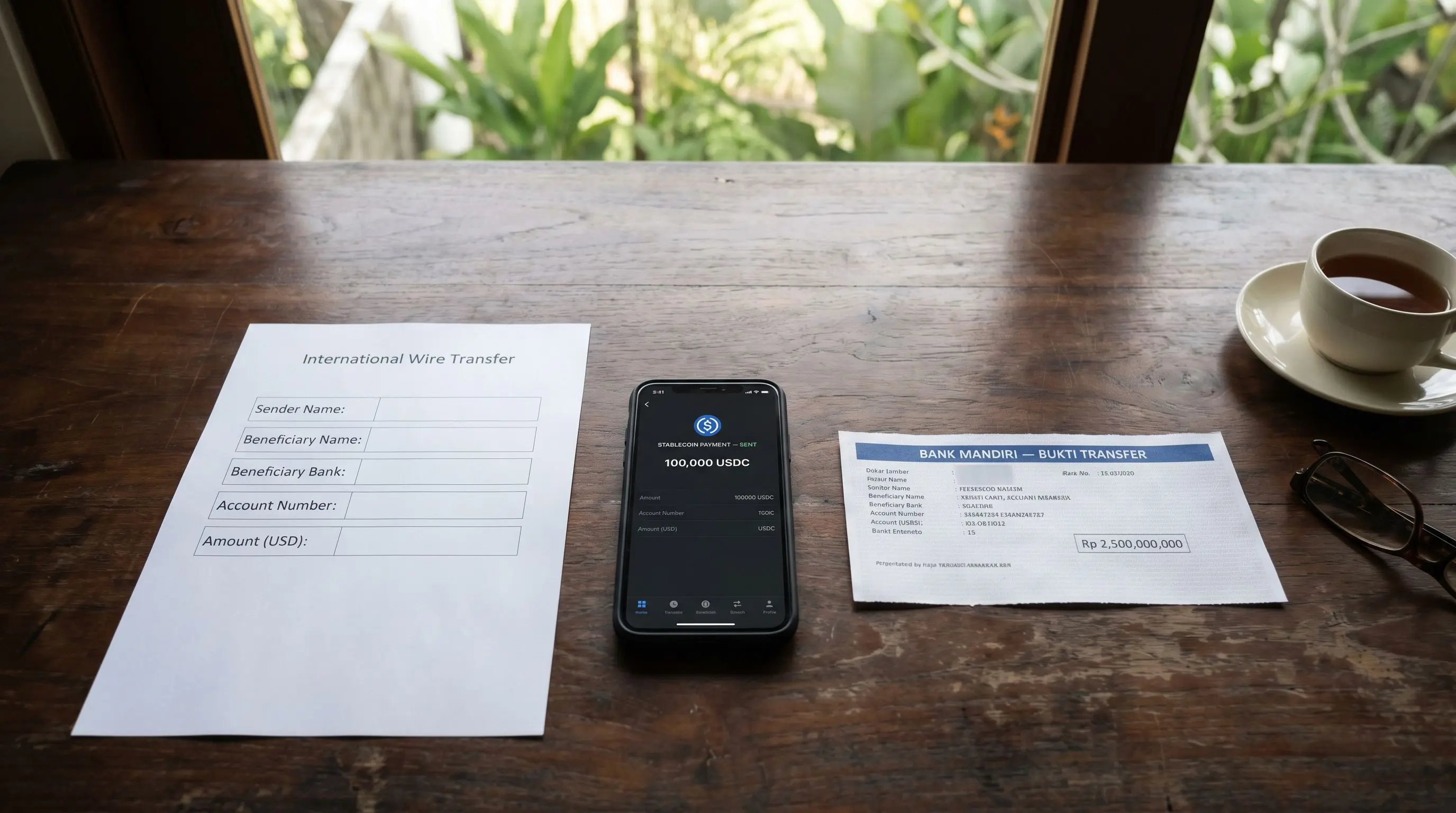
Across several thousand buyer conversations Anteya logged between 2023 and 2026, only a handful raised crypto or international-transfer mechanics as a question. Tiny count, but high-ticket. This article maps what's actually possible and legal for paying for a Bali property from abroad: international wire transfer, USDT / crypto, and alternative routes.
Anteya observation: Our Q1 2026 Bali dataset tracks several hundred projects across price points from studio floors around the $60K mark to premium villa ceilings in the multi-million-dollar range. Foreign buyers transfer capital via several distinct rails; the right rail depends on jurisdiction of origin, ticket size, and the specific Indonesian bank receiving the funds.
The legal framework: what's allowed
Indonesian law permits foreign-currency receipt by Indonesian PTs (developers selling property) through official banking channels. The practical rails:
- International SWIFT wire transfer: direct from foreign bank to Indonesian bank account held by the developer PT. Standard, well-documented, KYC-compliant. Timeline typically 3–5 business days per transfer; high-value transfers can attract additional OFAC/KYC scrutiny.
- Singapore / Hong Kong routing: two-step. Foreign-origin wire to a Singapore or Hong Kong account, then onward wire to Indonesia. Useful for buyers from jurisdictions with outbound currency controls or heightened KYC scrutiny; not inherently safer but can smooth sequencing.
- USDT / crypto via OTC desks: stablecoin deposit to an Indonesian OTC desk, which converts to IDR and delivers to the developer PT's bank account. Crypto itself cannot legally be used as payment for goods or services in Indonesia: Bank Indonesia confirmed the ban in 2022, and Bappebti (the commodities futures regulator) treats crypto as an asset class or commodity, not as legal tender. When a developer quotes a USDT price, they are typically routing the conversion through a licensed Indonesian OTC desk and receiving IDR — that is the legal path, not literal crypto receipt.
- Cash: permitted for smaller amounts but impractical at property-ticket scale; also triggers anti-money-laundering reporting thresholds.
SWIFT wire: the standard path
Default for most foreign buyers. Mechanics:
- Foreign bank receives SWIFT instruction from the buyer.
- Funds route via correspondent banking relationships to the receiving Indonesian bank.
- Funds clear on the developer PT's account, typically in 3–5 business days; large transfers sometimes longer if flagged for OFAC/KYC review.
- Developer confirms receipt; PPJB payment milestone marked complete.
Costs: combined originator + correspondent + receiving-bank fees typically land in the $50–$100 range for Indonesia-bound SWIFT, plus an FX spread on currency conversion (typically 1–3% if converting at the receiving bank, materially less if the buyer converts via a competitive FX service first).
Documentation: SWIFT message reference, bank receipt, confirmation of receipt by developer. Keep all three for the notaris step.
USDT / crypto routing: the real option set
Cryptocurrency cannot legally be used as payment for goods or services in Indonesia, but USDT and other stablecoins can function as a cross-border capital-movement rail if the buyer converts to IDR at a licensed OTC desk before the funds reach the developer:
- OTC desk (Indonesian): the buyer transfers USDT to a regulated Indonesian crypto OTC desk (pedagang fisik aset kripto). The desk converts USDT to IDR at a quoted rate. The desk (or the buyer, after withdrawal) transfers IDR to the developer PT's bank account. From the developer's bank-account perspective, the property payment is a normal IDR transfer; the crypto layer sits upstream of the property transaction, not inside it.
- OTC spreads and fees: typical 0.5–2% spread vs reference USDT-IDR rate; transaction fees depending on desk.
- Documentation: OTC desk provides conversion receipt; bank provides deposit confirmation. Notaris requires the IDR-side documentation for the property transaction, and will typically also want the OTC receipt to establish the source-of-funds chain.
Bappebti has regulated Indonesian crypto trading since 2019 (Regulation 5/2019 and subsequent), and OTC conversion of USDT to IDR via licensed pedagang fisik aset kripto is permitted. Paying the developer directly in crypto is a separate matter and is not legally recognised as payment. The transaction has to land in IDR. Most developers decline any crypto-denominated transfer and ask for the fiat wire after the buyer has done the conversion.
When Singapore / Hong Kong routing makes sense
Two-step routing (home jurisdiction → Singapore/HK → Indonesia) suits specific cases:
- Buyers from jurisdictions with outbound currency controls (specific mainland China, Russia, some African markets).
- Buyers with existing Singapore / HK accounts wanting to consolidate FX into a single currency before the Indonesian leg.
- Buyers whose home bank struggles with direct-to-Indonesia SWIFT (less common post-2020 but still occurs).
Costs compound across two wires: typically 2 × SWIFT fees plus two FX conversions. Worth it only when the routing solves a real constraint.
"Maybe if you book through Thailand, or Singapore, that be safer?"
Buyer inquiry, Anteya CRM, 2025
The "safer" framing in that question isn't quite right. Singapore/HK routing doesn't add legal protection vs direct SWIFT; it solves specific originating-jurisdiction constraints. For buyers without those constraints (EU, US, Australia, Canada), direct SWIFT is simpler and cheaper.
Documentation for the notaris step
Whatever rail you use, the notaris needs:
- Source of funds documentation: home-bank statements showing the funds pre-transfer, linked to the buyer's identity.
- Transfer confirmation: SWIFT message, OTC desk receipt, or both.
- Receiving-bank deposit record: Indonesian bank confirmation of IDR receipt on developer PT's account.
- NPWP (Indonesian tax ID) if the buyer has one, or passport + source-jurisdiction tax ID if not.
- Bank of Indonesia (BI) reporting: for transfers above reporting thresholds, automatic at the receiving bank. Buyer usually doesn't need to action separately.
Notaris will also cross-check transfer documentation against the PPJB payment schedule to confirm each milestone payment is properly funded and documented.
Payment-structure patterns
Most Bali off-plan product runs on milestone-based payment schedules tied to PPJB stages. Buyers with straightforward SWIFT pipelines complete payments smoothly; buyers with routing constraints need additional setup time before each milestone.
"What about the payment plan for the rest, how many months are comfortable for you to complete the rest?"
Buyer inquiry, Anteya CRM, 2025
Payment-plan timing intersects with transfer logistics. A buyer with direct SWIFT can hit milestones cleanly; a buyer using OTC-crypto or two-step routing needs 5–10 additional business days per milestone to execute. Communicate constraints upfront to the developer so the schedule accommodates actual transfer timelines.
"Are you considering almost ready-made property of off plan also works for you?"
Buyer inquiry, Anteya CRM, 2025
Ready-made (secondary-market) and off-plan (primary-market) have different payment-structure implications. Secondary-market typically requires one or two larger transfers at closing, so the rail choice matters once or twice. Off-plan requires 4–6 milestone transfers over 12–24 months, so transfer logistics scale with milestone count: the cost and friction of each transfer multiplies.
FAQ
Can I pay for a Bali property in USDT or crypto?
Not directly. Indonesia banned crypto as payment for goods and services in 2022; crypto is an asset class, not legal tender. The workable route is two-step: convert USDT to IDR at a licensed Indonesian OTC desk (pedagang fisik aset kripto, regulated by Bappebti), then pay the developer PT in IDR. When a developer says "we accept USDT", they almost always mean this OTC path, not literal crypto receipt.
What's the best way to transfer money from abroad to Bali?
For most foreign buyers: direct SWIFT wire transfer. Standard, well-documented, 3–5 day clearing in most cases, KYC-compliant. Typical bank fees land in the $50–$100 range, plus 1–3% FX spread. Competitive FX services (Wise, Revolut for personal amounts; specialist FX brokers for larger tickets) materially reduce the FX cost.
Do I need to route payment through Singapore or Hong Kong?
Only if your originating jurisdiction has outbound currency controls, heightened KYC scrutiny, or your home bank struggles with direct-to-Indonesia transfers. For buyers from EU, US, Australia, Canada, the UK, direct SWIFT is simpler and cheaper. Two-step routing adds cost; worth it only when solving a specific constraint.
What documentation do I need for the notaris?
Source-of-funds documentation (home-bank statements), transfer confirmation (SWIFT message or OTC receipt), Indonesian receiving-bank deposit record, NPWP if held or passport + source-jurisdiction tax ID, and PPJB milestone reconciliation. Notaris cross-checks transfer docs against the PPJB payment schedule.
Are there limits on how much I can transfer to Bali?
No hard legal limit on inbound transfers to Indonesian PTs from foreign buyers. Bank of Indonesia (BI) reporting thresholds trigger at higher transaction sizes (roughly around the IDR 1B equivalent level), but these are automatic bank-level filings, not buyer actions. Anti-money-laundering reviews at banks can ask for source-of-funds documentation; provide proactively to avoid delays.
How much does an international transfer cost?
SWIFT: roughly $50–$100 per transfer in combined originator + correspondent + receiving-bank fees, plus 1–3% FX spread on currency conversion. OTC crypto: 0.5–2% spread on USDT-to-IDR conversion plus a desk transaction fee. Over 4–6 milestone payments on an off-plan purchase, fees compound; worth optimising upfront rather than per transfer.
Is there risk in using a crypto OTC desk?
Risks exist. Choose desks registered with Bappebti (pedagang fisik aset kripto); licensed operators include Indodax, Tokocrypto, Pintu, among others. Keep transaction records; OTC desk receipts are required documentation for the notaris step. Most professional buyers stay with Bappebti-registered desks; unlicensed routes can complicate documentation at the notaris step.
Anteya Research is the editorial function of Anteya Real Estate, a Bali-based investment property advisory.
Browse Bali projects → Contact Anteya →
This article is general information, not legal, tax, or financial advice. Indonesian cross-border payment regulation evolves; consult a licensed Indonesian notaris and a cross-jurisdiction tax adviser for your specific situation.