Anteya Research
Real Bali Villa ROI in 2026: What 10% / 15% / 20% Returns Actually Look Like
April 22, 2026
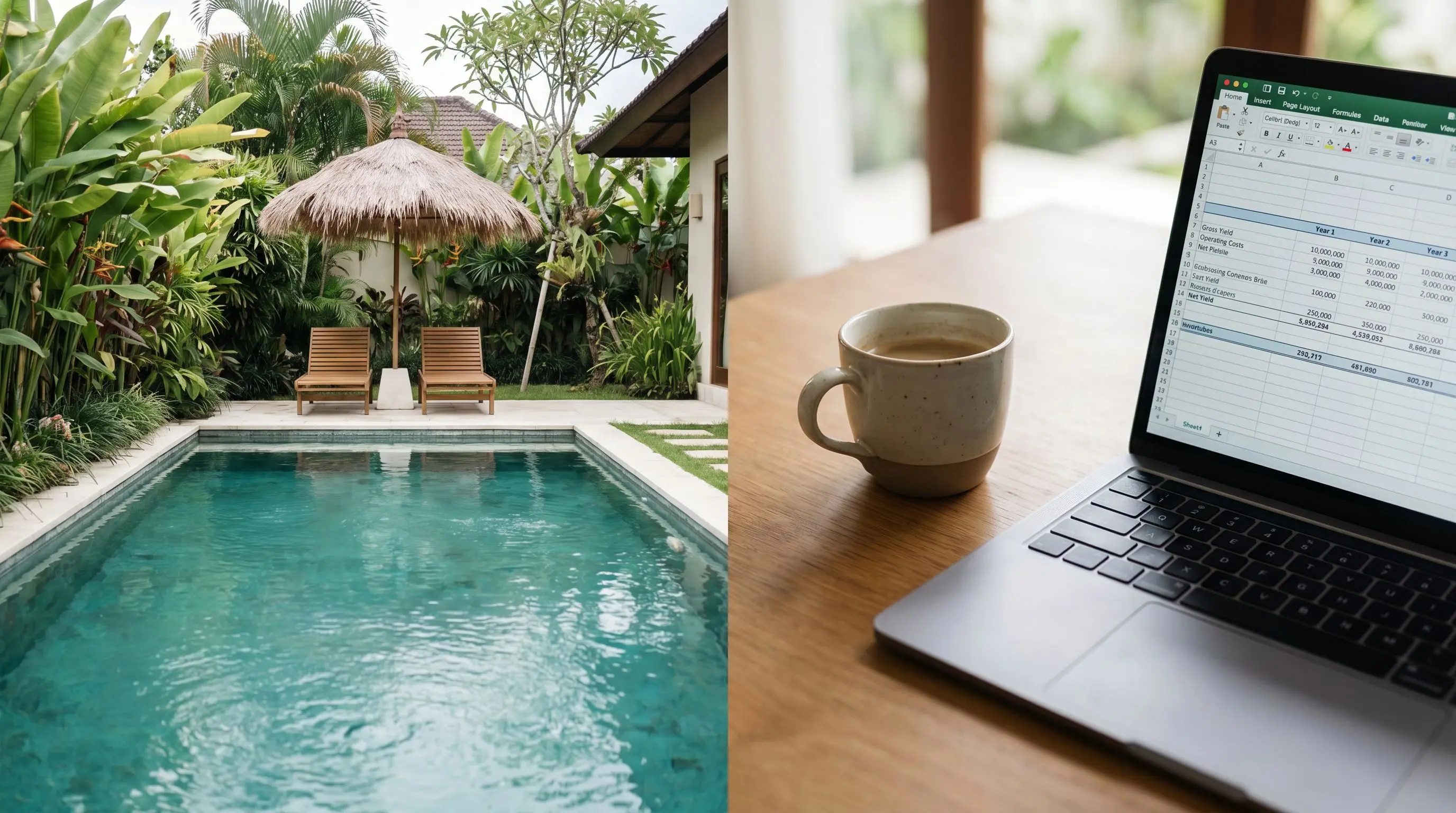
Across 5,308 buyer conversations Anteya logged between 2023 and 2026 (Anteya's CRM = lead-flow, not a market sample), approximately 2,708 (about 51%) raised ROI or rental yield before they raised price. Over half of Bali property shoppers are, functionally, yield investors. This article maps what a realistic Bali villa pro-forma actually contains in 2026, why headline yield claims need decomposing, and how to read the assumptions behind a 15% ROI pitch.
Anteya observation: 2026 is the cyclical delivery peak for Bali primary residential. Within our tracked supply dataset, this calendar year sees roughly 2.9× the historical average annual delivery pace through 2025; 2027 contracts by around 40% by unit count, and 2028 thins to a fraction of current volumes. For ROI planning, that means 2026 openings enter the most competitive supply environment of the cycle, while 2027–2028 openings start rental operations into materially thinner new supply.
What 10% / 15% / 20% actually means: gross vs net
Every headline yield number on a Bali villa sales deck needs one immediate question:
"Are the quoted returns gross or net, and what assumptions are used (occupancy percentage, management fees, maintenance, taxes)?"
Buyer inquiry, Anteya CRM, 2025
That question should be the first exchange with any developer or agent citing an ROI figure. The distinction is material:
- Gross yield = annual rental revenue / purchase price. Before any expense.
- Net yield (or net-net, depending on who's counting) = revenue minus operating expenses, management fees, maintenance, and tax.
The spread between gross and net on a typical Bali short-term-rental villa is 40–50%. A 15–17% gross yield becomes an 8–10% net yield on ready / handover-stage product after you subtract management fees, occupancy-tax, maintenance reserve, and capital replacement for finishes that burn out quickly in tropical climates. The same villa locked at off-plan / pre-sale pricing — where acquisition basis is set 15–25% below the ready-stage figure — typically prints 10–12% net on basis, because operating revenue scales with handover-stage market rates while your cost basis is locked earlier. Most Bali villa marketing cites gross yield without separating the line items, so always ask which one.
The pro-forma stack: what actually goes in
A defensible Bali villa pro-forma contains these line items on the revenue side:
- Nightly rate broken into high season (July–September, Christmas/New Year, Chinese New Year, Easter) and low season. Shoulder and low seasons often run at 40–60% of peak rates.
- Occupancy percentage: the single most sensitive input. Actual Bali villa occupancy ranges widely by location, category, and operator quality. Claims above 75% annual occupancy should be audited line-by-line; claims above 85% are rare even for well-operated premium product.
- Revenue leakage: platform fees (Airbnb/Booking.com at 3–20%), payment processing, currency conversion.
And on the expense side:
- Management fee: professional villa management typically runs 15–25% of gross revenue for full-service operations (listings, guest communication, check-in, cleaning scheduling, maintenance coordination). Self-management is possible but substantially more work than most off-island investors underwrite.
- Utilities: PLN electricity (capacity upgrades matter on older stock), water (PDAM where available, groundwater wells where not), internet, gas.
- Staff: housekeeping, pool/garden maintenance, property handyman.
- Pool chemicals, garden, pest control: variable by season but a real monthly line.
- Capital replacement reserve: 2–5% of revenue. Rattan furniture, outdoor fabrics, and fixtures age quickly in Bali's heat and humidity; underfunding reserves postpones rather than eliminates the cost.
- Taxes: rental income tax, annual property tax (PBB), banjar/desa adat contributions, and where applicable PPh (Pajak Penghasilan) at 10–20% depending on structure.
- Nyepi vacancy: one mandatory zero-revenue day per year plus typically 2–3 days of booking-pattern disruption either side.
"I would be prepared to go higher, but I need to understand the pro-forma behind the property to understand the ROI."
Buyer inquiry, Anteya CRM, 2025
That's the right posture. A buyer asking "show me the assumptions" lands at a cleaner deal than a buyer asking "what's the ROI?".
Occupancy: the assumption that breaks most pro-formas
Occupancy is the most manipulable input in any Bali yield deck. Developers pitch against high, round numbers (80%, 85%) because they make the rest of the math work. Reality:
- Canggu core (Batu Bolong, Berawa, Pererenan): year-round tourism + digital-nomad demand supports 70–80% occupancy for well-operated mid-to-premium product. Lower for older or poorly-managed stock.
- Bukit (Uluwatu, Pecatu, Bingin, Jimbaran): more seasonally-concentrated than Canggu. High-season peaks strong; shoulder and low-season drops can push annual occupancy to 55–70%.
- Ubud: different operating model. A wellness-retreat and long-stay tenant mix pulls occupancy out of nightly-rate normalisation; annualised occupancy metrics don't map cleanly, so look at revenue per available night instead.
- Emerging sub-markets (Seseh, Cemagi, Kedungu): lower awareness, thinner demand, more variable. 50–65% occupancy is realistic for well-positioned product; assumptions of 70%+ should be challenged hard.
Operational realities compress these numbers further. Wet season (November–March) shifts booking patterns and shortens lead times. The Balinese ceremonial calendar (Nyepi, Galungan/Kuningan) takes days off the delivery side even when bookings exist. PLN dropouts and generator switchovers are a real guest-satisfaction line.
Yield guarantees: the questions that separate legitimate from marketing-only
"[I] need to know the fine print of everything in terms of guaranteed ROI."
Buyer inquiry, Anteya CRM, 2025
Yield guarantees in Bali vary widely by developer. Some are using the guarantee as a legitimate financing instrument: they need off-plan capital at attractive terms, they have the balance sheet to cover a 2–3 year yield guarantee out of pocket, and the guaranteed rate is priced into the sale price (you're paying for the guarantee). Others are using "guaranteed 15%" primarily as a marketing headline: with guarantee mechanics that are either (a) too short to matter (1 year against a 25-year lease horizon), (b) backed by a thinly-capitalised PT, or (c) structured such that the "guarantee" converts to actual-performance-based payout after the first year. The questions below separate the two.
Useful questions to ask the developer of any guaranteed-ROI offer:
- How many years is the guarantee?
- What's the mechanism if actual revenue falls short: top-up from the developer, or a rent-reduction provision?
- What's the developer PT's balance sheet, and is the guarantee backed by any third-party escrow or insurance?
- What happens to the guarantee in year N+1 when actual performance data exists?
If the answer to any of these is vague, the guarantee isn't the feature the marketing makes it out to be.
What a realistic 2BR villa pro-forma looks like
Rather than citing specific Anteya yield figures (which vary materially by project and are outside the primary-market supply-pricing dataset our Q1 2026 report publishes), here's the shape of a defensible 2BR Canggu villa pro-forma:
- Purchase price: $300,000 (2BR villa, leasehold 25+, pink zone, well-located Pererenan/Berawa, ready or near-handover)
- Nightly rate blended: $180 (average across high/shoulder/low)
- Annualised occupancy: 75%
- Gross annual revenue: 365 × $180 × 75% = $49,275
- Gross yield on purchase price: 16.4%
- Management at 20%: –$9,855
- Staff + utilities + maintenance: –$7,200
- Capital reserve at 3%: –$1,478
- Tax (PPh rental, 10% of gross): –$4,928
- Net annual: $25,814
- Net yield on purchase price (ready-stage basis): 8.6%
That's the shape most real operators land at on ready / handover-stage product: gross 15–17%, net 8–10%, for well-operated mid-market product in Canggu core with honest assumptions. The same villa bought at the off-plan / pre-sale stage — where acquisition basis is locked 15–25% below the ready-stage figure — typically prints 10–12% net on basis, since operating revenue scales with handover-stage market rates while the cost basis is locked earlier. Annual income yield clusters in those bands; capital appreciation in established Canggu/Bukit cores has historically added meaningfully to total return for 5–12 year holds. Premium 4BR product carries a different profile: larger unit size and premium nightly rate, but typically lower occupancy, so the pro-forma math shifts rather than uniformly improves.
FAQ
What's a realistic ROI for a Bali villa in 2026?
Gross yield: 15–17% for well-operated mid-market Canggu/Bukit product with honest assumptions. Net yield after management, staff, utilities, maintenance, tax, and capital reserve: 8–10% on ready / handover-stage basis, 10–12% on the same villa locked at off-plan / pre-sale pricing. Marketing decks citing "15% ROI" almost always mean gross, not net. Apply a roughly 50% haircut as a first-pass sanity check.
Are the quoted returns gross or net?
Always ask. The typical gap is 40–50%: a 15–17% gross yield lands at 8–10% net on ready/handover-stage basis (10–12% on off-plan pre-sale basis) after management fees (15–25% of revenue), staff, utilities, maintenance, taxes, and capital reserve. Any ROI figure without this breakdown is not yet an underwrite-able number.
What's a realistic occupancy assumption for a Bali villa?
Canggu core 70–80% annualised for well-operated product. Bukit 55–70% (more seasonal). Ubud metrics don't map cleanly; use revenue per available night. Emerging sub-markets (Seseh, Cemagi, Kedungu) 50–65% for honestly-operated product. Claims above 80% should be audited line-by-line before accepted into a pro-forma.
What does a management company charge?
Full-service Bali villa management typically runs 15–25% of gross revenue. Includes listings, guest communication, housekeeping coordination, maintenance, and accounting. Below 15% usually signals a stripped-down service; above 25% should be justified by branded-hotel-grade operations. Self-management is possible but substantially more work than off-island investors underwrite.
Is a "guaranteed 15% ROI" a good deal?
Guarantees vary widely. Short-duration, weakly-backed guarantees are common; well-structured ones are rarer. Ask about duration, top-up mechanism, and the developer's balance sheet, plus any third-party backing. Vague answers mean the guarantee isn't what the headline suggests.
How do I verify a developer's yield claims?
Ask for the actual pro-forma with line-item assumptions (nightly rate by season, occupancy, fees, tax, reserve). Cross-check nightly rate against current Airbnb/Booking.com pricing for comparable units in the sub-market. Ask for occupancy data from existing delivered projects by the same developer if any exist. Claims without this level of detail are not yet verifiable.
What ongoing costs do I need to budget for?
Major recurring items: management fee (15–25% of revenue), staff (housekeeper, pool/garden, handyman), utilities (PLN, water, internet, gas), capital replacement reserve (2–5% of revenue; rattan and outdoor fabric burn out fast in Bali humidity), annual property tax (PBB) and rental income tax (PPh), banjar/desa adat contributions, insurance. Budget 35–45% of gross revenue for total operating costs on a well-managed villa.
Anteya Research is the editorial function of Anteya Real Estate, a Bali-based investment property advisory. This article reflects patterns across 5,308 buyer conversations logged in the Anteya CRM between 2023 and 2026, supplemented by first-hand observations from our Bali-based team.