Anteya Research
Bali Zoning 101: Pink, Yellow, Green Zones and What You Can Build/Rent in Each (2026)
April 22, 2026
Across buyer conversations Anteya has logged since 2023, zoning is one of the most common questions raised before signing, usually with some version of "is this pink zone?" or "can I Airbnb here?". This article answers those zoning questions in buyers' own words, with what our Q1 2026 supply tracking shows about what actually sits on each color.
Anteya observation: In our Q1 2026 supply tracking, the bulk of new Bali primary-market product sits on pink (tourism) zoning, consistent with villa-based short-term rental being the dominant operating model. Yellow (residential) and not-declared parcels together still make up a meaningful share, and require individual verification before underwriting any STR economics. Treat zone color as a data point, not a conclusion.
What Bali's zone colors actually mean
Every parcel of land in Bali falls under a regional spatial plan. RTRW (Rencana Tata Ruang Wilayah) is the province-level plan; RDTR (Rencana Detail Tata Ruang) is the detailed regency-level plan that refines it. These plans assign each parcel a zone color, which controls what can legally be built and operated there.
The colors buyers actually encounter:
- Pink (Pariwisata): tourism and accommodation.
- Yellow (Permukiman): residential.
- Red (Perdagangan dan Jasa): commercial and services.
- Brown (Coklat): mixed-use.
- Green (Pertanian / Hijau): agricultural, including subak rice-field land.
- White: undesignated or awaiting RDTR classification.
Zone color is a necessary, not sufficient condition. A plot can be correctly zoned and still fail, because the construction permit (PBG) wasn't issued, or because the operational license (pondok wisata, hotel permit, or residential lease contract) doesn't match the intended use. Buyers who check only the zone color and stop there are the ones who later find out their "pink zone villa" wasn't actually on pink land.
"We should choose a pink zone?"
Buyer inquiry, Anteya CRM, 2025
That question is the most common zoning line in our CRM, and it's almost always the right question at the wrong level of detail. Pink zone is step one of four, not the whole answer.
Pink zone: where daily rentals can be legally licensed
Pink zone (Pariwisata, tourism) is the principal zone where short-term rental is a primary permitted use. Brown (mixed-use) and red (commercial) zones can carry accommodation too, but only where the local RDTR explicitly lists it. On pink-zoned land, a villa operator can apply for pondok wisata (small accommodation license) or, for larger formats, a hotel izin usaha or apart-hotel license. These licenses are the legal basis for running Airbnb-style nightly bookings in Indonesia.
Pink is the single largest zone category in Bali's current primary-market supply, and that directly reflects the tourism-accommodation orientation of what's being built. Most new villa and branded-residence stock you see marketed for nightly-rate income is pink by design.
Pink zones cluster in tourism-heavy sub-markets where daily-rental economics work: most of Bukit (Uluwatu, Melasti, Pandawa), the Batu Bolong–Berawa–Pererenan coastal strip plus Echo Beach in Canggu, and Central Ubud around Monkey Forest Road with the Seminyak–Petitenget strip. If you're underwriting on nightly-rate cashflow, the land should be pink. Sub-market placement is not sufficient on its own; the specific parcel zone varies project-by-project and must be confirmed on the RDTR.
One caveat buyers miss: pink zone doesn't automatically carry the license. The license is a separate application, issued by the regency (kabupaten) government, and is tied to the specific operator and the specific building. When a project changes hands, the license does not transfer automatically; the new owner re-applies.
Yellow zone: residential-only, and the most common Airbnb trap
Yellow zone (Permukiman, residential) is for owner-occupation and long-term rental (monthly-plus kontrak rumah contracts). Short-term rental on yellow land is not a permitted use under the current RTRW framework and has been a primary enforcement target of the ongoing razia (license raids) cycle since 2024, led by provincial and regency authorities.
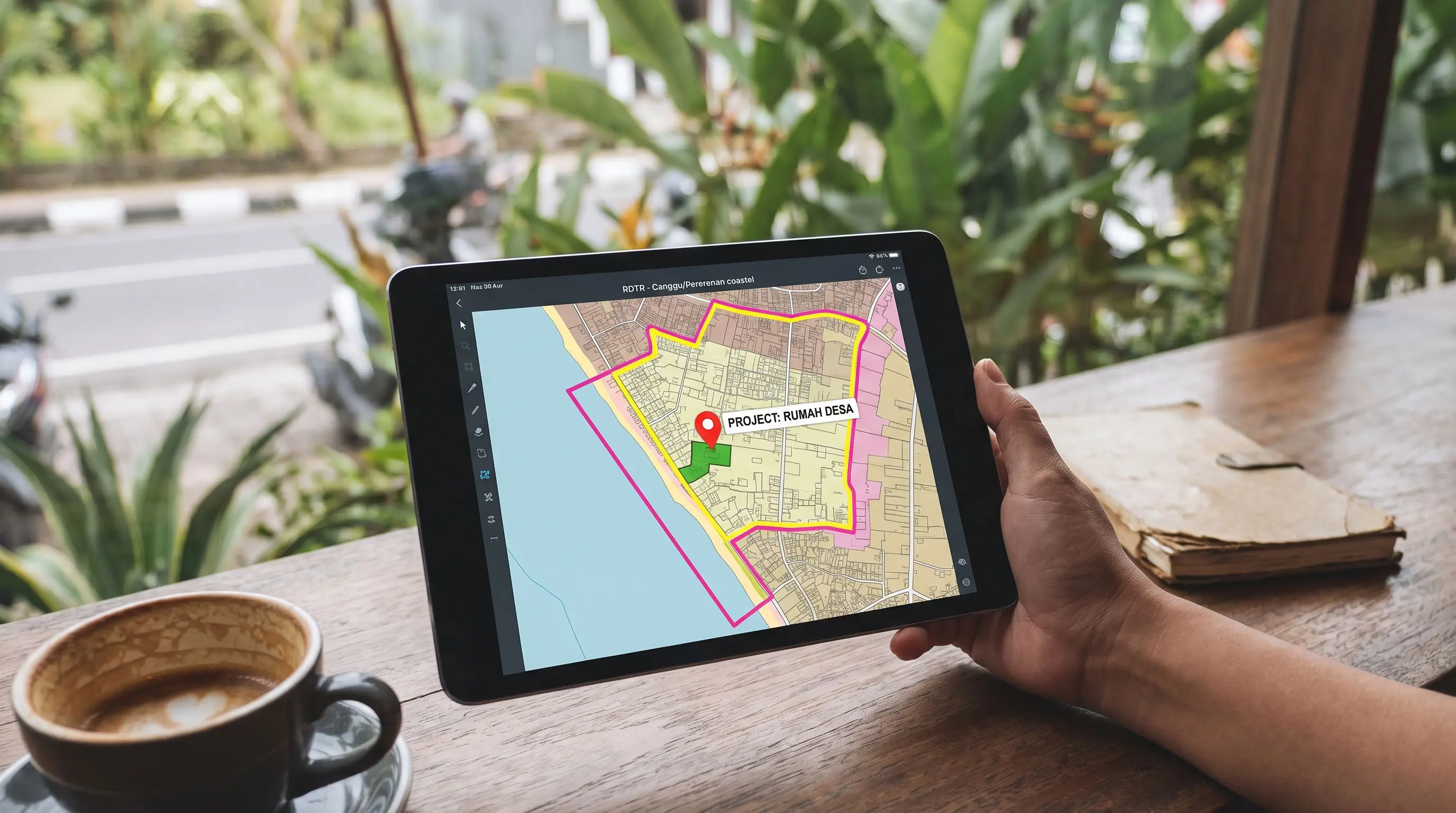
"Because i saw a map and when i zoom in... It gets kinda blurry bit still it looks like they are on the outside of the pink zone."
Buyer inquiry, Anteya CRM, 2025
That buyer was looking at the right map and spotted the right problem. Some projects marketed for Airbnb sit on yellow land just outside the tourism boundary — common across Canggu's edges. The sales-deck underwriting assumes pink-zone economics, but the plot can't legally carry the license.
If you're buying for residential use (second home, long-stay tenant, personal relocation), yellow zone is the correct zone. It's a meaningful share of primary-market supply, a legitimate category, not a broken one. Just don't run short-term rental economics on it.
Red, Brown, Green, and White: the four edge cases
-
Red (Commercial) is the zone for shops, restaurants, and commercial services. Standalone villa short-term rental via pondok wisata is generally not available on red-zoned land; only hotel, apart-hotel, or condotel formats where the local RDTR explicitly lists accommodation as a permitted use. Red-zone stock is a small minority of primary supply and concentrated in commercial cores such as Seminyak and parts of Berawa and Batu Belig.
-
Brown (Coklat, Mixed-use) is a conditional zone. Tourism accommodation is allowed only where the local RDTR explicitly lists it as a permitted use. Treatment varies materially between Badung, Gianyar, and Tabanan regencies. Mixed-use stock is thin in primary-market supply.
-
Green (Hijau / Pertanian, Agricultural) is protected land, including subak rice-field areas. Tourism construction on green-zoned land is not legal. Canggu enforcement escalated sharply from 2023 into 2025, and villas built on green zones have had their PBG (building permit) revoked. Green-zone product is a very small slice of declared primary-market supply, and any existing green-zone project should be reviewed carefully for permit legitimacy before purchase.
-
White (Undesignated) is land awaiting RDTR classification. Current rights are limited; future rights are uncertain. High regulatory uncertainty, and it requires individual legal review before commitment.
A fifth category: not declared. A meaningful share of primary-market projects have no zone recorded in public filings; it's the kind of gap a buyer has to close, not a published fact you can rely on. Don't assume "not declared" means "pink", it means "unknown until you check".
How to verify a plot's zone before you commit
Verification has four steps. Anteya runs them on every project we recommend; if you're going independent, here's the standard sequence:
- Get the exact parcel coordinates or nomor sertifikat (certificate number) from the developer or the selling agent. A screenshot of a promotional map is not enough; you need the actual land reference.
- Check the regency-level RDTR map. Most Bali regencies publish these online (Badung, Gianyar, Tabanan), though interfaces vary in polish. Look up the parcel and read off the zone color and the RDTR classification code.
- Cross-check at the local office. If the online map is ambiguous at the plot boundary (which is common near tourism/residential transitions), request a zone confirmation letter from the Dinas Tata Ruang at the regency level, or ask the notaris handling the transaction to pull it.
- Confirm permits separately. Zone green-lights the possibility of your intended use. It doesn't confirm that PBG, SLF, and the operational license have been issued for the specific structure.
Two local realities stretch this timeline: regency offices slow during Galungan / Kuningan and shut entirely for Nyepi, and rainy-season site visits (October–April) routinely slip. Plan around the Balinese calendar, not only your own. Anteya can run the zone-verification step on a specific plot before you commit, and route the notaris introduction at the signing stage.
"PBG certificate obtained"
Buyer inquiry, Anteya CRM, 2025
That was a buyer confirming the developer had the construction certificate, but it arrived before the zone verification, and the buyer came to us asking whether "PBG means the zone is right". It doesn't. PBG certifies the building was approved for construction; zone certifies what that building can legally be used for. Two separate filings, two separate documents.
What zone doesn't cover: PBG, SLF, and the license stack
A pink zone with the wrong permits is worth less than a yellow zone with clean paperwork for residential use. The three documents buyers should ask for by name:
- PBG (Persetujuan Bangunan Gedung): the construction permit. Replaced IMB in 2021 under the Cipta Kerja omnibus law (UU 11/2020, implementing regulation PP 16/2021). Rollout was progressive across regencies, so projects in the 2021–2022 transition window may hold either; confirm with the notaris. Post-rollout projects should have PBG.
- SLF (Sertifikat Laik Fungsi): certificate of worthiness of function, issued after construction completion. Confirms the as-built structure matches the PBG filing. A project with PBG but no SLF is not fully completed legally, even if it looks finished.
- Operational license: pondok wisata for small accommodation, hotel izin usaha for larger formats, or a registered residential lease contract for long-term rental. This is what actually authorises the business model.
For any purchase, a complete zoning-and-permits file should contain: the zone color in the current RDTR, PBG (or grandfathered IMB) matching the as-built structure, SLF, and the operational license matching the intended use. Tax registrations (NPWP / NPWPD) sit alongside. Skipping any one of these leaves a gap the regency government can later treat as non-compliance.
What the Q1 2026 supply picture shows about the zone mix
The short version: most new Bali primary supply is pink, consistent with villa-based short-term-rental dominance. The residential (yellow) and not-declared segments together still make up a meaningful share of primary-market projects; those are either residential-only or need individual verification. Treat zone color as a data point, not a conclusion.
For practical cross-reference, freehold-titled product is a small minority of supply and tends to sit on residentially-zoned (yellow) areas rather than tourism-zoned (pink) land. Buyers drawn to the freehold tenure segment should confirm whether their specific project sits on pink (rare for freehold) or yellow (more common for freehold) before underwriting on tourism-cashflow assumptions.
FAQ
Should I choose a pink zone?
If your model depends on daily rental income, yes: pink is the principal zone where pondok wisata or hotel licensing is a primary permitted use. If you're buying for owner-occupation or long-term residential tenants, yellow is appropriate. The right zone depends on the business model, not a universal preference.
For Airbnb, should I choose a pink zone for more flexibility of rentals?
Yes: pink zone is the zone designed for tourism accommodation, and it's where the enforcement environment currently treats short-term rental as a legal primary use. Yellow-zone Airbnb has been a primary target of the ongoing razia enforcement cycle since 2024. If Airbnb-style cashflow is the plan, the land should be pink.
The zoning map gets blurry when I zoom in. How do I know the plot is really pink?
A promotional or screenshot map is not the authoritative source. Get the parcel's nomor sertifikat from the developer and look it up on the regency-level RDTR platform, or ask the notaris handling the transaction to pull a zone confirmation letter from the Dinas Tata Ruang. If the plot sits near a zone boundary, the formal confirmation is the only check that matters.
What is a PBG certificate, and do I need one?
PBG (Persetujuan Bangunan Gedung) is the construction permit that replaced IMB in 2021. Any Bali project built or permitted after 2021 should have PBG; pre-2021 projects should have IMB. Always ask for PBG (or grandfathered IMB) plus SLF: PBG approves construction, SLF confirms the completed building matches what was approved.
Can I run a management company on a pink-zone villa without pondok wisata?
No: the operational license is required separately from the management-company contract. A management company handles operations (bookings, cleaning, maintenance). Pondok wisata is the government-issued accommodation license that authorises the villa to host paying guests. Both are needed. Most professional managers will decline to operate a property without a valid license on file.
What happens if my villa is on yellow zone and I rent it nightly anyway?
This is the central risk category. Penalties range from fines to forced closure, and enforcement has visibly escalated since 2024, most notably the July 2025 Bingin Beach demolitions. These cases hit specific permit-illegitimate properties; vetted projects on properly-zoned pink land are not the targets. Yellow-zone product fits owner-use and monthly-plus residential lets; daily-rental operation is not a recognised primary use under the current RTRW framework. Don't underwrite STR economics on yellow land.
How long does it take to get zoning confirmation on a specific plot?
Typical timeline from our experience is one to three weeks: a few days if the regency's online RDTR portal is clear and the parcel is well inside a zone, longer if the plot is near a boundary or the online data is ambiguous and you need the written confirmation from Dinas Tata Ruang. Budget this time into your closing timeline; don't sign the deposit assuming it's instant.
Anteya Research is the editorial function of Anteya Real Estate, a Bali-based investment property advisory. This article reflects patterns across buyer conversations logged in the Anteya CRM since 2023, supplemented by first-hand observations from our Bali-based team.
Browse Bali projects → Contact Anteya →
This article is general information, not legal advice. Indonesian real-estate rules change and individual situations vary; consult a licensed Indonesian notaris (notary) for your specific purchase.