Anteya Research
Bali Property in USD or IDR: FX Risk for Foreign Buyers (2026)
May 22, 2026

Across roughly 5,300 buyer conversations Anteya logged with Bali buyers between 2023 and 2026, one of the recurring pre-deposit questions is some version of "is the price in dollars or rupiah?". The answer is usually both: the price is quoted in USD on the marketing materials, the SPA names a USD-equivalent amount, and the actual settlement runs through IDR (Indonesian Rupiah) at a reference rate. The gap between the quote and the settlement is where foreign buyers carry FX risk for the 12 to 24 months of an off-plan milestone schedule. This article walks through how the Indonesian currency regime actually shapes Bali property contracts, where the FX exposure lives, what the notaris actually does at execution, and the hedging tools available to a foreign buyer with a multi-tranche payment plan.
The Indonesian Rupiah Law and why everyone quotes in dollars anyway
Indonesia's currency law (Undang-Undang 7/2011 tentang Mata Uang, the Rupiah Law) requires that transactions within Indonesian territory settle in Rupiah. Bank Indonesia (BI) has reinforced this through Peraturan Bank Indonesia (PBI) 17/3/PBI/2015, which expands the obligation to use Rupiah for both cash and non-cash transactions inside Indonesia, with specific exceptions for international trade settlement, government foreign-currency obligations, and a defined set of bank-product carve-outs.
The on-paper position: a Bali villa SPA between a foreign buyer and an Indonesian developer, settled inside Indonesia, should be denominated and settled in Rupiah.
The market reality: Bali off-plan villa pricing is overwhelmingly quoted to foreign buyers in USD (with EUR and AUD also common for European and Australian buyers). The pricing tables, the brochures, the price-per-square-meter benchmarks all run in USD. The contractual treatment varies:
- Quoted in USD, settled in IDR. The most common pattern. The SPA names a USD reference amount and specifies the IDR-equivalent at a Bank Indonesia reference rate (typically the JISDOR or middle rate) on a defined date.
- Quoted and settled in IDR with USD memo. A more compliant pattern. The SPA names the IDR amount as the contractual price; the USD figure appears as a non-binding reference.
- Quoted in USD, settled in USD via foreign account. Less common, structurally outside PBI 17/3/2015 on its face, and the route most likely to attract scrutiny.
Enforcement of the Rupiah-settlement rule against Bali residential property transactions has historically been light, but the regulatory framework is real and developers face a real downside on audit. The market has settled into a workable middle ground: quote in USD for buyer comfort, settle in IDR at a defined reference rate. That middle ground is where most foreign buyers actually transact.
"The developer keeps sending me prices in dollars but the SPA they sent me is in rupiah. Are these the same thing? What happens if the rupiah moves between now and when I pay?"
Buyer inquiry, Anteya CRM, 2025
They are the same thing only if the SPA explicitly ties the IDR amount to a USD reference at a defined exchange-rate mechanism. If the SPA names an IDR amount that was calculated at the quote-date FX rate but is not re-pegged at payment, FX movement between signing and payment falls on the buyer. The contractual language is what matters; the brochure does not bind anyone.
The currency clause: what the SPA actually says
The clause that determines who carries FX risk has a few variant forms. The four worth recognising:
Fixed USD amount, IDR at payment-date rate. The SPA names the USD price. Each milestone payment converts to IDR at a defined rate on the payment date (typically Bank Indonesia JISDOR mid-rate, or the developer's banking partner's quoted rate). Buyer wires USD; the IDR equivalent on the day clears against the milestone. FX risk between signing and payment: borne by the buyer (rate moves, you wire more or less in USD-equivalent depending on how the SPA reads).
Fixed IDR amount, no re-peg. The SPA names a single IDR amount calculated at the quote-date rate and that IDR figure is the contractual obligation. Buyer is still wiring USD into Indonesia, but the IDR target is fixed. FX risk: still on the buyer, but in the inverse direction; a strengthening dollar means the buyer pays less in USD terms; a weakening dollar means more.
Fixed USD with IDR cap or floor. A negotiated clause that defines a corridor (e.g. payment converts at the JISDOR rate on the day, but the IDR equivalent must not exceed a cap and not fall below a floor). Caps FX exposure for both sides but is uncommon in Bali residential off-plan; more typical in commercial developments.
Milestone-by-milestone re-pricing. Each milestone is treated as a separate calculation, with the IDR equivalent set at a rate quoted at or near the payment date. This is the cleanest form for the developer and the most exposed for the buyer when Rupiah moves materially during the construction window.
For a buyer reading the SPA, the question to ask the notaris is exactly one: "On the day I wire money, how is the IDR amount calculated against my USD wire?" The answer to that question is the FX-risk allocation, full stop. Any other clause language is decoration.
The reference rate that matters: JISDOR
When a Bali SPA names "Bank Indonesia rate" or "Indonesia middle rate", in practice it means JISDOR, the Jakarta Interbank Spot Dollar Rate. JISDOR is published daily by Bank Indonesia and is the standard FX reference for USD/IDR transactions inside Indonesia.
Three things worth understanding about JISDOR for SPA purposes:
It is a reference rate, not a transaction rate. Banks executing the actual conversion will quote a spread around JISDOR, typically 50 to 150 basis points depending on size and relationship. The SPA that says "JISDOR rate" delivers JISDOR on the conversion; the buyer's bank executing the wire delivers something slightly worse. The wedge is small per milestone but real over a 4-to-6-milestone schedule.
It is published once per business day. Settlements crossing weekends or Indonesian holidays use the last published JISDOR, which can be several days old when Rupiah is moving. The SPA should specify which JISDOR (publication date vs settlement date) applies.
It is the publicly observable benchmark. Both buyer and developer can independently verify the rate that was applied. This matters when a developer quotes an IDR amount that does not match the published JISDOR on the relevant date; the buyer has a clean basis to push back.
"How do I check whether the rate the developer applied is actually the official rate, or did they add their own margin on top?"
Buyer inquiry, Anteya CRM, 2025
Look up JISDOR on the Bank Indonesia website (bi.go.id) for the relevant date and compare it against the IDR figure the developer applied. If the rate the developer used is a defined number of basis points off JISDOR, that spread should appear in the SPA. If the spread is not in the SPA but appears on the invoice, you have a contract-construction issue to raise with the notaris before the payment goes through.
Where FX exposure actually lives across the milestone schedule
A typical Bali off-plan milestone schedule on a USD-quoted villa in 2024-2026 has shifted front-loaded compared with the 10/20/30/30/10 pattern common before 2023. Current schedules cluster around 30/30/30/10 (signing / structural / finishing / handover), 40/30/20/10 on faster-build product, and some boutique developers push 50% or 70% on signing for high-demand units. Handover triggers tie to PBG (or older IMB) and the akta jual beli / akta sewa-menyewa / leasehold transfer, with SLF often arriving after handover rather than coinciding with it. Twelve to twenty-four months between SPA signing and final handover; sometimes longer.
The FX exposure profile across that timeline:
Reservation and SPA-signing tranches (months 0 to 1). Short window, minimal FX exposure. Quote-to-payment gap is usually a few days; rate moves over that window are typically immaterial relative to total ticket.
Mid-construction milestones (months 6 to 18). This is where the FX exposure cluster lives. The buyer locked into the USD price at signing; the actual milestone payments are converting at the prevailing JISDOR at each milestone date. If Rupiah weakens 10% during construction, the IDR target moves; if the SPA reads "fixed USD, IDR at payment-date rate", the buyer's USD wire is slightly smaller in IDR terms (developer absorbs the FX). If the SPA reads "fixed IDR", the buyer's USD wire is larger to hit the IDR target (buyer absorbs).
Final tranche on handover (month 18 to 24). Longest exposure window. The biggest FX move in an emerging-market currency over a two-year holding period is rarely trivial. Rupiah weakened roughly 7% on a full-year basis in 2018 with peak-to-trough intra-year moves closer to 10%, spiked sharply to around 16,500 during the March 2020 COVID dislocation, and drifted roughly 5% weaker on a net basis between mid-2023 and mid-2024 (with peak-to-trough swings closer to 7-8%) before continuing to soften toward the 16,500-16,800 range through 2025. On a USD 300,000 villa, a 5-8% adverse FX move during construction is USD 15,000 to USD 24,000 of FX impact on whichever side carries it.
Anteya observation: in our deal flow across 2024 and early 2026, the buyer cohort that managed FX risk most effectively used a typical pattern: hold the dollar reserves in a high-yield USD savings account at signing, then time the conversion to Rupiah at each milestone using current JISDOR plus a known bank spread, rather than pre-funding the entire purchase into IDR at signing. The pre-fund-into-IDR approach gives certainty but loses optionality; the milestone-by-milestone approach takes more attention but typically lands better when Rupiah moves adversely.
Where the FX execution actually happens on Bali
A common buyer misconception: the notaris polices the FX clause at each milestone. They don't. Bali residential off-plan notaris involvement is concentrated at PPJB signing and again at AJB / Hak Pakai / HGB transfer at handover. Mid-construction milestone wires are handled directly between developer accounting and the buyer. The notaris will not look up JISDOR for each milestone or police whether the IDR sufficiency matches the SPA clause; the buyer is responsible for that verification.
The actual execution chain at each milestone:
The developer's finance team issues an invoice with the IDR amount required to satisfy the milestone (calculated against whatever rate the SPA specifies). The buyer wires USD (or EUR, AUD, USDT-via-Tokocrypto, etc.) to the developer's nominated account. Most larger Bali developers receive into IDR-denominated accounts at BCA, Mandiri, or Permata, with the bank handling conversion at its own TT rate around JISDOR. A meaningful share of smaller foreign-founded PT PMA developers route foreign wires to a Singapore-side OCBC, DBS, or UOB account first and bring funds onshore as capital injection. The conversion rate the developer actually receives is the bank's TT rate, which is JISDOR plus a 50 to 150 basis-point spread depending on size and relationship; the SPA-defined "JISDOR rate" is the contractual benchmark the buyer can compare against.
A practical note on JISDOR itself: Bank Indonesia reformed the JISDOR methodology in April 2022 to a transaction-based volume-weighted average across an extended interbank window. Some post-2022 SPAs name kurs referensi Bank Indonesia (BI reference rate) rather than JISDOR by name; the two refer to the same daily-published rate. International USD wires to Indonesia commonly take 1 to 3 business days; the SPA should specify which date's rate applies (publication date vs settlement date) for sufficiency calculation.
The buyer's defensive posture is to check JISDOR independently against the developer's invoice. A notaris fluent in foreign-buyer residential work may flag a soft FX clause at SPA review if specifically asked, but should not be relied on to police FX sufficiency unprompted at each milestone.
Hedging tools available to a foreign Bali buyer
Bali off-plan FX hedging is not the institutional-grade hedging available to corporate treasurers. The toolset is narrower:
Hold-and-time USD reserves. The simplest tool. Hold the milestone-funding reserves in a USD-denominated account (typically in the buyer's home jurisdiction or in a Singapore USD account), and convert to IDR only at each milestone. Captures any USD strengthening that occurs between signing and payment; loses on USD weakening. Zero direct cost beyond opportunity cost on the USD holdings.
Forward contracts via a home-jurisdiction bank. USD/IDR is traded as a non-deliverable forward (NDF) at major international banks for sophisticated clients with sufficient relationship and balance. The forward-implied IDR yield embeds an interest-rate differential of roughly 4 to 6 percent per annum on 12-24 month tenors (this is the carry, not the hedging fee); the dealer spread on the hedge itself typically runs 50 to 150 basis points on top. Practically, the all-in carry plus spread over an 18-month construction window often exceeds the expected adverse FX move on a typical Bali ticket, which is why forwards are rarely used below USD 1-2 million and almost never seen in Anteya deal flow. Available to private-banking clients with a directional view.
Currency-conversion via specialist providers. Provider routing varies materially by buyer cohort. Australian buyers default to OFX, which has reliable IDR delivery to Indonesian bank accounts with competitive spreads on AUD-to-IDR. UK and small-EU buyers default to Wise (note: Wise has per-transfer IDR caps that often require splitting milestone payments into multiple transfers). US buyers route via Wise or direct SWIFT to the developer's USD-denominated Indonesian-bank account. Singapore-resident buyers route via OCBC, DBS, or UOB SWIFT directly. Convera (the rebranded Western Union Business Solutions) handles USD 500,000-plus tickets as institutional cross-border real-estate FX. Revolut does not reliably deliver IDR to Indonesian bank accounts for property settlement; the article should not direct readers there.
Hold-and-time USD reserves vs pre-conversion at signing. A foreign buyer pre-handover rarely holds a personal IDR-denominated NPWP-linked Indonesian account capable of receiving a six-figure-USD reserve. Pre-converting at signing usually means leaving the IDR with a third party (the developer or an intermediary), which reintroduces counterparty risk on top of FX risk. This is the structural reason milestone-by-milestone conversion dominates actual Bali deal flow over pre-conversion.
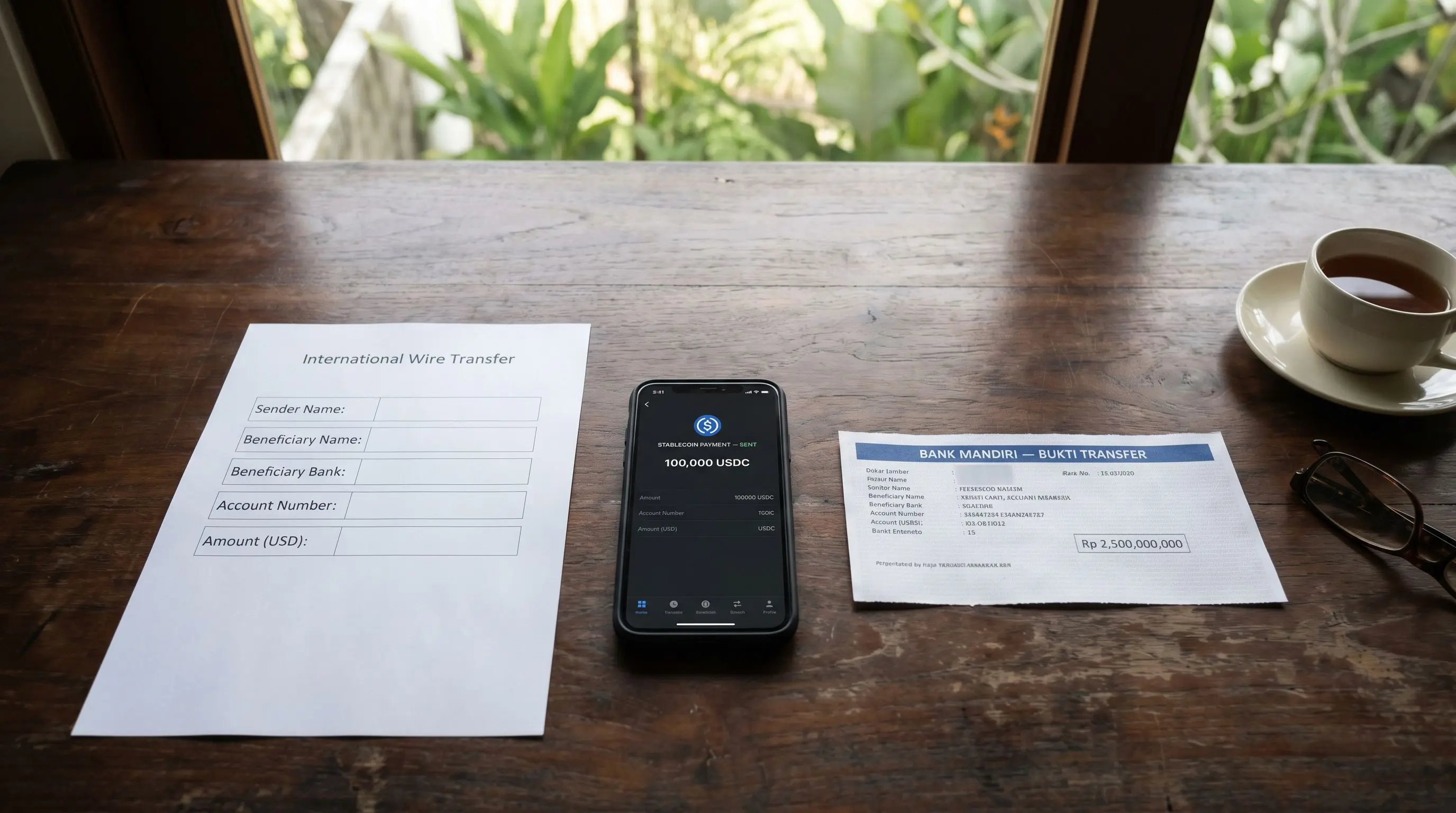
Crypto rails (USDT, USDC). A growing but legally ambiguous route. Some Bali developers accept Tether (USDT) or USDC for property purchase, routing through a crypto exchange and Indonesian bank infrastructure. Indonesian regulation of crypto-asset transactions transferred from Bappebti (the Commodity Futures Trading Regulatory Agency) to OJK (Otoritas Jasa Keuangan, the Financial Services Authority) in January 2025, with the transition formally completed in January 2026 under PP 49/2024 and OJK Regulation 27/2024 (as amended by POJK 23/2025). Crypto is now classified as a digital financial asset under OJK, still not as currency for settlement purposes. The on-chain USDT-TRC20 transfer to a Bali developer is the dominant settlement rail for Russian, Ukrainian, CIS, and a meaningful share of Asian buyer cohorts, routed through regulated Indonesian exchanges (Tokocrypto, Pintu, Reku, Indodax) or through parallel OTC desks operating informally out of Canggu. The conversion to IDR for SPA settlement still goes through Indonesian banking infrastructure and triggers the same UU 7/2011 / PBI 17/3/PBI/2015 questions. AML and KYC compliance at the regulated-exchange side is meaningful and tightening as OJK rolls out its full supervisory regime through 2026. Treat USDT as a transfer rail, not a settlement currency.
Repatriation: the FX problem in reverse
A topic worth raising at acquisition because it shapes structural choices: when the foreign owner eventually sells, the proceeds need to come back out of Rupiah into the holder's home currency. The repatriation regime is generally permissive for property-sale proceeds repatriated through legitimate banking channels with proper documentation (SPA, akta jual beli, tax clearance), but the FX exposure on exit is symmetrical to the FX exposure on entry: Rupiah moves matter on both ends.
Two structural points:
PT PMA-held property repatriation. Where the villa is held via PT PMA with Hak Guna Bangunan, exit proceeds flow as company-level revenue, distributed as dividends to foreign shareholders subject to Article 26 withholding tax. The default rate is 20%; tax-treaty rates typically reduce this to 10% or 15% depending on the treaty and the shareholding threshold, subject to the shareholder qualifying as beneficial owner and providing a valid Certificate of Domicile (DGT form). The FX conversion on dividend repatriation is at the prevailing rate.
Hak Pakai personal-title repatriation. Exit proceeds from a Hak Pakai sale flow to the foreign seller, typically subject to a 2.5% final PPh on the gross transfer value (not on the gain) for property sales. NPWP is required to apply the standard rate; without NPWP, Article 26 withholding can rise materially. Proceeds repatriate via an authorized Indonesian bank with tax-payment evidence required before the bank releases the outbound conversion to USD/EUR/AUD.
Leasehold (Hak Sewa) personal repatriation. Hak Sewa is a contractual right, not a registered title, so the exit is via akta cessie or akta pengalihan hak sewa. Tax treatment is structurally similar to the Hak Pakai case (2.5% final PPh on gross transfer value, NPWP requirement, tax-clearance gate at the bank before outbound conversion), though the assignment-mechanics differ at the notaris.
The buyer who structured FX risk well at entry has done the same work for themselves at exit. The reverse is also true.
When IDR moves materially during construction
Concrete scenarios that surface in actual buyer conversations:
Scenario A: USD weakens 10% mid-construction, SPA reads "fixed USD". Developer receives fewer IDR per USD wired; the project's IDR-denominated cost base did not change. Developer absorbs the FX loss against expected revenue. If the developer is well-capitalized, no visible buyer-side effect. If the developer is thin on margin, this can trigger requests for re-pricing or delay. Buyer-side defensive posture: have the SPA close the door to renegotiation triggered by FX moves alone.
Scenario B: USD strengthens 10% mid-construction, SPA reads "fixed USD". Developer receives more IDR per USD; project economics improve. Buyer paid the same USD as agreed; no buyer-side effect.
Scenario C: USD weakens 10% mid-construction, SPA reads "fixed IDR". Buyer wires more USD to hit the IDR target. Real out-of-pocket cost. Defensive posture: forward contract or USD reserves to lock the rate.
Scenario D: USD strengthens 10% mid-construction, SPA reads "fixed IDR". Buyer wires less USD to hit the IDR target. Real saving. The buyer who held USD reserves benefits.
The takeaway: the SPA currency clause defines who carries which direction of risk. Reading the clause carefully at signing changes the buyer's risk position more than most other clauses in the contract.
"Should I just convert the whole purchase price to rupiah at signing to lock in the rate, or wait and convert at each milestone?"
Buyer inquiry, Anteya CRM, 2025
Both approaches are defensible. Pre-conversion at signing locks the FX rate but loses the optionality value and the interest income on USD reserves. Milestone-by-milestone conversion preserves optionality and interest income but exposes each milestone to rate movement. In our deal flow, the milestone approach has generally outperformed pre-conversion across the 2023-2026 cycle because Rupiah drifted weaker over that window; the directional bet matters and is not predictable in advance.
Bali notaris workflow: the small details that compound
The notaris handling the SPA execution is doing several FX-relevant things that buyers rarely see explicitly:
- Confirming the SPA's currency clause is enforceable under UU 7/2011 (i.e., the IDR amount is the contractual obligation and the USD reference is a calculation device).
- Looking up JISDOR for each milestone payment date and documenting the rate applied.
- Verifying that the buyer's USD wire (or EUR, AUD, or USDT-routed payment) reached the developer's account at the stated value date.
- Reconciling any spread between JISDOR and the bank's actual TT rate, and confirming the developer accepts the milestone as satisfied.
- Documenting any FX-related side letters or addenda in case of dispute.
A notaris who is fluent in this workflow flags FX-clause ambiguities at SPA review, not after a milestone payment lands. The buyer who picks a notaris familiar with cross-border milestone-payment work avoids most FX-related contract disputes; the buyer who picks a notaris whose practice is mostly domestic Indonesian transactions can find this workflow harder to navigate.
Practical buyer-side checklist
A short sequence drawn from acquisition conversations:
At SPA review. Confirm exactly how the currency clause works. Is the price fixed in USD or IDR? What rate is used at each milestone date? Is there a spread above JISDOR specified? What happens if Indonesian-bank holidays delay the conversion? Get the answer in writing before signing.
At signing. Document the JISDOR or reference rate at signing date for record. If milestones are USD-denominated with IDR-at-payment-rate, the documentation establishes the baseline.
Between signing and each milestone. Monitor USD/IDR vs the implied break-even on your funding. If rate moves materially against the buyer, evaluate whether to bring forward conversion or extend the holding period in USD.
At each milestone. Verify the JISDOR rate the developer applied matches the published rate on the date defined in the SPA. Verify the bank-spread (if any) is consistent with what the SPA specifies. The notaris should be doing this; verify it independently.
At handover. Reconcile the total USD wired across all milestones against the contracted IDR-equivalent. Confirm with the notaris that the developer's books reflect satisfaction. Get the final reconciliation in writing.
At exit (years later). The repatriation regime applies to proceeds; have the same FX-clause discipline at sale that you had at purchase.
This article is general information, not legal or tax advice. Indonesian currency law, banking regulation, and cross-border payment infrastructure change. Consult an Indonesian notaris, a licensed Indonesian bank, and a home-jurisdiction tax adviser for your specific situation.
FAQ
Should I quote my Bali property purchase in USD or IDR?
In practice the price is quoted to you in USD by the developer's marketing, but the SPA settles in IDR per UU 7/2011 (the Indonesian Rupiah Law). The contractual currency that controls is whichever the SPA names as the binding amount; the other figure is a calculation reference. Read the SPA carefully and ask the notaris exactly which currency creates the contractual obligation.
Is it legal to settle a Bali property purchase in USD?
Indonesian regulation (UU 7/2011 and PBI 17/3/PBI/2015) requires Rupiah for transactions inside Indonesia, with limited carve-outs. Bali residential SPAs typically comply by settling in IDR while quoting in USD as a reference. Direct USD-to-USD settlement between a foreign buyer and Indonesian developer through Indonesian banking sits outside the standard carve-outs and exposes the developer to enforcement risk.
How do I check the JISDOR rate the developer is applying?
JISDOR is published daily by Bank Indonesia on bi.go.id. Look up the rate on the settlement date defined in the SPA and compare it to the IDR figure the developer used to size the milestone payment. The SPA should specify which date's JISDOR controls (publication date vs settlement date); discrepancies above 50 basis points warrant raising with the notaris before payment.
Who carries FX risk if the rupiah moves during construction?
Depends on the SPA's currency clause. "Fixed USD, IDR at payment-date rate" puts FX movement risk on the developer (more USD needed if USD weakens, but the contracted USD amount does not change). "Fixed IDR with USD reference" puts the FX movement on the buyer (more or fewer USD needed to hit the contracted IDR). The clause language is the controlling factor; the brochure framing is not.
Can I pay for a Bali villa in cryptocurrency like USDT?
Indonesian regulation treats crypto as a digital financial asset under OJK (supervisory authority transferred from Bappebti in January 2025), not as currency. USDT-TRC20 is the dominant rail for Russian, CIS, and many Asian buyer cohorts on Bali, via regulated exchanges (Tokocrypto, Pintu, Reku, Indodax) or OTC desks. Settlement still routes through Indonesian banking and triggers the same UU 7/2011 / PBI 17/3/PBI/2015 questions. Treat USDT as a transfer mechanism, not a settlement currency.
What hedging tools are available for a foreign Bali buyer?
The realistic options: hold USD reserves and time the conversion at each milestone, use a specialist FX provider (Wise, Convera, Revolut) for tighter spreads than retail banks, and for larger tickets explore USD/IDR forward contracts via a home-jurisdiction bank (typically available to private-banking clients). Pre-converting the entire purchase to IDR at signing locks the rate but loses optionality and any USD interest income on reserves.
What happens to repatriation when I eventually sell my Bali villa?
Property-sale proceeds repatriate with proper documentation (SPA, akta jual beli, tax clearance) through an authorized Indonesian bank. PT PMA-held property repatriates via dividends with 20% default Article 26 withholding (typically 10% or 15% under tax treaty, subject to Certificate of Domicile). Hak Pakai or Hak Sewa personal sales are subject to a 2.5% final PPh on gross transfer value, with NPWP required to apply the standard rate. FX exposure on exit is symmetrical to entry.
Anteya Research is the editorial function of Anteya Real Estate, a Bali-based investment property advisory. This article reflects patterns across roughly 5,300 buyer conversations logged in the Anteya CRM between 2023 and 2026, supplemented by first-hand observations from our Bali-based team.