Anteya Research
What Is a KITAP in Indonesia? Permanent Stay Explained for Owners (2026)
April 30, 2026

A KITAP (Kartu Izin Tinggal Tetap) is a permanent stay permit for foreigners in Indonesia. It is usually granted after you have held a KITAS for a qualifying period, or through marriage to an Indonesian citizen. A KITAP gives you longer-term residency and easier re-entry, but it does not let a foreigner hold freehold land (Hak Milik, the title on an SHM certificate). Ownership for foreigners still runs through Hak Pakai or a PT PMA company, whatever your visa status.
That gap between the right to stay and the right to own is where most buyer confusion lives.
!(/images/kitap-hero.jpg)
What a KITAP actually is
KITAP is the permanent-stay tier of Indonesia's residency system. A KITAS is a limited stay permit you renew fairly often; a KITAP is issued for a longer term (commonly described as five years, renewable) and cuts the annual paperwork. It usually pairs with a re-entry permit so you can leave and return without your status lapsing.
Eligible categories generally include former KITAS holders who have stayed continuously for the qualifying period, spouses of Indonesian citizens, certain retirees and investors, and former Indonesian citizens. The categories, validity periods, and fees are set by Indonesia's Directorate General of Immigration and are revised from time to time, so treat any duration you read online as a figure to verify, not a fixed rule.
"I have Kitas and maybe will open PT pma (I have already PT)"
Buyer inquiry, Anteya CRM, 2025
That message is typical. Buyers arrive mixing residency and ownership into one plan, when they are two separate tracks running alongside each other.
How you get to a KITAP
The KITAS-to-KITAP path. You generally hold a KITAS continuously for a qualifying period, often described as several consecutive years depending on your KITAS category, before you can convert to permanent status. Work, investor, and family categories each carry their own conditions, so an investor's path is not a retiree's.
The marriage route. A foreigner married to an Indonesian citizen may apply, typically after a spouse-sponsored KITAS has run for a qualifying period. It is sponsor-dependent, and worth reviewing with an immigration lawyer before you rely on it. Several Indonesian law firms publish English-language briefs that set out the current conditions.
Anteya observation: In buyer conversations logged in the Anteya CRM, questions about ownership structure ("Is it possible freehold?", "What land title is this sold under?") come up far more often than questions about visas or residency. Most foreign buyers settle where they can live before they register what they can own, and the two are not the same decision.
What a KITAP changes for property, and what it does not
A KITAP does not turn a foreigner into someone who can hold Hak Milik (freehold, shown on an SHM certificate). Indonesian agrarian law does not recognise foreign individuals as holders of Hak Milik, and a permanent stay permit does not change that. Nominee arrangements, where a local name sits on the SHM, are something Indonesian law does not recognise as valid foreign ownership.
"Is it possible freehold?"
Buyer inquiry, Anteya CRM, 2025
The answer we give is: not as a freehold title in your own name, KITAP or no KITAP. What a KITAP can do is support a Hak Pakai (right to use) title on a residence, because Hak Pakai for a foreign individual generally requires a valid stay permit. So residency and the ability to hold Hak Pakai are linked, but the ceiling stays Hak Pakai, leasehold, or a PT PMA company holding Hak Guna Bangunan. The PT PMA route is tied to the company, not your personal visa. We cover how foreign ownership works across KITAS, PT PMA, and Hak Pakai separately, with a deeper dive on Hak Pakai for buyers weighing that title.
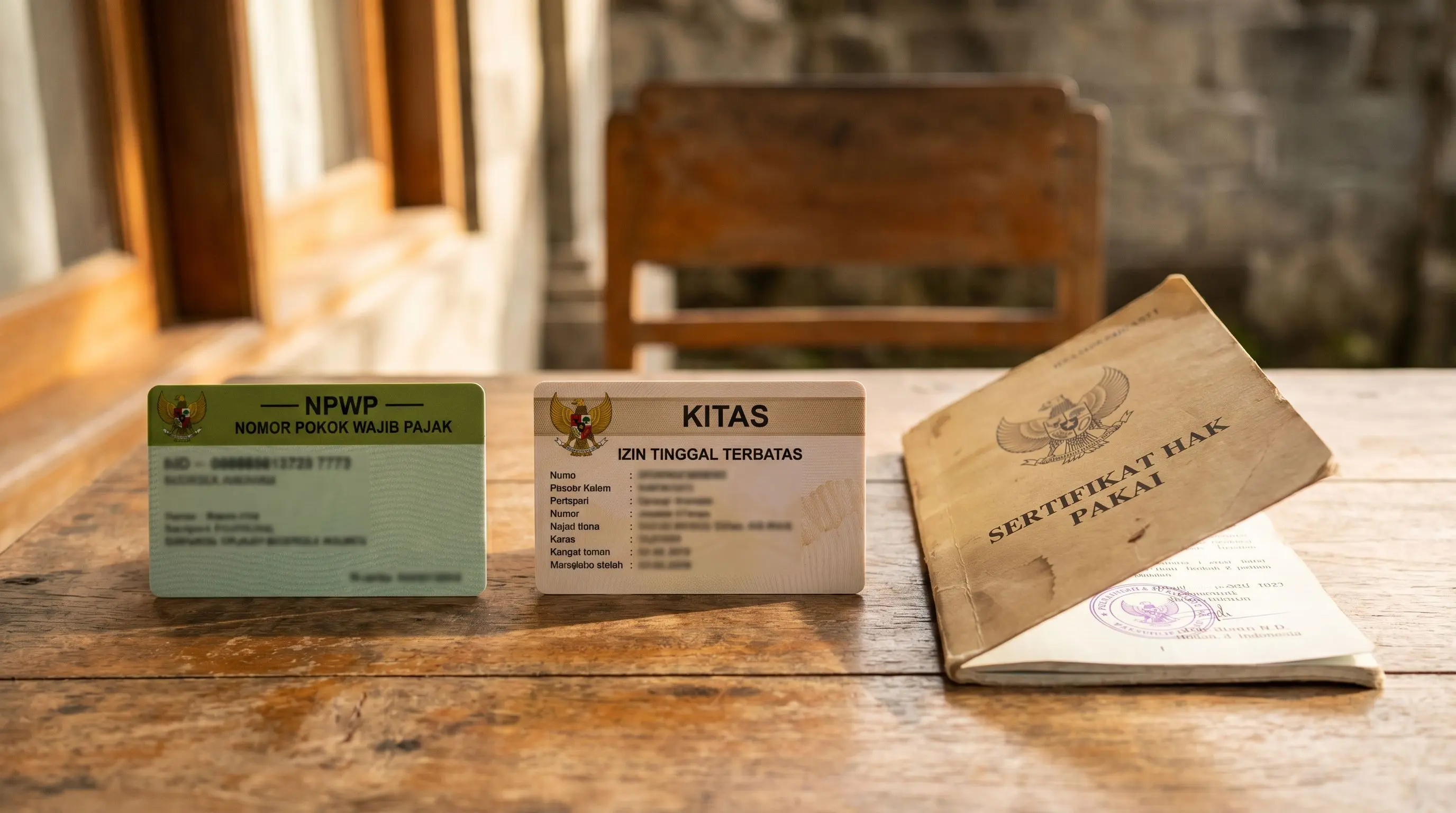
!(/images/kitap-titles.jpg)
KITAP vs KITAS: the quick contrast
- Validity. KITAS is limited-stay and renews more often; KITAP is longer-term with less frequent renewal.
- Re-entry. A KITAP generally carries a longer re-entry arrangement, which matters if you travel often.
- Sponsor. Both usually need a sponsor (employer, spouse, or your own PT PMA); KITAP conditions are stricter.
- Property link. Both can support a Hak Pakai title while valid. Neither unlocks personal freehold.
For an owner, the practical difference is stability and paperwork, not a new class of property right.
What to check before you lean on a KITAP for a purchase
"How much is lease extension for 25 additional years"
Buyer inquiry, Anteya CRM, 2025
That is the right instinct: a residency permit and a property horizon are two different clocks. Your KITAP does not extend a lease; a lease term is contractual, and any extension right is contractual too, not automatic. Confirm the current qualifying periods with immigration, verify the title on the specific villa (Hak Pakai, leasehold, or HGB) independent of your visa, and have a licensed notaris (PPAT) check the certificate and the seller's right to sell. If you set up a company to buy, the PT PMA registration runs through Indonesia's OSS system, separate from your KITAP file.
"We went in family vacation for the first time in the end of June 2026"
Buyer inquiry, Anteya CRM, 2025
Families relocating often want the permanence a KITAP signals. That is a fair reason to pursue it, as long as the property underneath sits on a title you can actually hold, and you have thought about what happens to that title on inheritance. A companion glossary entry on the KITAS itself is on the way: What is a KITAS in Indonesia? .
FAQ
Is it possible to own freehold in Bali if I have a KITAP?
Not as a freehold title in your own name. A KITAP is a stay permit, not an ownership upgrade. Indonesian agrarian law does not recognise a foreign individual as a holder of Hak Milik (SHM freehold). With a valid KITAP you can generally hold a Hak Pakai title, or buy through a PT PMA company. Confirm the structure with a notaris.
I have a KITAS and may open a PT PMA. Do I still need a KITAP?
Not necessarily. A PT PMA can hold property (Hak Guna Bangunan) based on the company, independent of your personal visa. A KITAP mainly helps your residency and can support a personal Hak Pakai title. Many investors run a PT PMA on an investor KITAS and pursue a KITAP later for stability. Review both tracks with an adviser.
How long do I need a KITAS before I can get a KITAP?
Immigration generally requires a continuous KITAS for a qualifying period, often described as several consecutive years, and the exact number depends on your KITAS category. Because these periods are revised periodically, confirm the current requirement with the Directorate General of Immigration or an immigration lawyer rather than relying on older articles.
Can I get a KITAP through marriage to an Indonesian citizen?
Often yes. A foreigner married to an Indonesian citizen can usually apply after a spouse-sponsored KITAS has run for a qualifying period. The application is sponsor-dependent, and marriage does not by itself let you hold freehold land in your own name. Property still runs through Hak Pakai, leasehold, or a company.
Does a KITAP extend my leasehold term?
No. Residency and lease term are separate. A KITAP does not lengthen a lease; the lease horizon is set in the contract, and any right to extend is contractual, not automatic. If a long horizon matters, negotiate the extension terms into the lease itself and have a notaris confirm they are enforceable, regardless of your visa status.
What land title is the villa actually sold under?
Ask this in writing for every property. Foreign buyers typically end up on Hak Pakai, a leasehold (Hak Sewa), or Hak Guna Bangunan through a PT PMA. The title, its remaining term, and the seller's right to sell all need checking on the certificate by a licensed notaris (PPAT) before any payment.
This article is general information, not legal advice. Indonesian immigration and real-estate rules change and individual situations vary. Consult a licensed Indonesian notaris (notary) and an immigration lawyer for your specific case.
Anteya Research is the editorial function of Anteya Real Estate, a Bali-based investment property advisory. This article reflects patterns across buyer conversations logged in the Anteya CRM between 2023 and 2026, supplemented by first-hand observations from our Bali-based team.