Anteya Research
Off-Plan Property in Bali: Timeline, Handover, and What to Do if It's Delayed (2026)
April 22, 2026
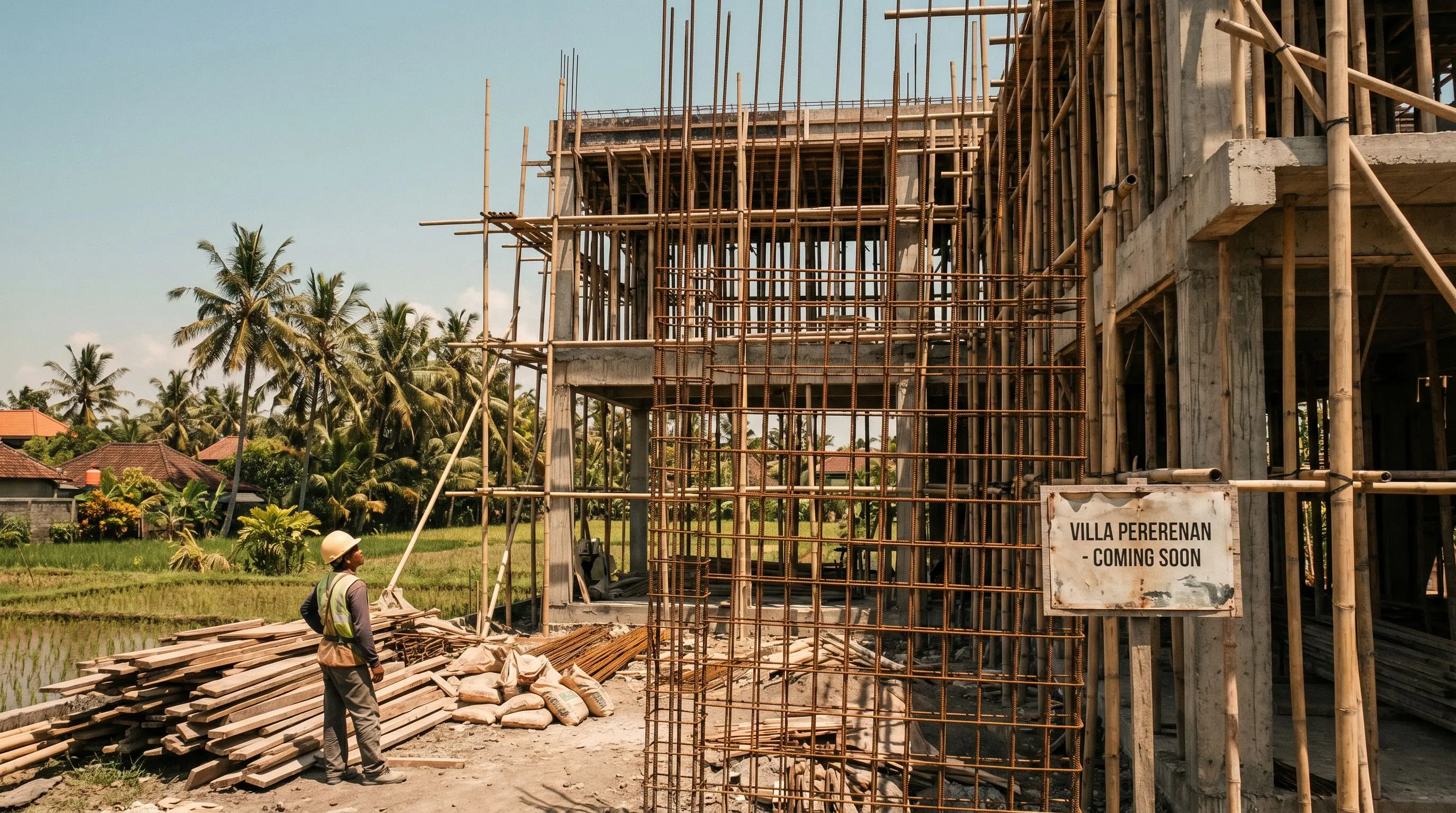
2026 is the cyclical delivery peak in Bali primary-market. That's why off-plan timing is on every buyer's mind — and why this article maps how to read it. Across thousands of buyer conversations Anteya has logged since 2023, off-plan timing and handover completion surface in roughly four of every five threads, anchored in the Q1 2026 supply picture that shows where real delivery risk sits.
The statistical picture, up front: most Bali off-plan projects do deliver, most deliver within a few months of target, and the small minority that stall can usually be identified by specific red flags before signing, not after. The buyer's highest-leverage protection is the PPJB review, not the legal action after things go wrong.
Off-plan vs completed: the trade-off buyers actually face
In our CRM, nearly every off-plan conversation starts with the same fork. A buyer wants to understand whether they should stretch for a completed, ready-to-rent villa at today's price, or commit to an off-plan build and trade 12–24 months of waiting for a lower entry price and a developer pipeline they can still influence.
"Are you open to off-plan projects, only completed, or both of them?"
Buyer inquiry, Anteya CRM, 2025
The shape of that question (asked in some form by dozens of Anteya buyers) reveals the actual decision framework. It's not off-plan versus completed in the abstract. It's about which product fits a specific budget, timeline, and appetite for construction risk.
Completed (handover done, SLF issued) means: immediate rental cashflow start, full visibility into finishes, no construction risk. You pay for certainty. Supply is tighter. Most primary inventory in 2026 is still under construction, not delivered.
Off-plan means: typically 10–25% lower entry price than completed equivalents, staged payments tied to construction milestones, choice of layout and finishes in earlier-stage projects, but you carry the handover-date risk and pay for the privilege of waiting.
The 2026 delivery peak: why this matters right now
Anteya observation: As of Q1 2026, roughly two-thirds of the Bali primary-market projects we track remain under construction. 2026 is the cyclical delivery peak: the bulk of projects currently scheduled to complete this calendar year stacks well above the typical annual delivery pace of the preceding years.
That statistic explains why the off-plan conversation is so dominant right now. Most buyers shopping Bali property in 2026 are, in effect, shopping a pipeline. The market they encounter is dominated by under-construction stock, not completed stock. Ready inventory exists but is a minority of choice.
The pipeline tapers sharply after 2026. 2027 delivery drops materially: our tracked pipeline shrinks by roughly 40% in unit terms. 2028 thins further, to a small fraction of the 2026 peak. Two practical consequences:
- If you're buying into a 2026-delivery project: you're in the widest part of the supply curve. Negotiation leverage is real. Product choice is at its maximum across size, location, and tier.
- If you're buying into 2027 or 2028 delivery: you're entering a materially thinner new-supply environment at the moment your rental operation starts. Less competition for guests, but a longer wait and more cycles of construction milestone payments to manage.
What actually slips: realistic delay ranges
Handover delays are common on Bali primary market projects. The gap between sales-deck marketing and field reality lives in the specifics: how common, by how much, and for which reasons.
Most professional Bali developers ship within 1–3 months of target; the longer slips concentrate at first-time-developer or undercapitalised-PT projects, which is what developer due diligence is for. In our deal experience, delay distribution looks roughly like this:
- On-time or within 1–2 months of promised date: common for established regional developers with multiple deliveries on their track record.
- 3–6 month slip: typical for mid-tier developers. The actual calendar drags are specific: the wet season (roughly November to March) slows concrete pours, foundations, and roofing; the Balinese ceremonial calendar (Nyepi shuts the whole island, Galungan/Kuningan sends Balinese crews back to kampung) takes days off every month; Ramadan/Lebaran pulls Javanese labour home for 2–3 weeks. Plus PBG permit timing and payment-milestone friction with the buyer group.
- 6–12 month slip: not rare for first-time developers or projects hitting desa adat friction (the customary-village layer under which banjar and pecalang operate): access-road disputes, piling-noise complaints, odalan temple-day stoppages. These sit separately from desa dinas administrative permits.
- >12 month slip or outright stall: the outlier category. Usually correlates with one of a small set of red flags: undercapitalised developer, unresolved land title issues, or a zoning/permit problem that predates the sale.
"Are these villas completed or off-plan, and if off-plan, what buyer protections are in place?"
Buyer inquiry, Anteya CRM, 2025
That's the right follow-up question. The answer to "what's the real handover date" is always uncertain; the answer to "what happens if it slips" is what actually underwrites the deal.
Buyer protections: what to demand in the PPJB
The PPJB (Perjanjian Pengikatan Jual Beli, the binding preliminary sale agreement) is where off-plan protections live or don't. The notaris executes the document and confirms identity. They do not monitor construction performance or verify milestones post-signing. That's a separate function the buyer arranges. Before signing any PPJB, the four clauses to verify:
- Payment schedule tied to construction milestones, not calendar dates. A typical structure is a deposit (10% is the market mode; the published range across Bali guides is 5–20%) at PPJB signing, then installments at roofing / walls / finishing / handover, each verified by the buyer, a retained quantity surveyor (QS), or a private inspector. Calendar-date payments transfer construction risk to the buyer; milestone payments keep risk with the developer.
- Handover tied to SLF, not just "completion". Handover should be defined as SLF (Sertifikat Laik Fungsi) issued + vacant possession. The SLF confirms the as-built structure matches the PBG filing and is the real legal handover gate. Name a specific month/quarter with contractually defined grace (typically 3–6 months) after which late-delivery penalties accrue to the buyer. The PBG status should sit in the PPJB schedule. PBG permit delays are the single most common cause of handover slips.
- Refund mechanism for developer default. True third-party escrow is rare on Bali primary-market villa deals; staged milestone payments are the realistic minimum substitute, ensuring the buyer never has their full capital at risk with an undelivered project. A rescission clause with refund terms matters more than the escrow label.
- Specification lock: finishes, appliances, pool dimensions, and built-area square-metres named specifically. "Similar quality" clauses give the developer discretion to downgrade finishes when costs rise during construction.
If the PPJB on the table is silent on any of these, the answer isn't "trust the developer"; it's "require the amendment before signing or walk away". On Pererenan villa product in particular, payment-milestone structure is usually the principal underwriting point alongside the finish specification.
How to track construction from abroad
For buyers in Singapore, Sydney, or London who committed to an off-plan Bali project, the real anxiety isn't the initial signing; it's the 18 months between signing and handover, during which construction happens on the other side of the world.
Practical tracking routes, ranked by reliability:
- Monthly developer progress reports with geotagged photos. Most professional developers include this in the PPJB. Ask for the format before signing. Weekly WhatsApp photos are not the same as a structured monthly report with site-plan annotations.
- Private QS or project manager retainer. Bali's third-party inspection market is thin. Formal inspection firms exist but most buyers use a privately retained quantity surveyor or project manager. Monthly inspection visits typically land in the low-to-mid hundreds of USD range depending on scope, site access, and report depth.
- Independent visits on a 3–6 month cadence. If you can travel, a single half-day on-site every two trips is worth more than any number of photos.
- Anteya's client channel. For buyers we represent on off-plan deals, construction-stage updates flow through our CRM alongside any developer-side communication, so the buyer sees both the developer's framing and our independent read of progress.
The common-sense rule: never rely exclusively on the developer's own photography for an 18-month wait. Budget for a third-party inspection line item or plan the travel.
FAQ
Should I buy off-plan or a completed property?
Depends on your timeline and price sensitivity. Off-plan typically saves 10–25% on entry price but carries a 12–24 month wait and handover-date risk. Completed means immediate rental start and zero construction risk but tighter inventory choice and a premium on the buy price. In 2026, most Bali primary-market stock is still under construction, which means the off-plan set is where the genuine product variety sits.
What is the best completion date to target in 2026?
There's no universal answer, but the supply pattern matters. 2026 is the delivery peak: the bulk of tracked primary-market projects hand over this year, so buyers entering 2026 projects get the widest product choice and strongest negotiating position. The 2027 pipeline is materially thinner; 2028 thins further. Buying into a 2027 or 2028 handover trades time for entry into a less competitive market at the moment rental operations start.
What buyer protections exist on off-plan Bali projects?
The main ones sit in the PPJB (preliminary sale agreement): payment schedule tied to construction milestones rather than calendar dates, a contractually defined grace period with late-delivery penalties, a refund mechanism for developer default (ideally escrow-backed), and a specification lock on finishes and built-area. A PPJB silent on any of these is the negotiation target, not a signing document.
How do I verify construction progress from abroad?
Three reliable routes: (1) require monthly geotagged progress reports in the PPJB; (2) retain a Bali-based third-party inspector or private quantity surveyor for independent monthly reports (typically a few hundred USD per visit depending on scope); (3) plan independent site visits on a 3–6 month cadence. Never rely only on developer-supplied photography for an 18-month wait. Professional developers typically include structured reports as a matter of course.
What should I do if my handover is delayed?
Respond in writing within two weeks of a missed milestone. Request specific explanation, revised timeline, and evidence of corrective action. If the response is weak or absent, escalate to a somasi (formal Indonesian demand letter) drafted by your advokat. For stalled projects (vs. simply slipped), the standard escalation path is somasi → mediation → PN or BANI arbitration, depending on the PPJB's dispute clause. Recovery options shrink the longer unresolved delays persist.
Are off-plan projects required to use escrow in Indonesia?
No, and in the Bali villa primary market true third-party escrow is rare. Most funds flow directly to the developer PT's operating account, which is the single largest structural risk in off-plan here. Substitute protections are staged milestone payments (so the buyer never has full capital at risk) plus a rescission clause with refund terms. Escrow is the gold standard; milestone staging is the realistic minimum.
Can I resell my off-plan contract before handover?
Yes, typically, but the PPJB governs the mechanics. Most contracts allow assignment (sale of the PPJB rights to a new buyer) subject to developer consent and a transfer fee; the exact percentage varies materially by developer. Review the PPJB assignment clause before counting on resale. Pre-handover resale is common when market pricing moves up between signing and completion; buyers capture appreciation without taking handover.
Anteya Research is the editorial function of Anteya Real Estate, a Bali-based investment property advisory. This article reflects patterns across thousands of buyer conversations logged in the Anteya CRM since 2023, supplemented by first-hand observations from our Bali-based team.