Anteya Research
Leasehold vs Freehold in Bali (2026): What Foreigners Actually Own
April 21, 2026
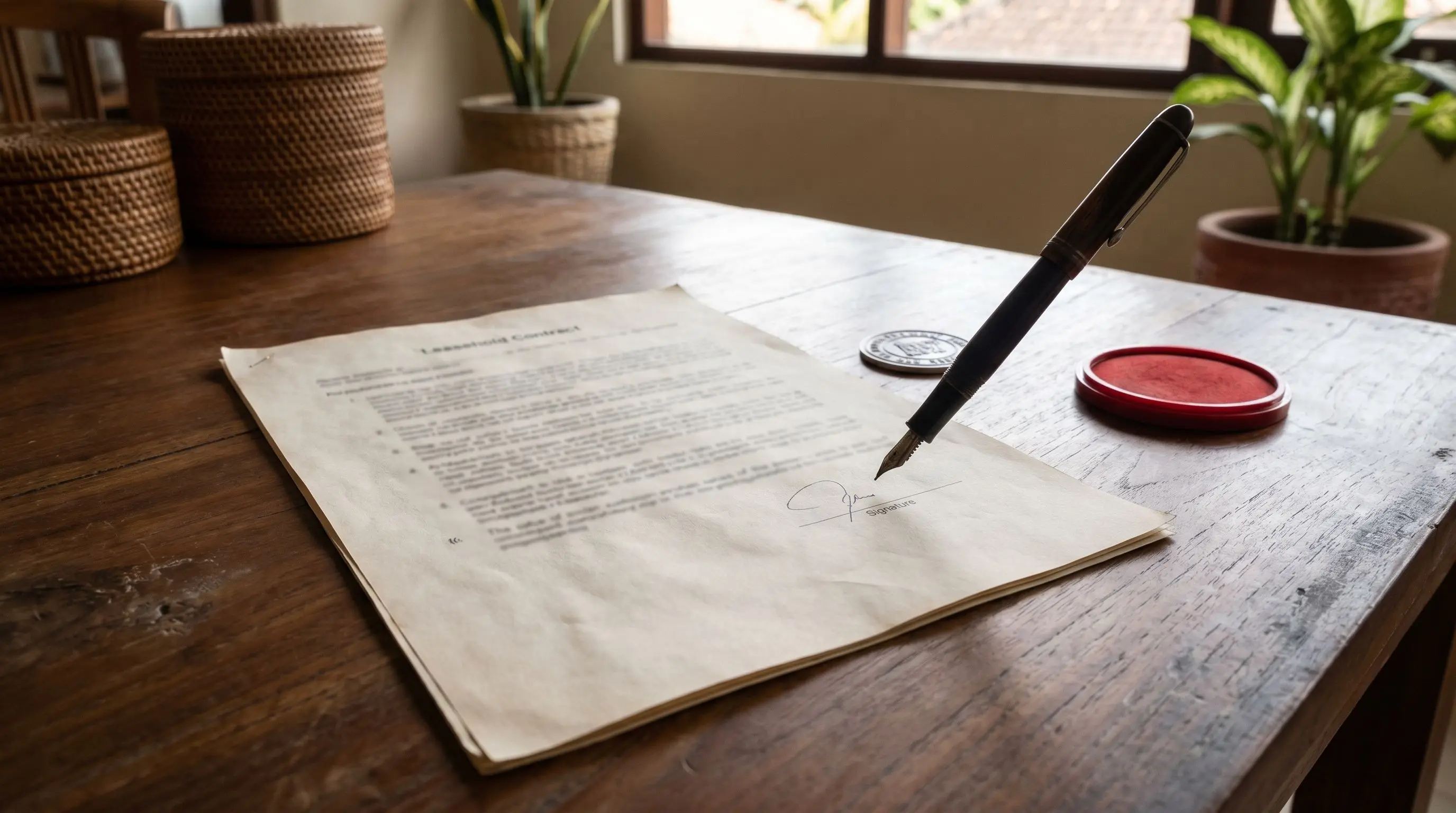
Across 5,308 inbound buyer conversations in Anteya's CRM between 2023 and 2026 (a sample of foreign-buyer enquiry, not the Bali market overall), 1,286 leads (roughly 24%) raised the leasehold vs freehold question in their opening messages. It's the single most common foundational question a serious foreign buyer asks. This article answers it the way our Bali team answers it on WhatsApp: with the specific tenure terms Indonesian law actually recognises for foreigners, the numbers our Q1 2026 supply dataset shows for pure-leasehold versus freehold-option stock, and the checklist of contract clauses that separate a clean purchase from a painful one.
The short answer for foreigners
Indonesian agrarian law does not recognise full freehold (Hak Milik) ownership in the name of a non-Indonesian individual. That's the starting point every buyer should internalise before any conversation about "freehold villas in Bali." What foreigners can actually hold, in descending order of how you'll see it on a Bali price list, is:
- Leasehold (Hak Sewa): a long-term lease, typically 25–30 years, often with a contractual right to extend. This is the dominant structure in our dataset.
- Right-to-use (Hak Pakai): a named foreign-titled right over certified land, available to foreigners with a valid residency permit (KITAS, KITAP, or second-home visa). Limited to residential use.
- PT PMA + HGB (Hak Guna Bangunan): a foreign-owned Indonesian company holding a building-use title. Typical for commercial or villa-rental use at scale; it carries ongoing compliance costs.
- Nominee "freehold": a freehold title held in an Indonesian individual's name on behalf of a foreigner. Indonesian courts have repeatedly treated this as unenforceable against the nominal owner, and Indonesian agrarian law does not recognise the underlying arrangement. Treat it as a structure to avoid, not to negotiate.
"You prefer leasehold or freehold properties?"
Buyer inquiry, Anteya CRM, 2024
When a developer says "freehold" on a Bali price list, in practice they almost always mean one of two things: (1) the unit is titled SHGB (HGB certificate) and can be sold into a foreign-owned PT PMA, or (2) it can be held under Hak Pakai if the buyer qualifies. Ask which one: they are not interchangeable.
What Bali's primary market actually sells: the tenure split
Anteya observation: In the Q1 2026 Anteya supply-pricing dataset, roughly 91% of declared unit capacity is either pure leasehold or leasehold with a freehold option. Pure freehold-only stock is a small minority of the primary market. Buyers searching "freehold villa Bali" are, statistically, searching the smaller end of what Bali developers actually sell. Anteya tracks ~60-70% of the primary market; figures are directional within that sample.
The detail under that 91% number matters, because leasehold-only and leasehold-with-freehold-option are very different products:
- Leasehold only. The default Bali product, with an average lease term of roughly 29 years.
- Leasehold + freehold option. A smaller slice of the market where developers give buyers a choice: pay the leasehold price, or upgrade to freehold at a premium, with extensions typically bundled. Combined terms on these listings average closer to 53 years.
- Freehold only. The rarest category, concentrated in residential-zoned (Yellow) areas rather than tourism-zoned (Pink) ones.
That last point explains why the freehold option is rare in the most rentable areas: much of what buyers actually want (a beachside villa on Pink tourism land in Uluwatu or Canggu) is legally licensed under leasehold structures that align with the zone's tourism-accommodation permits. If you insist on freehold in those sub-markets, your product choice narrows sharply.
What does "25 years + 25 years extension" actually mean?
Most Bali leasehold contracts are written as an initial term (commonly 25 or 30 years) plus one or two extension options. The cleanest form reads: "Initial term of 25 years, with a contractually granted extension of 25 years exercisable by the Lessee at a pre-agreed formula."
Several details decide whether that extension is worth the paper it's printed on:
- Who grants the extension. If the lease extension comes from the same freehold owner (pemilik hak milik) who signed the original lease, the commitment is durable. If the developer is merely promising to "assist with renegotiation," the extension is, in substance, a new negotiation at the landowner's asking price at the time.
- Pricing mechanism. The strongest contracts fix the extension price at signing (e.g., "USD 1,500 per are" or a formula tied to a published index). The weakest say "at market rate at the time of extension," a clause that transfers all upside to the landowner.
- Notarised and registered. The lease and its extension clause must be executed before a licensed notaris (Indonesian notary) and registered. An unregistered side-letter promising extension is not enforceable.
- Land-title cleanliness underneath. Even a perfect lease on top of a disputed Hak Milik certificate is weak. Title due diligence runs at the landowner level, not just the developer level.
"If leasehold, what is the exact lease term, extension rights, and current years remaining?"
Buyer inquiry, Anteya CRM, 2025
Contractual extension, not automatic extension, is how Indonesian property practice treats these clauses. The specific words in your akta sewa-menyewa (lease deed) are what your heirs and your future buyer will be reading.
The freehold premium: what the data shows
Anteya observation: Within the small subset of developers who publish both leasehold and freehold prices for the same unit (n = 19), the median freehold premium over leasehold is +20%, equivalent to a median $27,800 in absolute USD (Q1 2026 report, §3.4). Market-wide, freehold stock is a distinct and smaller segment that should not be compared directly to leasehold stock, because product, area, and zone profiles differ.
The 20% figure is a within-unit number: same apartment, same building, just a different tenure. Read it as: "if I want this specific unit as freehold instead of leasehold, roughly how much more?" Do not read it as: "freehold Bali property costs 20% more than leasehold Bali property in general." That second reading is not what the data supports.
A more honest framing for budgeting: "If a developer offers me a freehold option on a unit I like, I should expect it to cost roughly one-fifth more, and I should weigh that against the longer-term exit optionality."
Which ownership structure makes sense when
Leasehold, Hak Pakai, and PT PMA + HGB each fit a different buyer profile. Over-engineering is a real cost: a PT PMA carries setup fees, an annual NPWP corporate filing, accounting costs, and governance obligations. Under-engineering is a different cost: holding a rental villa as a personal lease in a tourism-zoned area may not match the operating license structure.
Rough rules of thumb our Uluwatu and Canggu/Pererenan buyers fall into:
- Single villa or apartment for personal use + occasional rental, under $500K. Leasehold is usually the right structure. Simpler, cheaper, aligned with how the developer is selling the product anyway. If you qualify (KITAS or second-home visa), Hak Pakai is an alternative.
- Multi-unit holding, income is the primary purpose. PT PMA + HGB starts to earn its keep at this scale. The compliance overhead is amortised across more units, and the structure aligns cleanly with pondok wisata or hotel-class operating licenses.
- Long horizon + preference for maximum exit liquidity. If a developer offers a freehold option and the premium fits your budget, freehold expands your future buyer pool. An Indonesian citizen can buy freehold directly, whereas a leasehold resale requires a buyer who accepts the remaining lease term.
"What land title is each villa sold under (Hak Pakai, HGB, or leasehold)?"
Buyer inquiry, Anteya CRM, 2025
In deals our team closed in Pererenan and Uluwatu through 2025, most buyers chose straight leasehold, not because freehold wasn't available, but because the premium didn't clear their ROI math given rental-focused goals.
Five tenure clauses we read first, every time
When our Bali team reviews a draft akta sewa-menyewa for a client, five things get read before anything else:
- Term and extension language. Specific years, specific extension price or formula, specific grantor. "Will be extended" is not extension language.
- Permitted use. Does the contract allow short-term rental? If the land is Pink-zoned and the lease says "residential use only," the zone does not save you; the contract governs.
- Transfer rights. Can you assign the lease to a third-party buyer? At what notice, and with what consents? A lease you cannot sell is an asset you cannot exit.
- Default and remedies. What happens if the developer misses handover? What happens if the landowner dies? Indonesian inheritance practice complicates leases that don't explicitly bind heirs.
- Registration status. The notaris's akta must be registered with the local BPN (land office). Un-registered leases are contractual, not in rem: they bind the original parties but may not bind a future purchaser of the underlying freehold.
This is general orientation, not legal advice. Indonesian real-estate rules change, and individual situations vary; speak to Anteya about your specific deal, and engage a licensed notaris for the signing step.
What we'd do on a $250K–$400K Uluwatu or Canggu deal today
Our Bali team sees the decision this way, based on 2025 dealflow and the Q1 2026 supply picture. In the two most-searched sub-markets (Bukit/Uluwatu and Canggu/Pererenan), leasehold stock is the volume play; freehold stock is rare enough that if a developer offers a freehold option on a unit you already like, it's usually worth pricing out. A within-unit freehold premium of roughly 20% is the benchmark to negotiate against: if a developer asks 35–40% more for the freehold option, ask the developer to show what's bundled into the premium beyond tenure (extension years, freehold-title cost, service charges).
FAQ
Can a foreigner own freehold property in Bali?
Not directly. Indonesian agrarian law does not recognise Hak Milik (full freehold) in a foreigner's personal name. Foreigners typically hold property under leasehold, Hak Pakai (with a valid residency permit), or via a PT PMA holding an HGB title. "Freehold" on a Bali developer's price list usually means the unit can be transferred into one of these structures; ask which one specifically before signing.
What is the typical leasehold term in Bali?
Across the pure-leasehold projects in our Q1 2026 supply dataset, the average lease term is roughly 29 years. Projects that offer a freehold option tend to bundle longer combined terms, averaging closer to 53 years. Individual contracts commonly read as "25 years plus a 25-year contractual extension," but the extension's price mechanism, grantor, and registration status determine whether it is real optionality or a renegotiation at the landowner's future asking price.
How much more does freehold cost than leasehold in Bali?
Based on 19 units where the same developer publishes both tenure options, the median freehold premium is around 20% over leasehold, equivalent to a median $27,800 in absolute USD at Q1 2026 pricing. This is a within-unit comparison. It does not mean freehold Bali property as a category costs 20% more than leasehold property, because the freehold segment skews to different areas and product types than the leasehold segment.
Is nominee freehold legal in Bali?
Indonesian agrarian law does not recognise a foreigner as the underlying owner when the title is held in an Indonesian citizen's name, and Indonesian courts have repeatedly ruled nominee arrangements unenforceable against the nominal owner. Treat nominee freehold as a structure to avoid, not to negotiate. The real-world risk is that the Indonesian name-holder is the legal owner, and the foreigner's side letter does not bind Indonesian land or inheritance practice.
What is the difference between Hak Pakai and leasehold for a foreigner?
Hak Pakai is a named Indonesian land right granted to qualifying foreigners who hold a valid KITAS, KITAP, or second-home visa, for residential use on titled land. Leasehold is a private contract between lessee and freeholder. Hak Pakai gives a stronger legal footprint but requires residency eligibility and typically applies to residential property. Foreign buyers without KITAS generally default to leasehold because it carries no residency prerequisite.
Should I use a PT PMA to buy property in Bali?
A PT PMA (foreign-owned Indonesian company) makes sense when the property is held for income: multiple units, pondok wisata or hotel-class rental operations, or any structure where HGB title and corporate taxation align with how you plan to operate. It carries real costs: setup, annual filings, accounting, governance. For a single villa bought for personal use and occasional rental under roughly $500K, leasehold is usually simpler and cheaper.
Can I sell a leasehold property in Bali before the term ends?
Yes, provided the akta sewa-menyewa permits assignment and the remaining term plus any contractual extension is attractive enough for a future buyer. The resale buyer pool is smaller than for freehold because the buyer inherits the remaining lease, not perpetual ownership. Clean transfer rights, notarised registration, and a clearly documented extension clause are what make a leasehold liquid on resale; the terms matter more than the years remaining.
Anteya Research is the editorial function of Anteya Real Estate, a Bali-based investment property advisory. This article reflects patterns across 5,308 buyer conversations logged in the Anteya CRM between 2023 and 2026, supplemented by the Q1 2026 Anteya supply-pricing report and first-hand observations from our Bali team.
Browse Bali projects → Contact Anteya →
This article is general information, not legal advice. Indonesian real-estate rules change and individual situations vary; consult a licensed Indonesian notaris (notary) for your specific purchase.