Anteya Research
How to Evaluate a Bali Developer Before You Send a Deposit (2026 Buyer Checklist)
April 22, 2026
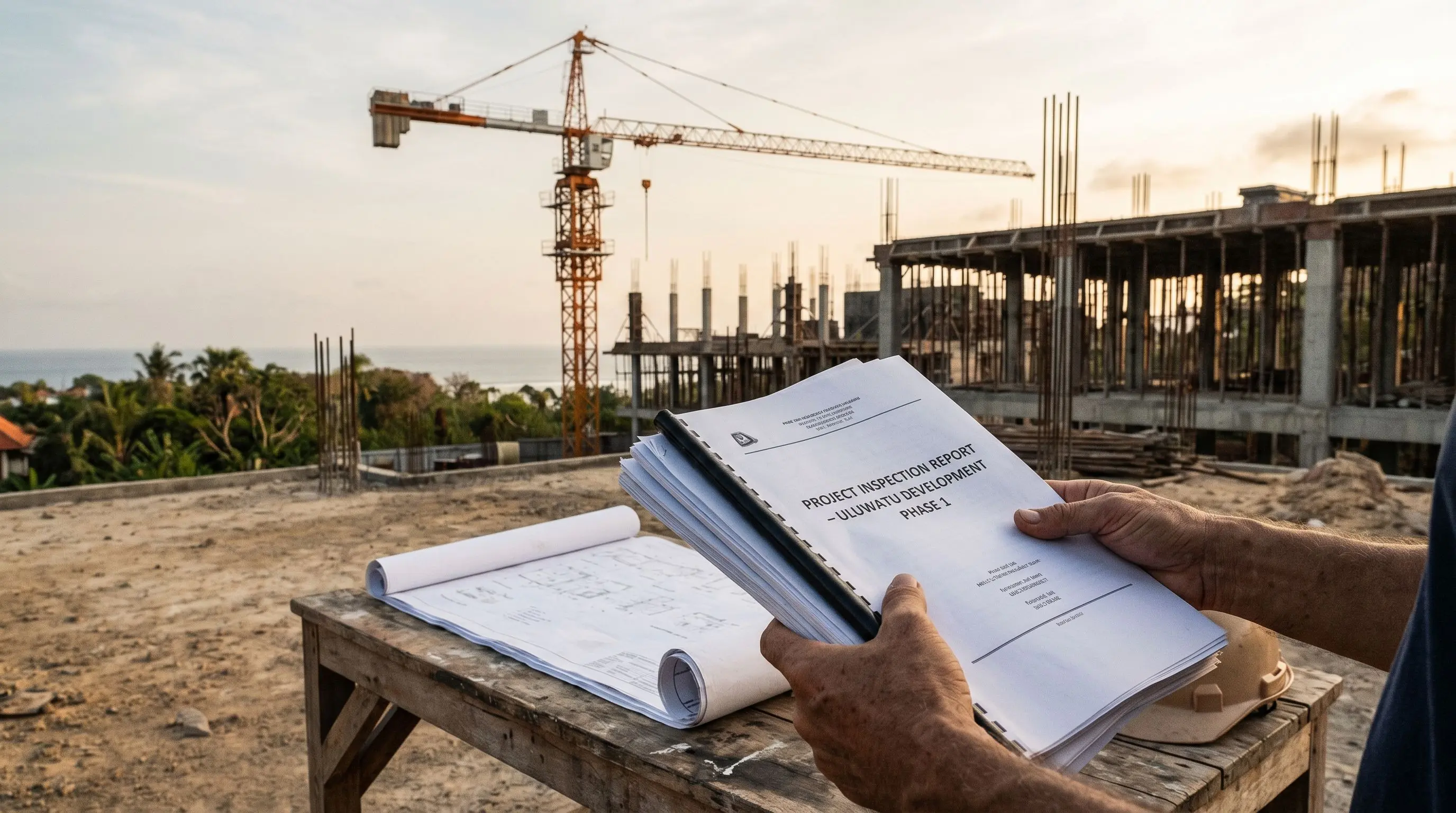
The most experienced buyers ask sharper developer questions earlier — this checklist gives every buyer the same toolkit. It's a buyer-side guide: what you should verify, who you should ask, and what answers should make you pause.
Anteya observation: The clear majority of Bali primary-market villa projects currently being marketed to foreign buyers are still under construction. Most of the villas foreign buyers are shopping right now are being bought on promises, renders, and pro-formas rather than finished product. That's the reality that makes developer evaluation the single highest-leverage due-diligence step.
The question most buyers don't ask often enough
"Have you checked the developer?"
Buyer inquiry, Anteya CRM, 2025
That question usually lands two weeks after the deposit already went out. In the timeline the buyer controls, it should be the first question before any payment. The checklist below is what "checking the developer" actually means in practice.
Check 1: Track record: delivered projects, not pitched ones
A developer's marketing deck shows pipeline projects and renders. Those are forward-looking claims. The meaningful signal is the delivered stock: projects the developer actually handed over, units buyers actually took possession of, and testimonials from owners still operating 2–3 years later.
What to ask for:
- List of completed projects, with locations, completion years, unit counts, and current occupancy status (occupied, on resale market, on rental platforms).
- Contact details for 2–3 past foreign buyers from those completed projects. A confident developer will connect you; a reluctant one is telling you something.
- Time from PPJB signing to actual handover on at least one completed project. The delta between marketed handover date and actual handover is the single most predictive number in a developer's history.
"Can you provide the developer's name, completed projects, and a notarized sample from a previous foreign buyer transaction?"
Buyer inquiry, Anteya CRM, 2025
That's exactly the right ask. A notarized sample PPJB from a previous transaction (with PII redacted) tells you how the developer actually structures deals (payment schedules, buyer-protection clauses, dispute-resolution mechanics) which is far more informative than a marketing brochure.
Check 2: Corporate structure: who you're actually buying from
The seller on your PPJB is almost always an Indonesian PT (Perseroan Terbatas, limited-liability company). That PT may or may not be capitalised to handle a construction overrun, a delivery dispute, or a mid-build funding shortfall.
What to check:
- PT name on the PPJB draft vs the developer brand marketed to you. Brand names are often holding-level; the PT selling you the specific unit may be a project-specific SPV.
- The PT's registration and paid-up capital: publicly searchable via AHU Online (Indonesian Ministry of Justice corporate registry). A project-SPV with IDR 50M of paid-up capital backing a $5M development is a structural red flag.
- Relationship between the PT and the marketing brand. Is this a subsidiary, a licensed use of the brand, or just a trading name? Each has different recourse implications if things go wrong.
- Beneficial ownership: who are the ultimate Indonesian nationals (pemilik) or PT PMA structure behind the developer? Shell-of-a-shell structures with no clear beneficial owner should raise serious questions.
Check 3: Permit and title file: is the deal actually legal
The developer's marketing copy assumes the project is fully permitted. Your job before depositing is to verify that assumption on paper.
- Land title: SHGB (Hak Guna Bangunan, building-use title) or Hak Milik (freehold), with the original certificate available for notaris inspection. Copies are not enough.
- PBG (Persetujuan Bangunan Gedung, the construction permit that replaced IMB in 2021) matching the as-being-built structure. Number of floors, built-area, and use-case on the PBG should match what's being sold.
- SLF (Sertifikat Laik Fungsi) if the project is already completed, confirming it can legally be occupied.
- Zone color on the current RDTR for the specific parcel: pink (tourism), yellow (residential), etc. Mismatched zone vs intended use is one of the most common structural issues foreign buyers discover only post-signing.
- Pondok wisata or hotel license (if the developer is selling an STR-model product) either in hand or with a defined path to issuance.
Your notaris can pull most of this. Pay for that step. The fee is immaterial compared to the risk.
Projects differ materially in how much of this evidence is ready to inspect pre-deposit. Leasehold product in pink-tourism corridors like Pererenan tends to carry one due-diligence stack (lease registration, pondok wisata path, PBG). Freehold-titled product in Melasti and similar yellow-zone sub-markets carries a different stack (Hak Milik chain, PT PMA setup if foreign-held, zone-vs-use alignment). Running this checklist is the buyer's responsibility; Anteya runs it on your behalf for any project we shortlist, and the notaris confirms the legal pieces.
Check 4: Financial health: is the project funded through handover
A common pattern with undercapitalised developers: the project launches off-plan, early-deposit capital covers the first construction phase, later deposits fund later phases, and a gap in deposit flow creates a cash-call to existing buyers or a stall.
Signals to probe:
- Construction financing: is there a bank-provided construction loan, or is the project funded entirely from buyer deposits? The latter is common in Bali but carries materially higher stall risk. Escrow arrangements are unusual in the Bali villa primary market; bank-held collection accounts are rarer still.
- Bank involvement: if a bank is involved, which one, and is there an escrow or collection-account arrangement?
- Current construction progress vs current sales progress. A 20%-built project with 80% of units already deposited is a different risk profile than one with matched construction and sales progress.
- Parallel projects by the same developer. A developer running three off-plan projects simultaneously with buyer-deposit-only funding is juggling cashflow in a way that should be understood.
Check 5: Contract mechanics: the PPJB as the real product
The PPJB is where every protection either exists or doesn't. Before signing, specifically check:
- Payment schedule tied to construction milestones, not calendar dates. A developer's PPJB that demands 40% of the price before construction starts is transferring construction risk to you.
- Grace period and penalty clause for late handover. Silence on penalties is a red flag; 3–6 months of defined grace followed by automatic compensation to the buyer is the professional-market baseline.
- Refund mechanism for developer default. What happens to your deposit if the project doesn't deliver? Escrow is rare in Bali villa primary market, so the substitute is staged milestone payments and a rescission clause with refund terms.
- Specification lock: finishes, appliances, pool dimensions, built-area square-metres named specifically. "Similar quality" clauses give the developer discretion to downgrade finishes when costs rise.
- Transfer and assignment clauses: what happens if you want to resell the PPJB before handover.
"Then please find out from the developer how it is possible that the property has been on booking for several weeks, and possibly even months?"
Buyer inquiry, Anteya CRM, 2025
That buyer was asking about a rental-platform listing for a unit that should have been handed over but wasn't. The larger pattern: even after the PPJB is signed, the developer's communication quality (or absence) is a leading indicator of delivery quality.
Check 6: Direct developer engagement: book the Zoom call
Most Anteya conversations end with a buyer meeting the developer directly by video before any deposit. Done right, the Zoom call is a 45-minute test of whether the developer's operational maturity matches the marketing polish.
What to ask on that call:
- Walk through the specific unit you're interested in, with the developer's project manager showing construction status live.
- Ask the developer to describe, on the call, one project that didn't go to plan, and how they handled it. Developers with zero imperfect history either haven't built long or aren't being honest.
- Ask about the after-handover relationship: how long they warrant construction defects, who handles warranty claims, and what the process looks like.
- Ask about current construction challenges: monsoon impact on schedule, PBG status, any banjar-level issues they've navigated. Specific answers suggest operational maturity; generic reassurances suggest the opposite.
Check 7: Red flags: specific patterns to walk away from
Anteya pre-screens developers against these signals before any project enters our recommendation set. Nothing alone is disqualifying, but combinations are:
- Pressure to deposit before document review ("this unit is about to go").
- "Guaranteed ROI" as the primary sales message without balance-sheet backing or defined guarantee mechanics.
- PBG still "in process" at the point of sale, with no timeline.
- PT with minimal paid-up capital relative to project size.
- Marketing brand that resists connecting you to past buyers.
- Vague or shifting answers on zone color, handover timing, or who holds the land title.
- Refusal to let your notaris review the PPJB before signing.
Walking away from a deal for any of these reasons is cheaper than signing despite them.
FAQ
What's the single most important developer check before a deposit?
Get the list of completed projects, the PT selling you the unit (not the marketing brand), and a notarized sample PPJB from a prior transaction. Those three pieces tell you whether you're dealing with an operator with delivered track record or a brand promising future delivery. Everything else refines; these three are the base.
How do I verify a Bali developer is legitimate?
Check AHU Online for the PT's registration and paid-up capital. Pull the land title and PBG status through your notaris. Request a list of completed projects and talk to past foreign buyers. Legitimate operators cooperate with this; evasive or pressuring responses are themselves the signal.
What documents should I demand before signing a PPJB?
At minimum: land title certificate (SHGB or Hak Milik), PBG matching the as-built or being-built structure, current RDTR zone confirmation for the parcel, PT registration and paid-up capital documents, PPJB draft for notaris review, and a list of the developer's completed projects with reference contacts.
Is it OK that the PBG is "still in process"?
Sometimes, but with conditions. A PBG genuinely in process should have a defined timeline, a specific document number, and a path to issuance your notaris can verify. An open-ended "in process" with no paperwork is a walk-away signal. PBG delays are the single most common cause of slipped handover dates, so the status should be understood concretely before any deposit.
What if the developer won't connect me to past buyers?
That refusal is information. A developer with delivered projects and satisfied owners has no reason not to facilitate a reference call. Evasion at this step is correlated with either (a) no genuinely delivered stock yet, or (b) delivered stock with unhappy owners. Either way, a reason to pause.
How much should I budget for legal due diligence on a Bali purchase?
A competent Bali notaris or advokat review of the full document package (land title, PBG, PPJB, corporate structure) typically runs IDR 15–40M ($1,000–$2,600) depending on project complexity. This is immaterial against a $250,000+ purchase. Buyers who skip due-diligence fees hit the exact problems the fees were sized to prevent.
What's the worst-case I should plan for?
The low-probability but real scenarios are: developer PT goes insolvent before delivery (recovery is slow, partial, and requires Indonesian-law counsel); PBG issues surface post-construction, blocking SLF and therefore legal occupation; land title dispute (rare on well-documented leasehold, more common on nominee freehold). Each has precedent in the Bali market; each is prevented or mitigated by the pre-deposit checks above rather than resolved after.
Anteya Research is the editorial function of Anteya Real Estate, a Bali-based investment property advisory. This article reflects recurring patterns across buyer conversations logged in the Anteya CRM between 2023 and 2026, supplemented by first-hand observations from our Bali-based team.