Anteya Research
Bali Property Under $150K / $300K / $500K: What You Actually Get at Each Tier (2026)
April 22, 2026
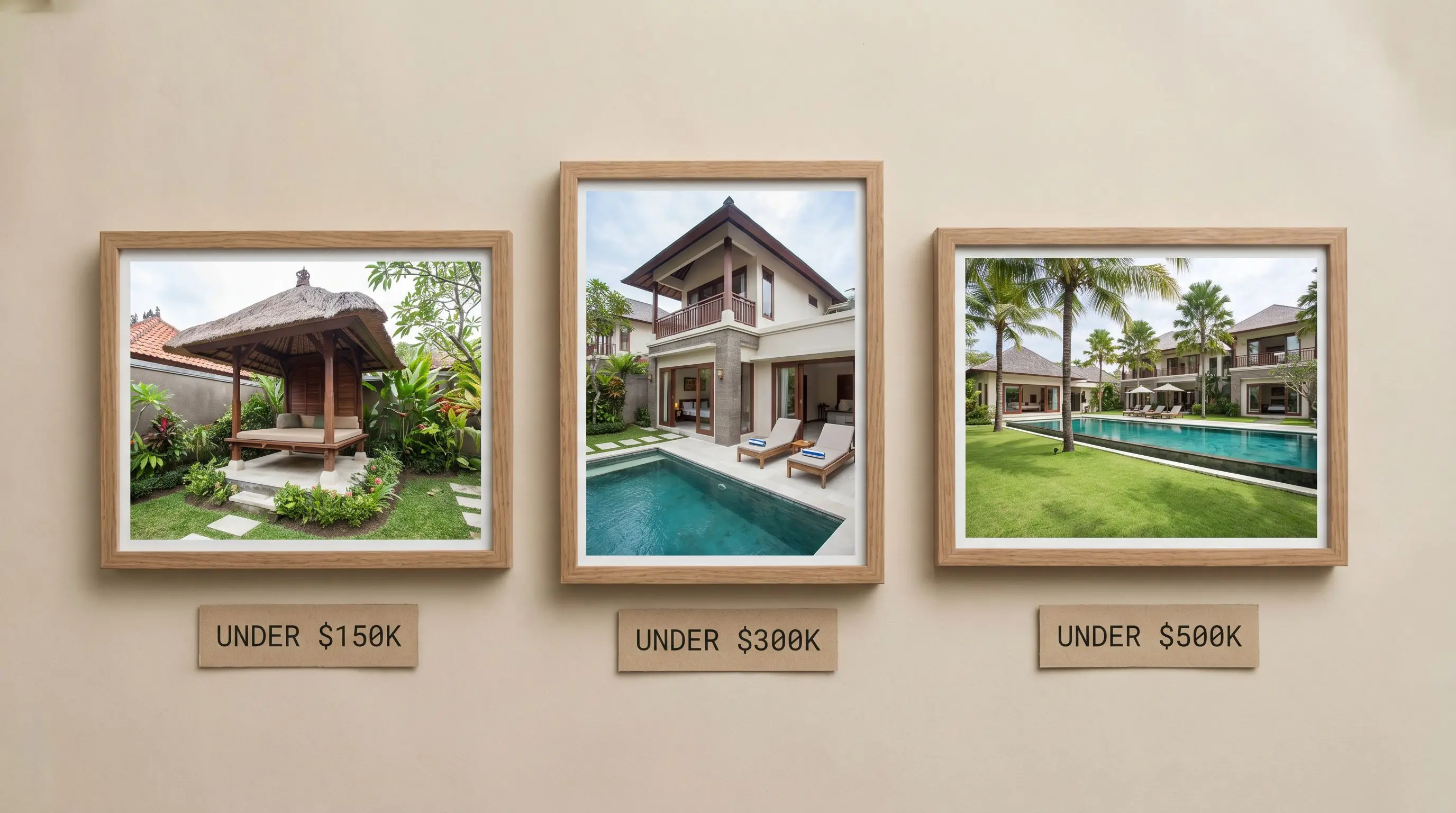
Across several thousand buyer conversations Anteya has logged since 2023, roughly four out of ten buyers name a specific price range within their first three messages. "What can I get for my budget" is the question every other decision circles back to. This article maps what each major price tier actually buys on the Bali primary market, anchored in Anteya's Q1 2026 primary-market coverage.
Anteya observation: Across the priced unit offerings in our Q1 2026 primary-market coverage, the distribution by price segment looks roughly like this: sub-$100K is a thin sliver (~4%), $100–150K is a small band (~12%), $150–300K is by far the largest segment (~38%), $300–500K sits around a quarter of stock (~25%), and $500K+ accounts for roughly a fifth (~21%). The $150–300K band is the single largest segment: the mass-market sweet spot where the widest competitive set and typical negotiating leverage sit. Anteya tracks ~60-70% of the primary market; figures are directional within that sample.
Under $100K: the sub-floor segment (~4% of stock)
Below $100K on the Bali primary market exists, but it's a narrow segment: a small minority of supply, almost all studios or small 1BR apartments in tourism-dense sub-markets where the 25–35 m² compact-rental format economics work.
"Would the starting price of $135,000 work for you?"
Buyer inquiry, Anteya CRM, 2025
That question comes up repeatedly below $150K. Buyers naming $100K usually find that the realistic product set begins around $120-150K once they see Bali primary-market spread; the sub-$100K band is a thin set of specific projects rather than a general shopping zone.
The realistic sub-$100K buyer is targeting a studio in the Ungasan/Melasti corridor, Uluwatu clifftop stretch, Nusa Dua, or Berawa, accepting compact format (typically 25–32 m² built), and underwriting nightly-rate cashflow as the only viable operating model. Pererenan and Cemagi at this ticket size are thin: they're villa-low-density areas, not studio-tower corridors.
$100–150K: studio-dominated, compact-rental economics (~12% of stock)
This is the studio tier proper. Most offers in the $100–150K band are studios; the rest skew to compact 1BR apartments and very small villa-land combinations in value sub-markets.
Typical studio pricing in this band sits around $130K at roughly 35–40 m² built area, which puts $/m² in the high-$3,000s: one of the highest per-metre bands across all product types. That's not a sign of expensive studios; it's a reflection of the compact-rental operating economics, where nightly-rate cashflow prices against unit count and occupancy, not against square-metre cost.
Studio buyer archetype: first-time Bali investor, ticket-size-first, targets rental yield as the operating thesis. Clusters into pink-zone tourism sub-markets (Uluwatu, Ungasan/Melasti, Nusa Dua, Berawa) where pondok wisata licensing + short-term rental cashflow is the standard model. Yellow-zone studios don't fit this model and should be avoided unless the buyer intends a long-term residential tenant.
$150–300K: the mass-market sweet spot (~38% of stock)
This is where most Bali primary-market conversations actually happen. Roughly 38% of our tracked stock sits in this band: the single largest segment. Three product archetypes converge here:
- Compact 1BR and 2BR villas in Seseh, Cemagi, Tumbak Bayuh / Munggu, and Ubud; deep-interior or short-lease Pererenan at this band. Typical 1BR pricing runs around $200K; typical 2BR around $280–290K.
- 1BR apartments in Melasti, Uluwatu, Nusa Dua, Berawa.
- Upper-end studios in Canggu's coastal sub-markets at $140–150K: larger studios at better locations.
"What's your budget range?"
Buyer inquiry, Anteya CRM, 2025
For buyers answering that question with "$200–250K", the sub-market choice drives product type. In Seseh, Tumbak Bayuh, or Cemagi, $250K can buy a compact 2BR villa at roughly 110–140 m² built. In Pererenan, that same ticket has gone thin: 2026 pricing has pushed entry 2BR above $300K unless the lease is short or the location is deep-interior. In the Ungasan/Melasti corridor or Uluwatu, the same ticket buys a 1BR apartment at a sharper $/m² but without land economics. In Ubud, $250K buys larger built area at a different operating model.
The competitive set is thickest here: more developers, more product permutations, more negotiating room. A buyer landing at $250K sees the widest option set on the island, several times the choice available at $125K or $600K.
Nusa Dua 1BR villa product and Pererenan 2BR villa product sit cleanly inside this band at either end of the product spread.
$300–500K: the quality-first band (~25% of stock)
At $300–500K, the product shifts. This is the 2BR–3BR villa segment with proper land plots, upper-tier finishes, and sub-markets where quality rather than yield-per-dollar is the decision driver. Roughly a quarter of tracked stock sits here.
The anchors:
- 3BR villas across Pererenan, Uluwatu, Ubud, Bingin/Pecatu. Typical 3BR pricing lands around $420K; the 3BR segment is almost entirely villas rather than apartments.
- 2BR villas in prime sub-markets: Batu Bolong, Bingin, Seminyak entry-level, Umalas.
- Upper-tier apartments: Nusa Dua beachfront, higher-end Seminyak formats.
"I see you are interested in a villa around $500K USD, correct?"
Buyer inquiry, Anteya CRM, 2025
The buyer at $400–500K is typically the second-property buyer, the owner-occupier with stronger space requirements, or the investor shifting from studio-unit scale to villa-per-household scale operations. This is the tier where land size starts to matter materially: a 3BR villa with a 250 m² land plot vs a 400 m² plot changes both the rental experience and the resale dynamics.
$500K+: the premium segment (~21% of stock)
The premium band (roughly a fifth of tracked stock) spans from entry-premium 3BR villas through the $1M+ estate segment. A larger share of the market than most buyers realise before they start shopping.
Product characteristics:
- 4BR+ villas dominate the space: typical 4BR+ pricing lands around $800K, and the 4BR+ segment is effectively villa-only.
- Prime-sub-market 3BR villas: Umalas, Petitenget, Berawa, Seminyak, Bingin, Uluwatu premium.
- Penthouses and prime apartments: a very small high-end segment in most cycles.
- Freehold-titled product where available: freehold-titled stock is a small minority of supply, typically in residential-zoned (yellow) areas, with Melasti as one of the more visible sub-markets.
The buyer at $500K+ often has one of two profiles. The investment buyer is consolidating capital into a single higher-yield villa rather than splitting across multiple compact units. The lifestyle buyer is personalising: 3–4 bedrooms for family, premium sub-market for lifestyle, and rental cashflow as a secondary rather than primary underwriting layer.
Pererenan 4BR villa product sits at the entry end of this tier.
What the sticker price doesn't include: closing costs and the 2026 PPN waiver
Buyers routinely underestimate closing costs. The three significant line items on top of the list price:
- PPN (Pajak Pertambahan Nilai, VAT on new property): 11% statutory rate (12% only on luxury residences above IDR 30B). Important for 2026: under PMK 90/2025 the Ministry of Finance has waived PPN on the first Rp2B of sale price for homes up to Rp5B, for 2026 handovers. For most Bali primary-market units, which sit well under the Rp5B (~$310K at current FX) threshold, the effective buyer-paid PPN in 2026 can be zero. Verify qualification with the notaris before assuming.
- BPHTB (Bea Perolehan Hak atas Tanah dan Bangunan, land & building acquisition tax): 5% of the transaction value above the regional exemption threshold (NPOPTKP). For most foreign-buyer deals this applies in full.
- Notaris fees: regulated at up to 1% of transaction value, typically split between buyer and seller.
Rule of thumb for 2026: statutory-rate all-in closing costs land at ~15–17% on top of sticker, but for units qualifying for the 2026 PPN-DTP waiver the effective buyer-paid figure is closer to 6–8%. On a $250,000 villa the all-in cost swings from ~$292,500 (statutory) to ~$267,500 (post-incentive) depending on eligibility. Material enough to underwrite explicitly.
FAQ
How much does a villa in Bali really cost in 2026?
Across the priced villa offers in our Q1 2026 coverage, the median sits around $345K. The mean is meaningfully higher because high-end outliers pull it up, so the median is the more representative number. The practical range runs from below $100K at the compact-villa floor to several million at the top of the prime segment. Typical 2BR villa $280–320K, typical 3BR around $420K, 4BR+ typically $800K and up.
What can I buy under $150K in Bali?
Under $150K is a small minority of supply (roughly 15% of tracked stock), mostly the $100–150K band, not sub-$100K. The realistic segment: studios (~$130K at 35–40 m²) and a few compact 1BR apartments in tourism-dense sub-markets. Villa product under $150K is narrow: land-light compact villas in value sub-markets like Cemagi or deep-value Ubud, often far from the coast.
What's the best value at $250K?
$250K sits in the thickest band (the $150–300K segment is ~38% of tracked stock). Best-value archetypes: a compact 2BR villa in Seseh, Cemagi, or Tumbak Bayuh (typical 2BR around $280–290K, so $250K buys slightly below); a 1BR apartment in Melasti or Uluwatu at sharper $/m²; or an upper-end studio in coastal Canggu. Product-and-sub-market fit matters more than area preference at this ticket.
What are the closing costs on a Bali property purchase?
Statutory-rate closing costs total ~15–17% on top of the list price (PPN 11%, BPHTB 5%, notaris ~1%). But for 2026 handovers, the Ministry of Finance's PMK 90/2025 PPN-DTP waiver zeroes PPN on the first Rp2B for homes up to Rp5B, covering most Bali primary-market units. Post-incentive effective closing cost drops to ~6–8%. Verify qualification with the notaris before underwriting.
Why are studios more expensive per square metre than villas?
The $/m² comparison is misleading. Studio pricing reflects the compact-rental operating model: nightly rate × occupancy × 365 days, normalised per unit. Villa pricing includes the land plot (built area plus land), which isn't captured in the $/m² built-area metric. For nightly-rate economics, studios genuinely price higher per built-metre; for total-capital-deployment and land-component economics, villas carry a different value story.
Is it cheaper to buy in Lombok or Tabanan?
Yes on ticket size, but the investment thesis differs. Tabanan (Kedungu, Nuanu City) typically prices 10–20% below Canggu coastal at comparable product. Lombok sits meaningfully lower again, but it's a separate island with its own tourism cycle and infrastructure story. These markets suit buyers with either deep local conviction or tolerance for a longer development-cycle bet, not first-time Bali buyers shopping ticket size alone.
When is the best time to buy in 2026?
2026 is shaping up as the cyclical delivery peak: the widest product choice and the strongest negotiating position we've seen across the current cycle. The 2027 and 2028 pipelines we can see today are both meaningfully smaller. Inbound tourism has run above pre-pandemic baselines since 2023, and visible supply tightens from 2027. The supply-side read: 2026 is likely the deepest buying window of this cycle. Demand-side assumptions remain the buyer's call.
Anteya Research is the editorial function of Anteya Real Estate, a Bali-based investment property advisory. This article reflects patterns across several thousand buyer conversations logged in the Anteya CRM since 2023, supplemented by first-hand observations from our Bali-based team.
If 2026 is your window, talk to Anteya now while the inventory is still wide.