Anteya Research
Bali Villa Running Costs in 2026: Staff, Pool, Banjar, Maintenance
May 23, 2026

The cost of buying a Bali villa is the line buyers underwrite most carefully and the cost of running it is the line most consistently underestimated. Brokers quote the purchase price; pro-formas show the rental income; the operating costs in between disappear into a single dismissive line that reads "approximately USD 800-1,500 per month, depending on size". The reality is more layered. Staff payroll, pool chemicals, garden, utilities, banjar contributions, THR religious-holiday bonuses, BPJS health insurance, maintenance reserve, insurance, and licensing operational fees together typically run USD 27,000-57,500 per year for a 2-3BR foreign-owned rental villa in 2026, and a meaningful chunk of that is paid in IDR with seasonal timing that catches first-time owners by surprise. This guide walks through the actual stack.
The full OpEx stack for a 2-3BR foreign-owned villa
Walking through the real line items by category in Q1 2026. All ranges assume a 2-3BR villa with private pool, 200-350 m² of garden, and active short-term rental operation. Owner-occupied villas have a thinner staff stack and similar utility costs.
Staff payroll
Bali villa staff structure typically includes:
- Villa manager / butler (often combined with housekeeping supervision): USD 300-700 per month for full-time, depending on language skills, experience, and whether the role is shared across multiple properties.
- Housekeeper(s): USD 200-400 per month each for full-time. A 2BR villa with active rental needs one full-time housekeeper; a 3-4BR villa typically needs one full-time plus one part-time.
- Garden and pool staff: USD 150-300 per month for daily attention; or USD 80-150 per visit for twice-weekly contracted service.
- Night security: USD 200-350 per month for one satpam (security guard) covering night shift; some clusters share security across the development at lower per-villa cost.
- Driver: USD 250-450 per month full-time; or USD 15-30 per hour ad-hoc.
A typical 3BR foreign-owned rental villa with full staffing therefore carries USD 900-2,000 per month in base payroll. Owner-occupied villas with reduced staffing might run USD 400-900.
Anteya observation: Across the 5,300 buyer conversations 2023-2026, owner-staffing structures cluster in two patterns. First-time foreign owners typically overstaff in year one (full villa manager plus 1.5 housekeepers plus dedicated garden and pool) and rationalize toward a leaner structure in years 2-3 once they understand the rental cycle. Long-hold owners typically settle at one villa manager doubling as housekeeping supervisor, one full-time housekeeper, and an outsourced garden-pool contract.
THR, BPJS, and the holiday-bonus reality
Indonesian labor law requires Tunjangan Hari Raya (THR), a religious-holiday bonus equal to one month's salary for any staff with 12+ months of service, pro-rated for staff with 1-12 months of service, paid at least 7 days before Idul Fitri or the staff member's relevant religious holiday. Most owners pay it without dispute; it's not optional.
Health and social-security contributions are split between BPJS Kesehatan (national health, 4% employer share, capped) and BPJS Ketenagakerjaan (work accident / death / old-age savings / pension; approximately 6-8% employer share combined when fully registered). Many household-staff arrangements in Bali register only BPJS Kesehatan, putting the employer's BPJS line at roughly 4%; full registration including BPJS Ketenagakerjaan typically lands at 10-12%.
Annualized, THR + BPJS therefore adds roughly 12-15% to your base monthly payroll bill on Kesehatan-only registration (the common household-staff arrangement), or 18-20% on full BPJS Kesehatan + Ketenagakerjaan registration. A villa running USD 1,500 per month in base payroll therefore runs USD 1,700-1,800 per month all-in with statutory employer costs, depending on the registration choice.
"I just got the THR bill for Idul Fitri. Nobody told me when I bought that I'd owe an extra month's salary to each staff member. Is this normal?"
Buyer inquiry, Anteya CRM, 2025
Pool maintenance
A typical residential villa pool (8-12 meters) consumes:
- Chemicals (chlorine, pH balance, algaecide): USD 60-120 per month.
- Equipment maintenance (pump, filter, lighting, skimmer): USD 30-80 per month in routine service and minor parts; budget USD 600-1,500 every 3-5 years for pump and filter replacement.
- Pool finishing care: tiles, grout, waterline cleaning, occasionally USD 200-500 per intervention.
- Heating (if you have it): USD 50-150 per month in season; rarely needed in Bali but increasingly added for premium product.
Bali pools also fight tropical plant litter (frangipani, fallen leaves) and rainy-season debris during Oct-Apr. The pool guy or housekeeper does daily skimming as standard. Without it, a Bali pool turns over in 48 hours during monsoon.
Garden and landscape
Bali landscaping is the silent cost line. A 200-300 m² garden with mature tropical planting needs:
- Daily watering in dry season (Apr-Oct): water cost USD 30-80 per month depending on bore vs PDAM supply.
- Weekly maintenance (pruning, weeding, replanting): bundled into garden staff cost above, or USD 50-100 per visit for outsourced.
- Pest control (termites for timber structures, ants, occasionally rodents): USD 30-80 per month routine, plus periodic interventions.
- Replanting (Bali tropical plants are aggressive but also die back in heavy monsoon): USD 200-600 per year on average.
Utilities
Bali utility cost varies sharply with size of villa, number of bedrooms with AC, swimming pool circulation hours, and water source:
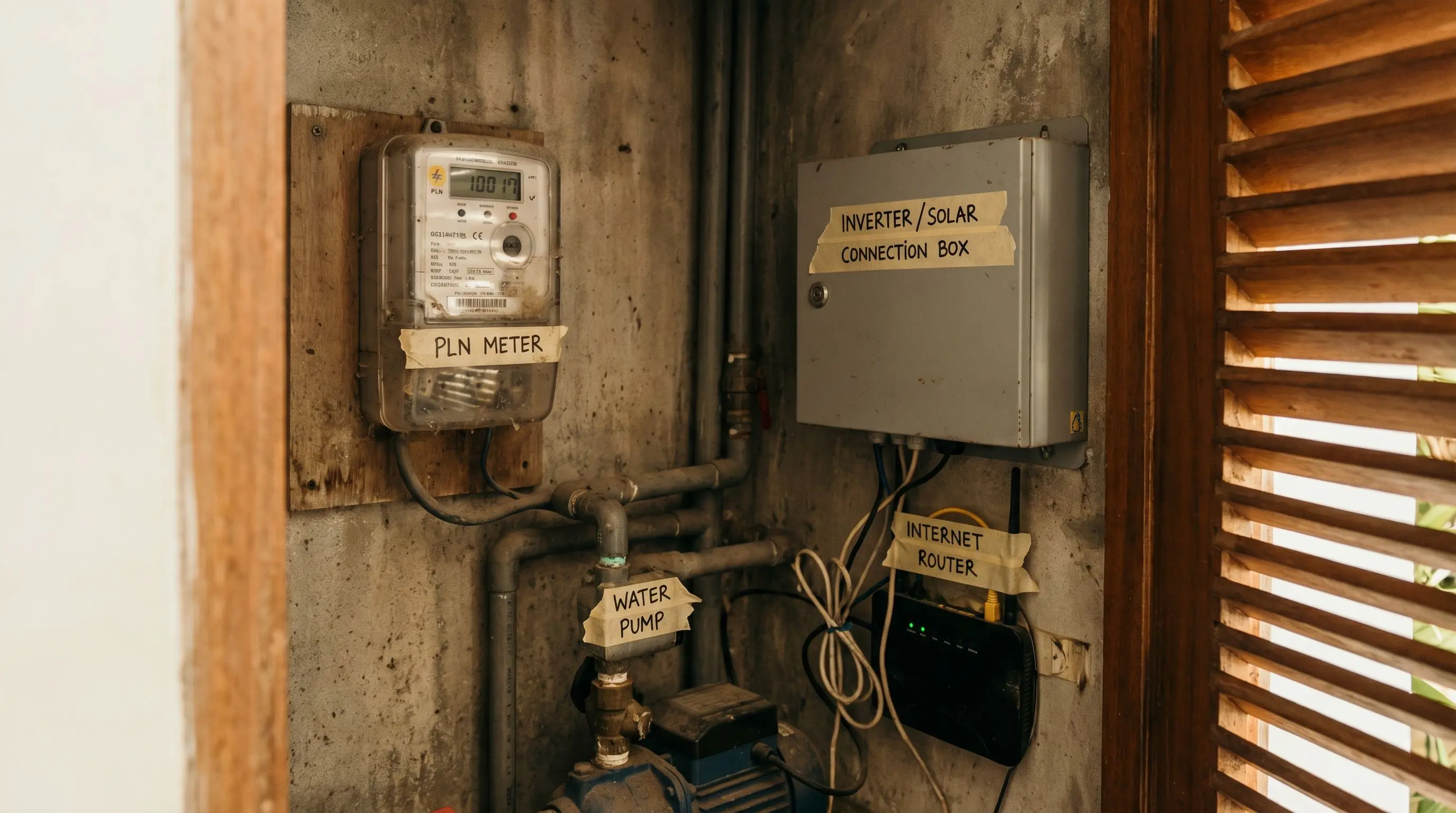
- PLN electricity: a 2-3BR villa with active rental occupancy, 4+ AC units, and pool pump running typically runs IDR 3.5-6.5M per month (USD 220-410); owner-occupied off-peak use commonly drops to IDR 1.5-3M (USD 90-190). Three-phase upgrade from single-phase is increasingly required for villas with 4+ AC units and pool pump, and costs USD 800-2,200 in upfront infrastructure plus a higher daily kWh tariff.
- Water: PDAM municipal supply runs IDR 200-500K per month (USD 13-32) where available. Bore + filtration is more common in Canggu, Pererenan and coastal Bukit; bore-pump electricity and filter cartridge replacement runs USD 30-80 per month.
- Internet: fibre (IndiHome, MyRepublic, Iconnet, Biznet) typically USD 30-60 per month for 100-300 Mbps residential service.
- LPG (cooking gas): 12 kg cylinder costs IDR 220K-300K (USD 14-19) and a typical villa goes through 1-3 cylinders per month.
- Generator fuel (if you have backup): USD 30-80 per month depending on how often PLN trips.
Banjar and customary contributions
This is the line foreign owners most underestimate at purchase. Every Bali village runs a dual structure: desa dinas (administrative village, handles PBB and government affairs) and desa adat (customary village, runs the banjar neighborhood council). OpEx contributions sit on the adat side. The banjar collects regular contributions from residents and property owners; foreign owners running villa rentals are routinely placed in a higher tariff band than local residents or long-term renters, so public-forum quotes from non-rental contexts (IDR 50-200K per month) understate what a Canggu rental villa actually pays. Typical structure for foreign-owned rental villas:
- Monthly iuran banjar (regular dues): IDR 200K-1.5M (USD 13-95) depending on property size, banjar tariff, and visibility of rental operation.
- Ceremonial contributions for Galungan, Kuningan, Nyepi, Odalan (temple anniversary, recurring roughly every 7 months on the 210-day Pawukon calendar), and other major events: IDR 500K-2M per event (USD 32-130), spread across 5-10 events per year. Nyepi (Day of Silence, usually March) shuts down the entire island for 24 hours: no flights, no movement, no lights visible from the street, with pecalang (banjar enforcement) patrolling. Rental guests must be briefed in advance and arrivals or departures rerouted around the date.
- Construction-stage contributions during build or renovation: a one-time payment that can run IDR 5-20M (USD 320-1,300) depending on scope.
- Special collections for banjar hall repair, ceremonial gear, security, or emergency response: typically IDR 100-500K per ad-hoc request.
Annual banjar cost on a Canggu villa typically lands at IDR 8-25M (USD 510-1,600). Foreign owners who skip these contributions damage the relationship with the kelian banjar (council head) and the broader banjar membership, which has practical consequences for permits, security response, and local-issue resolution.
"The kelian banjar came around with a request for IDR 5 million for the Odalan ceremony. Is this a real thing or are they extracting from the foreigner? My villa manager says to pay; I want to understand."
Buyer inquiry, Anteya CRM, 2026
Insurance
Property insurance for Bali villas typically runs 0.15-0.40% of replacement value per year. A villa with USD 600,000 replacement cost runs roughly USD 900-2,400 per year in property coverage. Public liability for guests typically adds USD 200-600 per year. Earthquake and volcanic-event coverage is often a separate rider.
Maintenance reserve
Villas in Bali age fast under tropical humidity, salt spray (coastal sub-markets), and monsoon-cycle water intrusion. A disciplined maintenance reserve is 1.0-1.5% of replacement value per year: USD 6,000-9,000 for a USD 600,000 villa. Common annual line items the reserve covers:
- Roof inspection and re-coating (every 2-3 years)
- Exterior paint refresh (every 3-4 years)
- Termite barrier renewal (every 3-5 years)
- AC service and refrigerant top-up (annual per unit)
- Pool pump and filter replacement (every 4-6 years)
- Bore pump and filtration replacement (every 5-7 years)
- Septic and grease-trap service (semi-annual)
Owners who skip the reserve discover the cost line at year 5-7 when several systems need replacement simultaneously.
Licensing and operational fees
If you operate the villa as a short-term rental through a PT PMA holding KBLI 55193 (villa license), recurring costs include:
- PT PMA annual filings: USD 500-1,200 per year for accountant, tax filings, NPWP renewals, NIB maintenance.
- PT PMA tax compliance: monthly tax filings via accountant, USD 80-200 per month depending on transaction volume.
- Rental-tax remittance: 10% withholding (PPh) on gross rental income; foreign owners should verify withholding mechanics with their accountant.
- License renewals: PBG-related compliance, SLF updates as required.
Property tax (PBB)
Annual Pajak Bumi dan Bangunan (PBB) on a Bali villa typically runs 0.1-0.5% of NJOP (the official assessed value, which is materially below market value). For a Canggu villa with USD 600,000 market value, PBB typically lands at USD 200-800 per year, paid annually around July-September.
The all-in annual OpEx total
Pulling the lines together for a typical foreign-owned 2-3BR Canggu rental villa with full staff structure in 2026:
| Category | Annual USD |
|---|---|
| Staff payroll (base) | 10,800-24,000 |
| THR + BPJS (12-15% Kesehatan-only / 18-20% full registration) | 1,300-4,800 |
| Pool maintenance | 1,100-2,400 |
| Garden and landscape | 1,000-2,500 |
| Utilities | 3,500-6,800 |
| Banjar and ceremonies | 510-1,600 |
| Insurance | 1,100-3,000 |
| Maintenance reserve | 6,000-9,000 |
| PT PMA filings and tax compliance | 1,500-3,800 |
| Property tax (PBB) | 200-800 |
| Total annual OpEx | USD 27,000-57,500 |
That's USD 2,250-4,800 per month, before any one-off interventions. The commonly-cited USD 800-1,500 per month figure that pro-formas use describes a thin staff structure, no maintenance reserve, no PT PMA compliance, and a fortunate year without major intervention. It's the wrong number to underwrite against if you actually own the villa.
Cost differences by sub-market
OpEx varies meaningfully by sub-market:
- Canggu (Berawa, Pererenan, Batu Bolong): staff competition is sharpest around the Berawa-Batu Bolong corridor (Echo Beach, La Brisa, the Jl. Pantai Berawa restaurant strip), where rental-villa density pulls housekeeper and manager wages 15-25% higher than Tabanan or rural Ubud; banjar contributions tend to higher end of range; utilities run higher because rental occupancy is heaviest here.
- Bukit (Uluwatu, Pecatu, Ungasan): wages similar to Canggu; water cost higher due to bore-dependence and salination on coastal plots; PLN brownouts in dry season push some villas to generator dependence.
- Ubud (Penestanan, Sayan, Tegallalang): wages 10-20% lower than Canggu; banjar contributions tend lower; garden cost meaningfully higher due to more intensive tropical landscaping; utilities lower (less AC use due to elevation).
- Tabanan (Kedungu, Selemadeg, Kelating): lowest wage and banjar contribution band; utilities lowest; logistics for materials and maintenance can be slower (suppliers further from site).
"I'm running my villa through a property management company. They quote me 25% of gross rental for full management. Is that competitive or am I overpaying?"
Buyer inquiry, Anteya CRM, 2025
DIY versus property management company
Some owners run staff and operations themselves; many engage a property management company. Typical Bali property management structures in 2026:
- Full management (rental, staff, marketing, maintenance, owner reporting): 20-30% of gross rental revenue. Lower percentages usually mean a thinner service.
- Maintenance-only (no rental management): USD 250-600 per month for routine oversight, contractor coordination, and quarterly inspection reports.
- Hybrid: rental booking and revenue management via OTA (Booking.com, Agoda, Airbnb), with separate maintenance and staff coordination via local manager. Typically 12-18% rental commission plus USD 200-450 per month for ops.
The 20-30% full-management fee comes with real value if the company is competent: they handle THR negotiation, banjar relationship, contractor management, guest disputes, and remit your rental withholding tax. Owners who try to DIY from abroad typically discover within 6-12 months that the management overhead they captured back is offset by quality slippage and crisis-management cost.
Anteya observation: In our 5,300 buyer conversations, owners who switch from DIY-from-abroad to professional management typically do so after a specific incident, not on a calendar. The triggers are usually staff turnover, a major guest complaint, or a banjar issue that the absent owner can't navigate. Building the management relationship before the incident is materially cheaper than building it after.
Practical OpEx discipline
For owners committed to running the villa, the disciplined approach:
- Build a 13-line monthly budget tracker covering each OpEx category, in IDR with USD conversion. Update monthly. The number you didn't see coming is the number you don't track.
- Reserve the THR liability every month rather than absorbing it as a one-time hit. One-twelfth of total annual payroll set aside monthly equals next year's THR.
- Annual maintenance walk-through in October before monsoon, covering roof, gutters, drainage, pool seals, termite barriers, exterior paint.
- Mid-year banjar relationship check with the kelian banjar via your villa manager; resolve any quiet tensions before they become permit or security issues.
- Local PLN, water, and internet redundancy: backup generator with auto-transfer switch, dual-internet failover, water tank with 2-3 day buffer.
- Insurance review annually with replacement value recalculated for construction-cost inflation.
- Staff contracts in Bahasa Indonesia and English, with explicit THR timing, BPJS contributions, and notice periods. Verbal arrangements degrade.
Where to take this next
Bali villa OpEx is the most consistently under-modeled line in foreign-buyer pro-formas. The realistic annual cost for a 2-3BR foreign-owned rental villa in 2026 typically lands at USD 27,000-57,500 once staff, statutory employer contributions, banjar and ceremonial costs, utilities, maintenance reserve, and PT PMA compliance are all included; that's two to four times the commonly-quoted USD 10,000-15,000 figure that surface-level pro-formas use.
The single biggest mistake at the inquiry stage is buyers underwriting yield off the thin OpEx number and discovering the gap in year one. The second is owners managing from abroad without local presence to handle THR timing, banjar relationship, and crisis response. Both are knowable in advance with the right modeling and local-team setup.
This article is general market information, not legal, tax, or investment advice. Indonesian employment law, banjar customary practice, and PT PMA tax compliance vary by location and individual situation. Consult a licensed Indonesian notaris (notary), qualified accountant, and labor-law adviser for your specific operation.
FAQ
What does a 2-3BR Bali villa actually cost to run per year in 2026?
For a foreign-owned 2-3BR Canggu villa with full staff structure operating as a short-term rental, all-in annual OpEx typically lands at USD 27,000-57,500. That covers staff payroll plus THR and BPJS, pool and garden, utilities, banjar contributions, insurance, maintenance reserve, PT PMA compliance, and PBB. The thin USD 10,000-15,000 figure quoted in many pro-formas describes a much lighter structure without reserves or statutory employer costs.
What is THR and do I really have to pay it?
THR (Tunjangan Hari Raya) is a religious-holiday bonus equal to one month's salary, paid at least 7 days before Idul Fitri or the staff member's relevant religious holiday. Required under Indonesian labor law for any staff with 12+ months of service, pro-rated for 1-12 months of service. Most owners pay it as standard; non-payment damages the staff relationship and creates labor-law exposure.
How much should I budget for banjar contributions on a Canggu villa?
Annual banjar cost on a Canggu villa typically lands at IDR 8-25M (USD 510-1,600), covering monthly iuran banjar dues, ceremonial contributions for Galungan, Kuningan, Nyepi and Odalan, and ad-hoc collections. Ubud and Tabanan tend to lower bands; Bukit similar to Canggu. Construction-stage contributions during build or renovation can be a separate IDR 5-20M one-time line.
How much do villa staff cost in Bali in 2026?
Full-time monthly salaries: villa manager USD 300-700, housekeeper USD 200-400, garden and pool staff USD 150-300, night satpam USD 200-350, driver USD 250-450. A typical 3BR rental villa with full staffing carries USD 900-2,000 per month in base payroll, before THR and BPJS add another 12-15% on Kesehatan-only registration or 18-20% on full BPJS registration. Canggu wages run 15-25% higher than Tabanan or rural Ubud.
Is a property management company worth the 20-30% rental fee?
For most foreign owners, yes. A competent management company handles THR negotiation, banjar relationship, contractor management, guest disputes, and rental-tax compliance. The fee feels high until you DIY-from-abroad and absorb the first staff turnover, banjar issue, or guest crisis without local presence. The 20-30% range maps to full management; maintenance-only or hybrid structures are cheaper.
How much does a pool cost to maintain in Bali per month?
A typical 8-12 meter residential pool runs USD 90-200 per month in chemicals plus routine equipment service. Add USD 600-1,500 every 3-5 years for pump and filter replacement, and periodic tile and grout intervention. Tropical plant litter (frangipani, leaves) and monsoon-debris cycles mean daily skimming is essential; without it, a Bali pool turns over in 48 hours during rainy season.
What's the realistic utility bill for a 2-3BR rental villa in Bali?
Annual utilities (PLN electricity, water, internet, LPG, generator fuel) typically run USD 3,500-6,800. PLN electricity is the biggest line at USD 220-410 per month during active rental periods; water USD 13-80 per month depending on PDAM versus bore plus filtration; internet USD 30-60; LPG cooking gas USD 15-60. Three-phase PLN upgrade may be required for villas with 4+ AC units and pool pump.