Anteya Research
Branded Residences in Bali: Marriott, Banyan Tree, Hyatt Buyer Guide
May 23, 2026
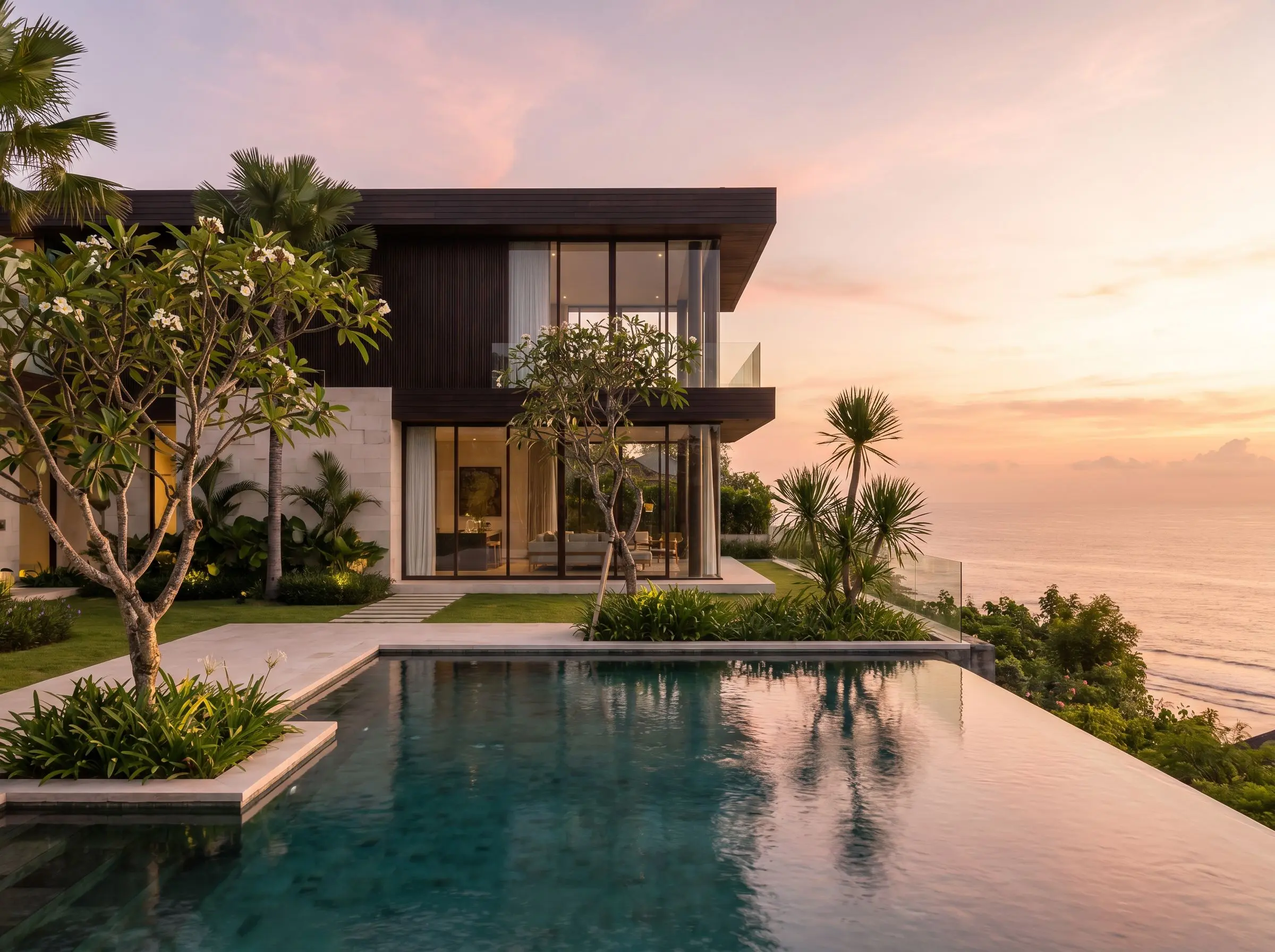
A buyer who walks in asking for a Bulgari villa is not really asking for the building. They want a known operator running the front desk, a brand logo that holds value at exit, and a rental program that doesn't require them to vet a property manager from 8,000 km away. Branded residences price all three into the unit. In Bali by Q1 2026 that premium is roughly 20-40% per square meter over comparable independent product, and the net yield after service fees and operator splits typically lands 4-7% rather than the 8-12% an independent Berawa villa might post.
This guide unpacks where the premium goes, who the meaningful operators in Bali are in 2026, what the rental program actually does to your annual income, and where the resale market thins out fast. Buyers who understand the math walk into the showroom asking the right questions. Buyers who don't end up paying brand rent for service standards they could have arranged independently.
What "branded residence" actually means
The term gets used loosely. In Bali the structure is almost always the same: a residential developer builds the villa product, a hotel operator licenses its brand to that developer, and the operator runs the rental and service program. The buyer owns the villa (through Hak Pakai, leasehold, or PT PMA structure depending on the project), and the operator runs the hospitality layer.
The operator is paid two ways. First, the developer pays a one-time licensing fee and ongoing royalty, which is baked into the per-square-meter price. Second, the operator takes a share of rental revenue, typically 50/50 to 70/30 in the operator's favor, depending on how much capital the operator put in versus pure brand licensing.
Anteya observation: Across our 5,300 buyer conversations 2023-2026, branded-residence inquiries cluster heavily in Bukit and Ubud, with a smaller cohort in Nusa Dua. A meaningful minority of serious buyers (under one in five) asks about a named operator unprompted. The most common operator mentions are Bulgari, Six Senses, Banyan Tree and Mandapa.
There are three sub-types worth distinguishing:
- Full hotel-attached residences. The villa sits inside the resort footprint, shares amenities, and the operator runs both the hotel and the residence. Mandapa Ritz-Carlton Ubud and Apurva Kempinski Nusa Dua sit here.
- Standalone branded residences. No on-site hotel, but the developer pays for the brand and the operator runs the residential rental program from a regional office. Several Hyatt and Marriott projects launched 2024-2026 sit here.
- Concept-branded residences. A lifestyle brand (not a hotel operator) licenses its name to a residential project. Less common in Bali but emerging.
The buyer math is different for each. Full hotel-attached carries the highest premium and the deepest service layer. Standalone branded sits in the middle. Concept-branded sits closer to independent product on yield, with the brand mostly working at resale.
The 2026 Bali landscape
By Q1 2026, the named operators in Bali fall into two categories that buyers routinely conflate at the inquiry stage. The distinction matters: only the first category has units you can actually buy today.
Operators with delivered or actively-marketed branded-residence-for-sale product in Bali (Q1 2026):
- Six Senses Residences Uluwatu (Pecatu): cliff-side, wellness-led, deep rental program integration; entry-level 1BR has historically marketed from around USD 1.25M.
- COMO Uma Canggu (Berawa): the residence and penthouse component is the main exception to the Canggu "independent-only" rule; smaller footprint than Bukit luxury.
- Anantara Ubud Residences (Ubud) and Anantara Dragon Seseh (Seseh, 2027 pipeline): Anantara's actual for-sale branded-residence footprint in Bali, not Uluwatu or Ungasan.
- Soori Estate (Kelating, Tabanan): SCDA-designed architectural villas with a residential-sales history dating back to the Alila Villas Soori era; west-coast positioning; verify current for-sale availability with the developer.
- The St. Regis Bali (Nusa Dua): the Marriott group's longest-delivered Bali presence (since 2008), primarily hotel with a small residential tail; widely referenced by buyers asking about the Marriott portfolio.
Operators that buyers ask about as reference brands but whose Bali footprint is hotel-only or limited residence tail (Q1 2026):
- Bulgari Resort Bali (Pecatu/Uluwatu): ultra-luxury cliff-edge hotel; villa inventory is largely hotel keys with a very small residential tail. More benchmark than transactable.
- Mandapa, A Ritz-Carlton Reserve (Kedewatan/Ubud, on the Ayung river): hotel-attached suite and villa inventory, not sold to individual buyers.
- Banyan Tree Ungasan (Ungasan/Bukit): all-villa hotel resort; branded-residence component is pipeline rather than delivered track record.
- The Apurva Kempinski Bali (Nusa Dua): hotel-attached villa collection; integrated MICE flow; villas operate as hotel inventory.
- Capella Ubud (Keliki/Payangan, north of Ubud town): luxury tented camp format hotel; no for-sale residence inventory.
- Alila (Manggis, Uluwatu, Seminyak, Ubud-area): mature Hyatt-group hotel operator; frequently asked about by Hyatt-portfolio buyers but no delivered branded-residence-for-sale.
- Andaz Bali (Sanur): Hyatt lifestyle hotel; no delivered residential component.
- Six Senses Ubud (Ayung river): second Six Senses site; hotel inventory rather than for-sale residences (the residential offering is Uluwatu-only).
Marriott-group expansion in Bali (Westin, JW, additional St. Regis pipeline) has been discussed publicly for 2026-2028 delivery in Bukit, Ubud and Nusa Dua corridors. Buyers should verify specific project names, brand-license terms and delivery dates directly with the developer; announced-but-unsold pipeline is a different risk class than delivered product, and brand-licensing agreements have collapsed in other Asian markets between announcement and handover.
"We want a Marriott-level brand. The reason we're shopping branded is that I'm in Singapore and my wife is in Sydney. Neither of us has time to manage a Bali villa by ourselves. We need someone to actually run it."
Buyer inquiry, Anteya CRM, 2025
Geographic concentration. Delivered branded-residence product clusters in Pecatu/Uluwatu and Ungasan on the Bukit (cliff-edge premium), along the Ayung river and Payangan north of Ubud town (river/jungle premium), and Nusa Dua (resort integration). Canggu has limited branded-residence supply because the area's planning history (Tibubeneng-area RDTR zoning, banjar land-use dynamics, fragmented sub-2,000 m² plots) favored independent boutique developers; the land cost-to-rental math also didn't pencil for major operators until recently. COMO Uma Canggu in Berawa is the main current exception. Further pipeline has been discussed for 2026-2028 in Berawa-Pererenan, but delivered branded stock remains thin on the central coast as of Q1 2026.
The premium: what you pay for and what you don't
The price-per-square-meter premium on branded residences in Bali typically runs 20-40% over comparable independent product in the same micro-market. For example: an independent 2BR villa at Pererenan-Berawa edge typically prices at USD 3,500-5,500 per m² built, depending on fit-out level and freehold versus leasehold structure. A branded-residence 2BR at Uluwatu in 2026 typically prices at USD 7,000-12,000 per m², though land cost, view, and project density account for a meaningful share of that. Stripping out the location premium, the brand layer itself adds something like 15-30% of the per-m² price.
What the premium buys:
- Operator-grade FF&E specification. Furniture, fittings, kitchen specification, soft goods all chosen to operator standards. Six-figure FF&E kitchen budgets are typical at ultra-luxury operators, well above what a comparable independent build absorbs.
- Architectural and landscape design oversight. The operator's design team reviews and signs off; this typically prevents the worst developer-side cost-cutting at handover.
- Centralized maintenance and engineering. A standing maintenance team handles HVAC, pool, generator, water systems on a maintenance schedule rather than reactive.
- Front-of-house and concierge. Reception, guest services, security operate to operator standards.
- Rental distribution. The villa goes into the operator's reservation system, gets pushed to its loyalty members, sits alongside the hotel inventory.
What the premium does NOT typically buy:
- A guaranteed yield. Brand affiliation does not equal locked-in cash flow. Some projects market fixed-payout windows in years 1-3 to push pre-sales, but these typically come with capital lock-up clauses and are not a long-term yield expectation.
- Capital protection. Brand affiliation does not insulate the unit from market-wide pricing moves or developer-specific completion risk.
- Exit liquidity. Branded resale in Bali is a thinner market than independent resale, not deeper. More on this in the exit section.
"The 25% premium versus an independent villa at Bingin, that I can swallow. What I want to know is whether the operator stays committed to this project for the full 20-year cycle. If Marriott pulls the brand in year 8, what am I left with?"
Buyer inquiry, Anteya CRM, 2026
The rental program: revenue split and the real take-home
This is where the buyer math gets uncomfortable. Headline rental revenue on a branded Bukit villa typically runs USD 800-1,500 per night for 1-2BR formats and USD 1,800-4,500 per night for larger ultra-luxury villa formats, with stabilized occupancy in the 55-70% range across the high/low-season split (the Oct-Apr monsoon period drags the annual average meaningfully below the peak-season figure). That produces a gross room-revenue figure that looks compelling against an independent Canggu villa pricing at USD 250-500 per night.
But the operator takes a share. The typical structure on Bali branded residences in 2026:
- Gross room revenue = total nightly rate × nights × occupancy.
- Less OTA commissions (Booking.com, Expedia, Agoda, direct distribution costs) of typically 15-22% of gross.
- Less operator management fee, typically 8-12% of gross.
- Less F&B and amenity revenue retained by operator, in hotel-attached structures.
- Less villa-level OpEx: housekeeping, linen, in-villa F&B costs, repairs.
What's left, the net operating income at villa level, is then split between owner and operator. Common splits:
- 50/50: owner gets half, operator gets half. Aggressive operator-favored.
- 60/40 owner-favored: more common in standalone branded.
- 70/30 owner-favored: typical for older projects or projects where the developer absorbed more of the brand-license cost.
Anteya observation: In the priced-and-disclosed sample of branded-residence pro-formas we've seen from Bali developers across 2024-2026, the marketed gross yield commonly sits at 8-11% of purchase price. The realized net yield, after all the deductions above, typically sits at 4-7%. Independent villa product in equivalent locations often delivers a higher net yield, with the trade-off being the buyer takes on all management risk personally.
Translated: if you pay USD 1.2M for a branded 2BR and the operator's pro-forma shows USD 110,000 gross annual rental, your realistic take-home (after all deductions and the operator's share) is typically USD 55,000-80,000. That's a 4.5-6.7% net yield. The pro-forma headline of "9% gross" was technically accurate but not what hits your bank account.
"I just signed off on the Six Senses pro-forma but I want to understand: when the OTA commissions and the operator's 12% fee come off the top, what's actually mine? The brochure said 9% but my friend who owns one says he sees more like 5%."
Buyer inquiry, Anteya CRM, 2025
Service charges and ownership cost
Branded residences carry monthly service charges that cover the central maintenance, security, landscaping, common-area engineering, and operator management fee. Typical ranges in Bali by Q1 2026:
- Mid-tier branded (Hyatt, Marriott lifestyle lines): USD 1,500-2,500 per month for a 2BR villa.
- Upper-luxury branded (Banyan Tree, Anantara, Capella, Apurva Kempinski): USD 2,500-4,000 per month.
- Ultra-luxury branded (Bulgari, Six Senses, Mandapa): USD 3,500-5,500 per month, sometimes higher.
These are roughly 3-6x what an independent Canggu villa's OpEx (staff, pool, utilities, banjar, maintenance reserve) typically runs. The trade-off is the owner doesn't have to hire, train, or supervise staff and isn't exposed to staff-turnover risk.
Service charges escalate annually, typically pegged to local CPI plus a delta. Buyers should ask for the operator's service-charge history on existing projects across 3-5 years to see actual escalation versus what was projected in the buyer's-pack pro-forma. In Bali, where many branded projects are first-cycle (operator's first project in the market), there's limited historical data. That uncertainty is itself a risk.
Exit: where the resale market thins fast
The single most underestimated buyer-side issue with branded residences is the exit. The resale market for branded residences in Bali is structurally thinner than for independent villas, for several reasons:
- Brand-licensing cycle risk. Most operator licensing agreements run 15-30 years. If the brand exits, doesn't renew, or downgrades the project to a lower-tier flag, the resale value drops materially.
- Buyer pool concentration. The branded buyer is a specific cohort: international, premium-budget, often passive-investor. That cohort is smaller than the general Bali buyer pool and can disappear quickly during a soft cycle.
- Service-charge drag at resale. A prospective buyer who underwrites the unit at exit sees the same USD 3,500-month service charge, which depresses the cap-rate math.
- Operator-control on resale. Some branded-residence purchase contracts give the operator a right of first refusal or restrict who the unit can be sold to. Read the SPA carefully here.
The general guidance from sale data on mature branded markets (Phuket, Dubai, Mexico) is that branded residences resell at a discount to original purchase price more often than independent product in equivalent locations during the first 5-7 years, then catch up if the brand affiliation holds. In Bali, with most branded supply being first-cycle, this dynamic is largely untested at scale.
Anteya observation: In our 5,300 buyer conversations, the proportion of buyers asking explicitly about branded-residence resale liquidity is markedly higher in 2025-2026 than in 2023-2024. The cohort has gotten more sophisticated. Sellers of branded units who try to exit in years 2-5 typically tell us they expected the brand to lift resale demand and instead found a smaller buyer pool than they'd anticipated.
"My agent is telling me to buy off-plan at the new Banyan Tree project. I'd hold it for 7 years, then sell. What I can't get a straight answer on is who buys it from me in year 7. Is the resale market the same as Canggu villas or is it thinner?"
Buyer inquiry, Anteya CRM, 2026
Who branded residences actually fit
Stripping all the brochure copy away, the buyer profile where branded residences make sense:
- Non-resident, time-poor buyer who values not having to vet and manage a property manager from abroad. The operator handles everything; the buyer's involvement is signing the annual statement.
- Brand-affinity buyer who wants to use the unit themselves 4-8 weeks per year and prefers the social and service environment of a branded property. The unit is partly a lifestyle purchase, partly a yield play.
- Estate-planning buyer who values the recognizability of the brand for succession or eventual sale by heirs. The brand label provides a known anchor that simplifies the future heir's exit conversation.
- First-time Bali buyer who is uncomfortable with the legal, contractual, and operational complexity of independent villa ownership and is willing to pay the brand premium for a "ready-made" experience.
The buyer profile where branded residences typically do NOT fit:
- Yield-maximising buyer. Independent product in Berawa, Pererenan, or Cemagi will typically out-yield branded on a net basis for the same capital outlay, with the trade-off being operational complexity.
- Resident or near-resident buyer who plans to be in Bali 4-6 months per year and values flexibility, custom interiors, and personal staff management.
- Short-hold buyer (less than 5 years) who is exposed to the thin-resale-liquidity issue most acutely.
For buyers in the middle, the genuine question is: how much is operator-managed-without-the-headache worth to you in dollar terms, and how does that compare to the 200-400 basis points of net yield you give up? Both numbers are knowable in advance. The conversation should happen at the pro-forma stage, not at handover.
Practical due diligence before signing
When evaluating a specific branded-residence project in Bali, ask for and verify:
- The actual brand-licensing agreement. Get the redacted version that names the operator, the license period, renewal terms, and termination triggers. If the developer refuses to share, treat that as a flag.
- Operator's actual investment in the project. Is the operator a pure licensor (brand only) or does the operator have hospitality-management commitment (running the rental program, staffing the front desk)? The two are very different.
- Historical service-charge data from the operator's other Bali, Phuket, or Bangkok projects. Three-to-five-year actual versus projected.
- The rental program structure, including operator share, OTA commission flow, owner blackout dates, and any guaranteed-return provisions with their lock-up terms.
- Resale restrictions in the SPA: operator right of first refusal, brand-approval of new buyers, restrictions on selling to non-operator-managed pool.
- The Indonesian legal structure for foreign-buyer ownership: Hak Pakai (right-of-use, individual foreign-name title), Hak Sewa (lease right registered against an underlying SHM or SHGB held by an Indonesian counterparty), or beneficial ownership through a PT PMA that holds SHGB title. Each has different exit, tax, and succession implications.
- Developer track record independently of the brand. The operator is licensing the brand; the developer is building and delivering. A branded sticker on a weak developer is still a weak delivery risk.
Where to take this next
Branded residences in Bali are a defensible product for a specific buyer cohort. The math works for time-poor international buyers who value brand-anchored exit and hands-off ownership, and who can absorb a 200-400 bps net-yield concession for that. For yield-first buyers, independent product in the same micro-market typically delivers more cash on a comparable capital outlay.
The single biggest mistake we see at the inquiry stage is buyers underwriting the operator's gross-yield pro-forma without modeling the full deduction stack to net take-home. The second is underestimating the resale-cycle risk when the brand license comes up for renewal. Both are knowable in advance with the right contractual review.
This article is general market information, not legal, tax, or investment advice. Indonesian real-estate rules and brand-licensing arrangements vary by project, and individual situations differ. Consult a licensed Indonesian notaris (notary) and qualified tax adviser for your specific purchase.
FAQ
Are branded residences a better investment than independent villas in Bali?
It depends on what you're optimizing for. On net yield, independent product in Berawa, Pererenan or Cemagi typically out-performs branded by 200-400 basis points. On hands-off ownership and resale recognizability of the brand, branded wins. The honest answer is that "better investment" is the wrong frame; they're different products with different risk-return profiles.
What's the actual net yield I should expect on a branded residence in Bali?
For ultra-luxury branded (Bulgari, Six Senses) and luxury branded (Banyan Tree, Anantara), realistic net yields after all operator splits, OTA commissions, and service charges typically land in the 4-7% range. The marketed gross yields of 8-11% rarely translate into that level of take-home cash flow.
Do I have to put my villa into the rental program?
Most branded-residence contracts in Bali require participation in the operator's rental program for a minimum period (typically 5-10 years) with limited owner-use blackout windows (typically 4-8 weeks per year). Some allow opt-out but charge a higher service fee. Read the rental management agreement carefully before signing the SPA.
Can foreigners own branded residences in Bali?
Yes, through the same legal structures that apply to all Bali property: Hak Pakai certificates for individual ownership, Hak Sewa (lease right registered against an underlying Indonesian title), or beneficial ownership through a PT PMA holding SHGB. The branded label does not change the underlying legal options. The SPA should be reviewed by a notaris (notary) independent of the developer.
What happens if the brand exits the project?
Most licensing agreements have termination provisions. If the operator exits during the license period due to operator-side reasons, there are usually contractual remedies. If the license simply expires (typically year 20-30), the developer may renew with the same operator, switch to a different brand, or de-brand. Unit owners are typically affected at resale value rather than at use-rights.
How much capital do I need to enter the branded-residence market in Bali?
Entry tickets vary widely. Smaller-format branded (1BR or studio units) at mid-tier operators can start around USD 600,000-900,000. Six Senses Uluwatu Residences 1BR has historically marketed from around USD 1.25M. Ultra-luxury branded villas typically start at USD 2.5M and run to USD 8-15M for larger formats with prime cliff or river positions.
Is branded residence ownership treated differently for Indonesian tax?
The villa itself is taxed the same as any Indonesian property of equivalent value: annual Pajak Bumi dan Bangunan (PBB), and Bea Perolehan Hak atas Tanah dan Bangunan (BPHTB) at transfer. The operator-fee and rental-revenue flow has tax implications at both Indonesian and home-country level. Get specific tax advice for your residency situation before signing.