Anteya Research
Bali vs Sumba, Lombok, Nusa Penida: Indonesian Islands Compared
June 7, 2026
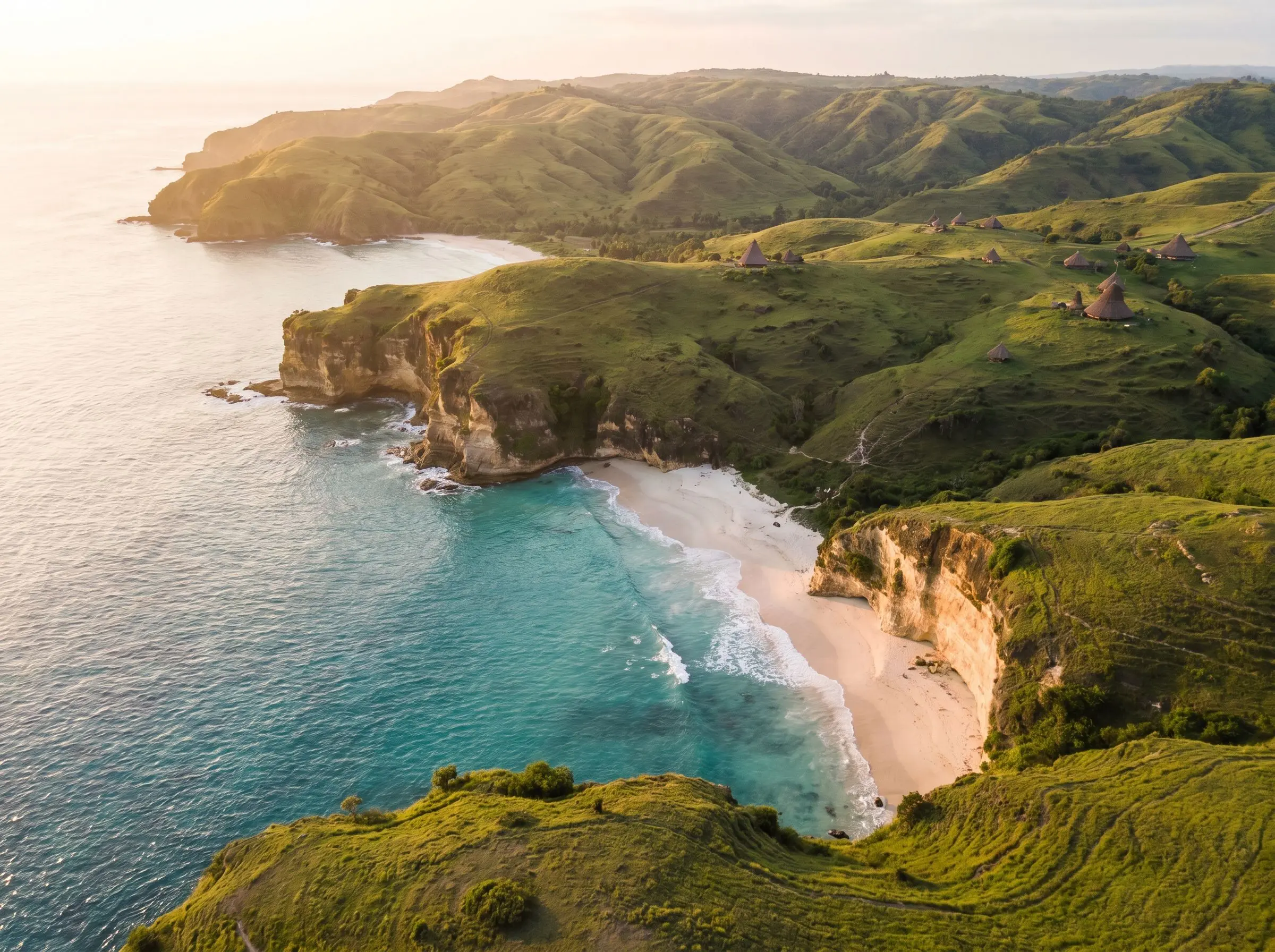
A buyer who lands on a Bali villa pro-forma and quotes 8% net is implicitly comparing Bali against nothing. There is no second Indonesian option in their head. But Indonesia has 17,000-plus islands, and 5 to 7 of them now have credible foreign-buyer hospitality real estate: Sumba luxury safari, Lombok and the Gilis for surf, Sumatra around Lake Toba, the Nusa Penida cliffs, and Belitung at the emerging edge. None of them replace Bali. Each lives in a different risk-return cell, and buyers seriously evaluating "beyond Bali" should understand that cell before they commit a deposit. This article walks the five alternatives, the connectivity that decides everything, the legal layer that does not change, and where each route genuinely wins.
The decision matrix that actually matters
When a buyer asks "should I look at Sumba instead of Bali?", the productive answer is not a feature list. It is a comparison across six variables that decide outcome.
Connectivity. Bali has roughly 35 to 40 direct international routes. Lombok has a growing direct list from KL, Singapore, and seasonal European charters into Mandalika. Sumba has two airports (Tambolaka for the west, Waingapu for the east), with 3 to 5 daily Denpasar flights between them, mostly ATR turboprops, around 75 minutes, weather-cancellable in the Nov-March wet season. Sumatra's Silangit-Toba airport added domestic capacity in 2022-2024 but international remains a Jakarta or KL transit. Nusa Penida has no airport; it is 30 to 45 minutes by fast boat from Sanur. Belitung sees domestic flights from Jakarta.
Land prices per are (100 m²). Coastal Bali sits roughly at $15,000 to $40,000 per are in the hot belts and higher in Bingin or Uluwatu cliffs. Coastal Lombok runs roughly $5,000 to $15,000. Sumba entry-level coastal is $2,000 to $3,000, with the Nihi belt higher. Nusa Penida is $8,000 to $20,000 with sharp cliff premiums. Sumatra around Lake Toba runs lower, often a few hundred dollars per are inland.
Infrastructure readiness. PLN main-grid coverage, drilled water sources, fibre internet, road quality, and waste management vary by regency far more than buyers expect. Bali is the comparison baseline; everything else is thinner.
Operator base. Bali has a deep bench of property managers, F&B operators, trained service staff, English-speaking maintenance contractors. Lombok is shallower but real. Sumba and Sumatra are sparse; you import or train.
Legal regime. Identical across all Indonesian islands. Hak Pakai (right of use), leasehold via Hak Sewa, PT PMA with KBLI 55130 (Pondok Wisata, the homestay/villa code commonly used by foreign-investor PT PMA structures, since the 55193 code is UMKM-restricted) villa licensing, the BPHTB transfer tax. The law does not change at the provincial border.
Exit liquidity. Bali has a functioning secondary market with thousands of resale listings on local platforms. Lombok-Gili has a thin but existing one. Sumba, Sumatra, and Nusa Penida have almost no resale depth today; you exit by finding a single buyer through brokers, not a market.
"We loved Sumba on our holiday. If we built a villa there, who would actually buy it from us in seven years?"
Buyer inquiry, Anteya CRM, 2026
Sumba
Sumba is the flagship example of "vision real estate" in Indonesia. The pull is genuine: empty beaches, dramatic limestone hills, a Marapu animist culture that has not been packaged, surf breaks like Occy's Left and Miller's. Nihi Sumba, the resort that put the island on the global luxury map, anchors the south-west coast (Sumba Barat regency, roughly an hour from Tambolaka airport) at the high end.
Land prices reflect the lack of competing demand. Coastal are prices on the south and west coasts sit roughly $2,000 to $3,000 in the entry-level belt; near Nihi or in the small handful of operator-led estates, prices step up but remain a fraction of Canggu equivalents. A 30-are coastal parcel at $2,500 per are is $75,000, an order of magnitude below comparable Bali coordinates.
Then the friction starts. Build cycles run 18 months minimum. Skilled contractors are scarce; many villas import a foreman from Bali or Java. Materials are barged in. PLN coverage is patchy outside small clusters; most luxury villas run hybrid solar plus diesel generator. Water is drilled or trucked. Internet works but is not redundant.
The bigger structural issue is exit. There is no functioning secondary villa market on Sumba in 2026. If you buy land, build a $1.5M villa, and want to sell in five years, you are essentially fishing for one other buyer with a similar vision; you cannot list on the Bali resale stack and expect comparable engagement. Rental yields exist but are highly operator-dependent; without a Nihi-tier brand or a competent boutique manager, occupancy is unreliable.
Anteya observation: Across buyer conversations that mention non-Bali islands, the typical Sumba inquiry is from a high-net-worth lifestyle buyer who is not relying on the property for yield, and treats the eventual exit as a known unknown. The buyers who run a yield-driven pro-forma usually self-select out within two conversations.
The honest framing: Sumba is for buyers who want the property to be the asset and the lifestyle the return. Treat any rental income as upside, not the base case.
Lombok and the Gilis
Lombok is the closest substitute to Bali on the variables most yield-driven buyers care about. It has a working international airport at Praya (Mandalika), direct connections from Kuala Lumpur and Singapore, the MotoGP circuit at Mandalika that drives an annual demand spike, and three established tourism nodes: Senggigi on the west coast, Kuta Lombok in the south, and the Gili Islands (Trawangan, Air, Meno) off the north-west coast.
Coastal land prices in 2026 run roughly $5,000 to $15,000 per are in active belts, with Gili Trawangan beachfront higher and Gili Meno still discounted. Build costs sit modestly below Bali; the labor pool is shallower but functional, and many established Bali contractors now operate Lombok divisions.
The yield math is honestly different, not just cheaper. Average daily rates (ADR) in Kuta Lombok villa segments run 30% to 40% below comparable Canggu or Uluwatu villas. Occupancy is more seasonal: peak July-August and December-January, deep low season April-May and October-November. A Lombok villa pro-forma that pencils 10% gross frequently lands at 5% to 7% net after the lower-ADR reality and the longer marketing cycle for the off-peak months.
The Gilis have their own structural caveat: no motorised transport on any of the three Gilis (Trawangan, Air, Meno; cidomo horse-cart only); PLN reaches all three via the 2017-2018 undersea cable from Lombok mainland but outages are frequent; freshwater leans on rain catchment plus reverse-osmosis desalination, particularly on Trawangan. These constraints make construction expensive per square meter and limit unit size.
Mount Rinjani has been quiet since 2015-2016 but is continuously monitored; the 2024-2025 ash disruptions to Praya came from Mount Lewotobi on neighbouring Flores. Operators price volcanic risk in as a long-term reality regardless of the specific volcano.
"We're between a Canggu off-plan and a Kuta Lombok villa. Same budget, different yield story. Which actually nets more after five years?"
Buyer inquiry, Anteya CRM, 2026
For yield-driven buyers willing to trade ADR depth for entry-price relief, Lombok is the most honest "alternative Bali" route. For lifestyle buyers, it competes well on uncrowded beaches and surf. For speculative land plays, the Mandalika belt has plausible upside if the MotoGP-anchored tourism plan keeps executing.
Sumatra (Lake Toba, Aceh, Padang)
Sumatra is a different conversation entirely. The island is enormous, demographically and economically the second pillar of Indonesia after Java, and the foreign hospitality real estate footprint is still narrow.
Lake Toba is the centrepiece of the government's KEK (Kawasan Ekonomi Khusus, Special Economic Zone) push, with infrastructure investment around Silangit-Toba airport and the road system to the lake. The aesthetic is unlike Bali: a 100-kilometre crater lake at 900 meters elevation, Batak culture and architecture, cooler climate, almost no beach-tourism overlay.
Aceh in the north has surf points (Lhoknga, Lampuuk) that generate some niche interest, but Aceh's local qanun (sharia-derived regional bylaws) layer over national law creates additional friction around mixed-use hospitality. Padang and the Mentawai chain are surf-driven; the Mentawais themselves have boutique surf-camp investment but are operationally remote.
For foreign property buyers, Sumatra in 2026 is largely a niche play: retirement, second-home for buyers with a personal connection, or boutique surf-camp operators. Resale market depth is minimal. The land is cheap; the operator ecosystem is not yet there. A Lake Toba villa today is a 7-to-10-year position, not a 3-year flip.
Nusa Penida
Nusa Penida is the most-discussed Bali alternative in 2026 buyer conversations, because it is geographically the closest: 30 to 45 minutes by fast boat from Sanur, visible from Bali's east coast. Day-trip tourism is enormous; the Kelingking cliff, Angel's Billabong, and Diamond Beach pull massive Instagram-driven volume.
The investment thesis is straightforward: Penida has the photographable coastline that Bali's east coast lost, the price gap is still wide, and the build-out is accelerating. The catch is everything else.
PLN main-grid coverage on Penida is partial. Large areas of the centre and west of the island run on solar-plus-generator hybrid, with diesel reliability dependent on the boat schedule. Water is drilled and frequently saline; villas use reverse-osmosis filtration. Roads are narrow and steep; logistics for building materials add 20% to 30% to construction cost compared with Bali baselines. There is no airport; everything moves by boat from Sanur or Padangbai.
Land prices in 2026 run roughly $8,000 to $20,000 per are with sharp cliff premiums; truly clifftop parcels with sea view trade higher when they trade at all. The build wave from 2024 to 2026 has been heavy: small boutique villas, hostel-villa hybrids, and several mid-tier resorts.
The speculation argument: if Penida gets a regular ferry upgrade or a small airport in the next decade, land appreciation could be 3x to 5x off current coordinates. The counter-argument: the island has fragile water, the regency's daily-rental regulatory posture is still being formed, and a flood of supply between 2024 and 2027 will pressure ADR for the operators building today.
"Honestly, is Nusa Penida just a cheaper Bali, or is it a different product? Because the pictures look the same."
Buyer inquiry, Anteya CRM, 2026
The honest framing: Penida is a speculative land position with a hospitality-yield wrapper. It is not "cheaper Bali" because the operating reality is materially harder. Buyers who treat it as a land call with optionality on connectivity catch the thesis; buyers who treat it as a Canggu clone get disappointed by occupancy in year two.
Belitung and the Java side
Belitung, east of Sumatra and off the south-east tip of the Bangka peninsula, has emerged in the last few years as a quiet alternative for buyers who specifically want low tourism volume and granite-boulder beach aesthetics. Belitung's regional positioning as Negeri Laskar Pelangi (Land of the Rainbow Warriors, after the famous Indonesian film) and its 100-plus surrounding granite-boulder islets signals the positioning: small-island boutique, not a Bali clone. Direct domestic flights from Jakarta. Foreign investor interest is real but small; resale depth is minimal.
On the Java side, the conversation is different. Yogyakarta, the cultural-heritage centre, has a premium-tier hospitality market anchored by the Borobudur and Prambanan UNESCO sites and a creative-economy buyer base. Land near the south coast (Parangtritis, Krakal) sees some villa interest. Bureaucracy at the provincial and regency level is heavier than Bali; PT PMA establishment runs the same statutory path but local processing tempo varies. Bandung and the highlands serve a domestic weekend market that does not pull foreign yield investment.
For most foreign buyers asking "what about Java?", the realistic answer is: lifestyle and cultural-investment yes, hospitality yield no. The economics work in Bali and Lombok; in Java they work for hotels at scale, not for individual villa pro-formas.
The legal-tax overlay that doesn't change
A common misconception is that the rules vary by island. They do not. Indonesian agrarian law and the foreign-ownership framework operate at the national level.
Hak Pakai (right of use, the standard foreign-individual title) requires a KITAS or KITAP and follows the same multi-year-with-extension structure on Sumba or Lombok as it does in Bali. Leasehold via Hak Sewa runs as a private contract anywhere in Indonesia, typically 25 to 30 years with negotiated extension, and the contractual nature of the extension does not change between provinces. PT PMA (foreign-investment company) establishment follows the same OSS (Online Single Submission) workflow, and the KBLI 55130 villa-accommodation business code is the same code in Aceh as in Badung. BPHTB transfer tax sits at the same statutory rate countrywide, though valuation (NJOP) varies sharply by regency.
What does vary is the practical layer: notaris (notary) quality, English-language capacity, processing tempo, BPN (land registry) backlog, and the local regency's posture on daily-rental permits. Bali's Badung and Gianyar regencies have a deep bench of notaris with foreign-buyer experience. Sumba, Sumatra, and Belitung have far fewer English-speaking notaris with this specific transaction practice; many transactions in those provinces route through a Bali or Jakarta-based notaris coordinating with a local counterpart, which adds time and cost.
The takeaway: the law does not penalise you for going beyond Bali. The execution friction does. Budget extra weeks and an extra retainer for legal coordination if you are buying on Sumba, in Sumatra, or on a smaller Java island.
When each route actually wins
Sumba wins for the vision buyer. If the property is a personal asset, the rental income is upside, and a 5-to-10-year hold is acceptable, Sumba offers entry economics no part of Bali can match. The buyer profile is someone with other liquid wealth, a real reason to want to be on this specific island, and patience for the operational thinness.
Lombok wins for the yield buyer who wants Bali-adjacent at 30% to 40% lower entry. If the pro-forma can absorb an ADR step-down and a longer marketing season, Lombok delivers honest numbers. Mandalika-belt land speculation is a separate, higher-risk overlay for buyers comfortable with infrastructure-execution risk.
Sumatra wins for niche and retirement. Lake Toba is a different climate, different culture, different rhythm. The buyer is not optimizing for yield. Resale will be slow; the build is the destination.
Nusa Penida wins for speculative land with hospitality optionality. The buyer is making a connectivity bet, not buying into a stable yield market. If ferries upgrade and infrastructure catches up, the appreciation thesis works. If not, the operational reality is harder than Bali on every variable that matters.
Belitung and Java side win for narrow profiles only. Belitung for low-volume boutique seekers; Yogyakarta for cultural-investment buyers. Neither is a yield play.
Anteya observation: In typical buyer conversations, around four out of five non-Bali inquiries either return to Bali within the same decision cycle, or remain non-Bali curious without converting. The conversion that does happen on Sumba and Lombok tends to come from buyers with a personal connection to the island, not from buyers comparing options on yield spreadsheets alone.
The pattern is not "Bali is always better." It is "Bali is the easier execution path on every operational variable, so non-Bali only makes sense when the buyer has a non-yield reason to be there, or is making a deliberate speculative bet."
Practical due diligence for non-Bali purchases
Five things to verify before depositing on any non-Bali Indonesian property:
Local notaris. Confirm the notaris is licensed in the specific regency where the land sits (not just nationally), and has executed at least 5 to 10 foreign-buyer transactions in that regency. Ask for redacted reference checks. A Bali-registered notaris-PPAT cannot sign a Sumba parcel; PPAT working areas are province- and regency-specific, so cross-province transactions require local appointment or coordination.
Flight or boat connectivity. Verify the actual schedule, not the marketing schedule. Pull the live booking system for the next 90 days. Check weather-cancellation history with the operator if you can.
PLN coverage map. Ask the seller for the PLN service confirmation in writing, and the historical outage log if available. Solar-plus-generator is a different operating model than grid-connected; price it in.
Water source. Drilled well, municipal, or trucked. Confirm yield in litres per day at the dry-season minimum, not the wet-season maximum. Saline intrusion is a real issue on small islands.
Daily-rental regulatory posture. Each regency interprets the national hospitality KBLI framework and IMB/PBG rules slightly differently. Confirm with the regency tourism office that the parcel's zoning supports daily rental, and get this in writing. This is not a Bali-only check; it matters more on islands where the rules are still hardening.
Closing
The decision to look beyond Bali is not a mistake. It is a real conversation for the right buyer profile. The mistake is treating Sumba, Lombok, Sumatra, Penida, or Belitung as substitutable for Bali on yield economics. They are not. Each is a different product with a different risk-return profile, a different execution cost, and a different exit story.
The buyers who do well on non-Bali tend to share three traits: they have a non-yield reason to be on the specific island, they budget for higher operational and legal friction, and they accept that exit liquidity is a slow process rather than a public market.
This article is general information, not legal or investment advice. Indonesian real-estate rules and regional infrastructure conditions change. Consult a licensed Indonesian notaris in the relevant regency for any specific purchase.
FAQ
Is buying property in Sumba a real option in 2026?
Yes, for a specific buyer profile. PT PMA structuring typically routes through Bali or Jakarta counsel; the land deed itself must be signed by an NTT-licensed PPAT in the parcel's regency. Sumba has a small hospitality stack anchored by Nihi. It is not a yield-driven market. Treat it as a 5-to-10-year personal-asset position with rental income as upside. Exit liquidity is thin; plan for a single-buyer sale.
How much does a Lombok villa cost compared to Bali?
Coastal Lombok land runs roughly $5,000 to $15,000 per are in active belts, against Bali's $15,000 to $40,000-plus. Build costs sit modestly below Bali. The yield gap is real, not just cosmetic: average daily rates in Kuta Lombok villas run 30% to 40% below comparable Canggu or Uluwatu villas, and occupancy is more seasonal. Net yields typically land 5% to 7% versus Bali's 6% to 9% in honest pro-formas.
Is Nusa Penida a smart land speculation play?
Possibly, for buyers comfortable with infrastructure-execution risk. The thesis: cliff coastline, photogenic, 30 to 45 minutes from Sanur, future ferry or airport upgrade. The counter: heavy 2024-2026 build pressure on operator yields, fragile water, partial PLN grid, evolving regency rental rules. Treat Penida as a land call with hospitality optionality, not a stable yield market. A 5-to-7-year hold horizon is more realistic than a 2-to-3-year flip.
What about Lake Toba and Sumatra for foreign buyers?
Lake Toba sits inside a government KEK push with new airport capacity at Silangit-Toba. The aesthetic is highland-crater-lake, not beach. For foreign buyers, Sumatra is largely a niche play: retirement, personal-connection second home, or boutique surf-camp operators in Aceh and the Mentawais. Resale depth is minimal; operator ecosystem is thin. Land is cheap, but a Lake Toba villa today is a 7-to-10-year position, not a flip.
Do the same Indonesian foreign-ownership rules apply outside Bali?
Yes. Indonesian agrarian law and foreign-ownership rules operate at the national level. Hak Pakai, leasehold via Hak Sewa, PT PMA with KBLI 55130, and BPHTB transfer tax all work the same on Sumba or Sumatra as on Bali. What varies is the practical layer: notaris availability, English-language capacity, BPN registry tempo, and how each regency interprets daily-rental permits. Budget extra time and coordination outside Bali.
Where can I get the highest ROI: Lombok, Bali or Nusa Penida?
For yield-driven base-case pro-formas, Bali still produces the deepest distribution of honest net yields, because the operator base and resale market are mature. Lombok offers lower entry with lower ADR; the ratio can work for the right asset. Penida is a speculative land play with hospitality wrapped around it, not a yield market. Highest expected ROI depends on whether you are buying for yield (Bali, then Lombok) or land appreciation (Penida).
Which alternative island has the easiest legal and notaris infrastructure?
Lombok. It has the deepest bench of notaris with foreign-buyer transaction experience outside Bali, partially because Mandalika and the Gilis have drawn enough foreign capital to support specialist practice. Sumba and Sumatra typically route through Bali or Jakarta notaris coordinating with a local counterpart, which adds weeks and cost. Nusa Penida transactions usually use Bali-based notaris because the parcel sits inside a Bali-administered regency (Klungkung).
Anteya Research is the editorial function of Anteya Real Estate, a Bali-based investment property advisory. This article reflects patterns across buyer conversations logged in the Anteya CRM between 2023 and 2026, supplemented by first-hand observations from our Bali-based team.