Anteya Research
Customizing an Off-Plan Bali Villa: What You Can Actually Change
June 5, 2026
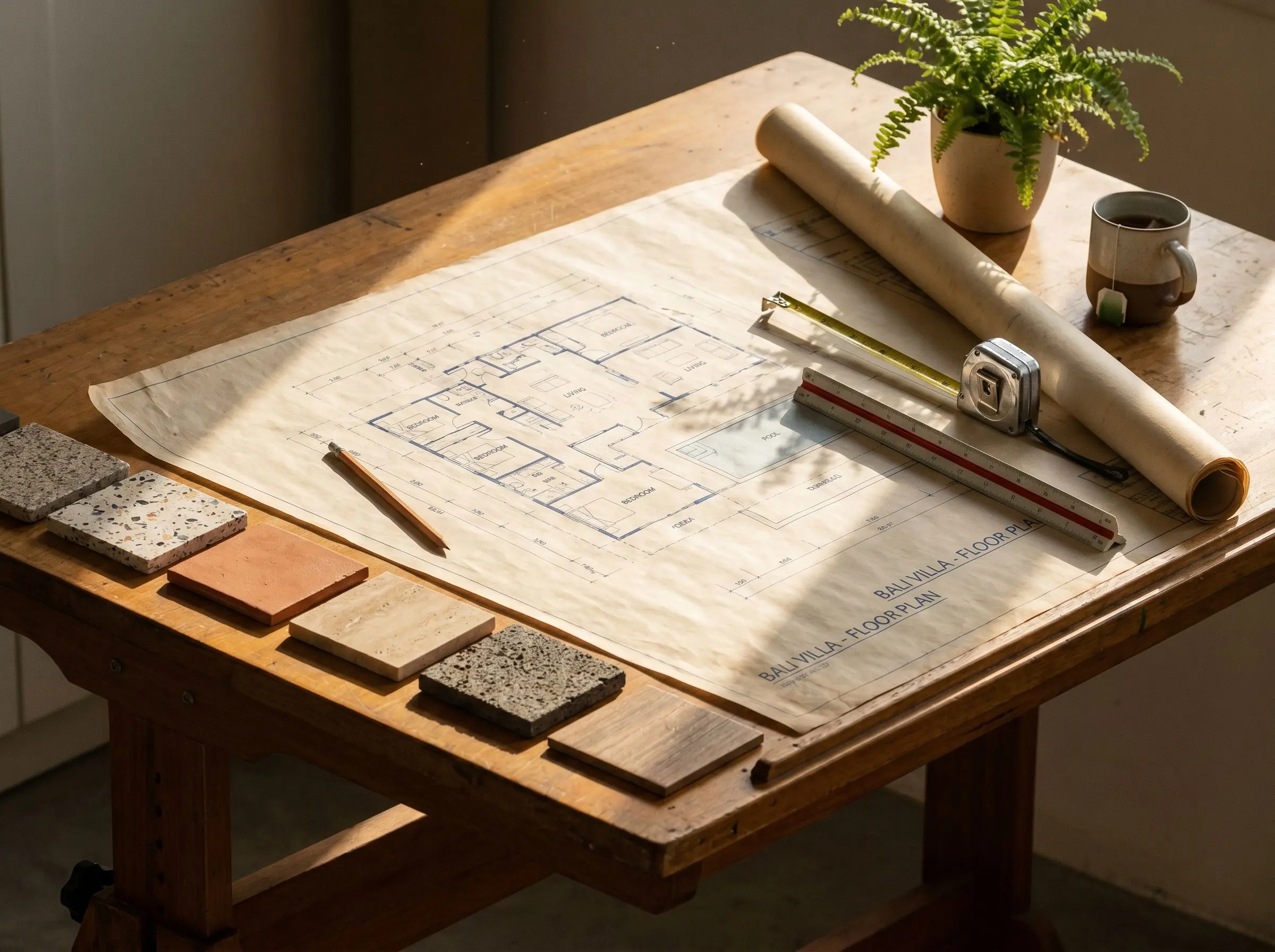
Across 5,308 buyer conversations Anteya logged with Bali buyers between 2023 and 2026, roughly 78% touched off-plan handover at some point, and a smaller but persistent slice asked the question competitors avoid: can the unit actually be changed? Buyers expect off-plan to behave like custom architecture. Reality is closer to "configurable, not custom" and the configuration window closes faster than most foreign buyers realize. This article walks through what a Bali developer will genuinely change, what is locked from day one, and the cost and timing mechanics that decide which conversation you can still have.
A typical inquiry sounds like this:
"Can I make the two bedroom model into a three bedroom having the third bedroom on the first floor because it's more open with glass I like that style? Do they furnish it?"
Buyer inquiry, Anteya CRM, 2025
That single message contains four separate customization questions: changing the unit count, relocating a bedroom, altering the facade glazing, and confirming the furniture package. Each one sits in a different category of negotiable, and each one has a different deadline. The rest of this piece is how Anteya's team triages them on real deals.
The customization spectrum
Customization requests on a Bali off-plan villa fall into four bands. Knowing which band a request belongs to is the difference between a productive conversation with the developer and a polite refusal.
Locked from day one. The plot boundary, foundation type, building footprint, total floor count, roof structure, external facade, and any common-area design (shared lobby, shared pool, shared driveway in a clustered project) are fixed at the point the developer applied for the PBG (the Indonesian building permit that replaced the older IMB regime). Changing any of these means re-submitting the permit, which a developer will almost never accept on a single unit because it slows the entire project.
Semi-negotiable. Interior partition walls, window and door dimensions, kitchen layout orientation (left-handed vs right-handed counter run), private pool dimensions inside your plot, and the position of internal staircases. These can move within limits but require the developer's structural engineer to sign off and usually carry an extra cost.
Open by default. The FF&E package (furniture, fixtures, and equipment), the finish tier inside the developer's pre-priced range, the color palette, the kitchen splashback, bathroom tile, hardware finishes, and paint colors. These are not just negotiable; the developer usually expects you to choose.
Buyer-pays-extra. Premium brand swaps, custom-fabricated joinery, imported sanitaryware, upgraded air-conditioning units, smart-home pre-wiring, and any pool equipment beyond the standard skimmer-and-pump baseline.
The single most common mistake foreign buyers make is treating band two (semi-negotiable) as if it were band three (open). A developer will let you choose between three tile palettes for free. Moving a wall on the ground floor is a different conversation and a different invoice.
The timing window
A request that costs USD 3,000 at reservation can cost USD 30,000 six months later, or be flat-out impossible. The deadline depends on where the project is in its construction cycle.
Pre-sale and reservation stage. Maximum flexibility. The developer wants the unit off their books and is willing to entertain structural variations because the foundation has not been poured. Almost any band-two change is on the table at this stage; some band-one changes can even be negotiated if the developer has not yet locked the PBG.
Phase one: foundation. Once the foundation is poured (typically four to six weeks after construction start), structural changes become expensive and slow. Adding load above a beam that was not designed for it requires structural recalculation and reinforcement, which adds roughly 10 to 25% on top of the base change cost.
Phase two: wall framing and roof. Partition walls can still move; structural and exterior changes are locked. This is the last window for moving doors, resizing windows, or repositioning a bathroom.
Phase three: finishing. Only FF&E, finishes, paint, tile selection, and fixtures. The shell is closed and any internal change now means demolition. Most developers will refuse internal partition changes at this stage outright.
Pre-handover (last 60 days). Paint colors, hardware swaps, and FF&E substitutions only. Even tile changes are usually refused because the tile has already been laid and grouted.
In practice, a foreign buyer signing a SPA (sale and purchase agreement) at the reservation stage has perhaps three to four months of meaningful structural flexibility. After that, the conversation narrows.
Anteya observation: roughly two-thirds of customization requests we see arrive in the wrong phase. A buyer signs in month one, travels for three months, then writes to the developer in month six asking to move a bedroom. By that point the wall framing is up and the answer is no. The fix is simple: book a customization conversation with the developer inside the first 30 days of signing, while you still have leverage.
What you can typically change at no extra cost
Inside the developer's pre-priced range, several common requests cost nothing.
Finish tier swaps within the same price band are usually free: choosing the "premium" tile set over the "essential" set, or moving from laminate to engineered hardwood if both are listed in the FF&E schedule. Kitchen layout reversal (mirror-image flip) is typically free if requested early, because it does not affect plumbing rough-ins materially. Pool finish color and tile, paint colors throughout, and bathroom hardware finish (matte black vs brushed nickel vs polished chrome) are decisions the developer expects you to make.
A useful rule: anything that does not change the bill of materials cost or the schedule is on the house. Anything that does, is not.
What costs extra but is technically possible
This is where most of the negotiation happens. The numbers below are typical ranges from deals our team has tracked in Canggu, Pererenan, and Uluwatu in 2025 and 2026. Actual quotes vary by developer and by how busy the project is.
Adding a partition wall to create a fourth bedroom out of an oversized lounge or to split a master into a walk-in closet plus bedroom: typically USD 2,500 to 6,000 where AC re-routing or door work is involved. Includes the wall itself, electrical re-routing, and finish.
Removing a partition to open up a kitchen-living space: typically USD 1,000 to 3,000. Cheaper than adding, but only possible if the wall is non-structural. The developer's engineer confirms this.
Bigger window or sliding door in place of a standard opening: typically USD 3,000 to 8,000, rising to USD 12,000 where structural lintel work is involved, depending on glazing and whether the change affects the structural lintel. Buyers often underestimate this one because they think "it's just a bigger hole."
Premium kitchen brand swap from a mid-tier brand (Modena (Italian-founded brand, Indonesian distribution), Electrolux) to a European tier (Bosch, Siemens, Miele): typically USD 8,000 to 25,000 for a full appliance package. The developer usually adds a small handling fee on top.
Pool expansion from a standard 8 to 9 meter plunge pool to a 12 to 14 meter lap pool: typically USD 15,000 to 40,000. Depends heavily on whether the plot has the room and whether the pool equipment shed needs to move.
Adding a rooftop deck to a villa that does not have one in the base design: typically USD 25,000 to 60,000. This is a structural change because the roof slab has to be designed for occupied load, so it must be agreed before phase two. Past phase one foundation pour, it is almost always refused.
A practical caveat. None of these are list prices. The developer will give you a quote against the actual project conditions, and quotes vary by 20 to 40% between projects in the same area. Treat the numbers above as the right order of magnitude, not as a quote.
What is almost never possible
A few customization requests come up regularly and get refused regularly. Worth knowing the list before you ask.
Adding a floor. Going from a two-story to a three-story villa requires recalculating the structural load, redoing the foundation design, and re-submitting the PBG. Most plot designs in Canggu and Uluwatu were sized for the original building envelope; adding a floor often exceeds the zoning's floor-area ratio and is refused at the regency level. Even if zoning permits it, the developer will not redo a permit for one unit.
Changing the plot orientation. The building footprint is set by the PBG and tied to plot boundaries and setbacks. Rotating the villa or shifting it within the plot is effectively a new permit application.
Adding a basement. Bali's water table sits high in most coastal areas (Canggu, Seseh, Berawa, Pererenan), and basement construction requires waterproofing and pumping infrastructure that is rarely designed in. Adding one post-design is an order-of-magnitude cost increase, in the USD 100,000+ range, and most developers refuse.
Expanding the building footprint beyond the PBG-approved boundary. The footprint is permit-protected. Extending it requires a permit amendment and almost always exceeds setback rules.
When a buyer asks for any of these, the most useful answer Anteya's team can give is: pick a different unit or a different project that already has the configuration you want. Customization is for adjustments, not redesigns.
The 2BR-to-3BR conversion case
The single most common substantive request our team sees: converting a two-bedroom unit into a three-bedroom by adding a bedroom on the ground floor. It is also one of the most often misunderstood, so it deserves its own section.
Whether the conversion is possible depends on what the ground floor currently contains. If the original two-bedroom plan has an oversized lounge, a flex room, or a utility room of meaningful size, the developer's engineer can usually slot a third bedroom in by adding a partition wall and converting a powder room into an ensuite. Typical cost: USD 8,000 to 20,000, including the wall, the ensuite plumbing, electrical work, and finish.
If the ground floor is already tight (small living area, no flex room, single utility), the conversion usually means giving up storage or shrinking the kitchen. Buyers rarely accept this tradeoff once they see the revised plan, so the conversation tends to end there.
A useful nuance for permit-aware buyers: because this conversion is an internal partition change with no impact on the building envelope, PBG re-submission is usually NOT required. The developer's engineer signs off internally and the change appears in the SPA addendum. The same is not true if the conversion involves moving a structural wall or changing the roofline, in which case the permit conversation does kick in.
"I want to swap the kitchen for a Miele package and upgrade the pool to 12m. Will the developer let me, and how much?"
Buyer inquiry, Anteya CRM, 2026
This is a productive request, because both parts fall inside the negotiable bands. The Miele swap is band four (buyer-pays-extra, no schedule risk); the pool expansion is band two (semi-negotiable, possible if plot size allows). In our deals, the answer is usually yes to both if the conversation happens before phase two, and the combined cost on a sub-USD 500,000 villa typically lands between USD 25,000 and 55,000.
FF&E package negotiation
FF&E (furniture, fixtures, and equipment) is the band where buyers have the most leverage and use it the least. Developer-supplied packages on the Bali primary market are usually mid-tier: Modena (Italian-founded brand, Indonesian distribution) or Electrolux kitchen appliances, locally fabricated sofas, domestic-brand mattresses, basic split-type air conditioning, standard pool pump and skimmer. These are functional but not what most foreign buyers picture when they read "fully furnished" in the brochure.
Common upgrade requests our team helps negotiate:
Kitchen appliances. Stepping up to Bosch (mid-premium) or Siemens / Miele (premium) is the most common swap. Bosch tends to add roughly USD 5,000 to 10,000 on a 1BR or 2BR kitchen; Miele typically adds USD 15,000 to 25,000.
Sofa and lounge quality. Locally fabricated sofas in the base package are USD 600 to 1,200 retail equivalent. Stepping up to a King Living (Australian, Sydney-based), Natuzzi Edition, or comparable premium-design tier adds roughly USD 4,000 to 12,000 per villa.
Mattress brand. Base mattresses are typically Comforta or Airland. Tempurpedic, Simmons, or King Koil adds USD 1,000 to 3,000 per bedroom.
Air conditioning. Base AC is usually a basic split-type non-inverter unit (lower upfront, higher running cost). Stepping up to Daikin inverter units across the villa adds USD 2,000 to 4,000, and payback typically lands at 3 to 5 years on a daily-rental property.
Pool equipment. Adding a heater or a sand-filter upgrade adds USD 1,500 to 4,000.
The negotiation tactic that works: ask for the FF&E schedule as a line-item document at SPA signing. Developers who hand you a vague "furniture package" line in the contract are betting you will not ask. The line-item version lets you price upgrades cleanly and decide where the marginal dollar goes.
Practical due diligence before committing to customization
Five things our team enforces on every deal that involves more than a paint-color choice.
Get changes documented in a SPA addendum, not verbally. A handshake with a project manager on site is worth nothing six months later when the project manager has moved on. Every change, every cost, every schedule impact goes into a written addendum signed by both parties before construction starts on the affected element.
Pay customization extras in milestones, not upfront. The default developer ask is full payment for upgrades at signing. The defensible position is: pay in two or three milestones matched to the construction stage of the affected element. A USD 25,000 kitchen upgrade should be 30% at signing, 40% on appliance order, 30% on installation sign-off.
Sign off at each milestone with photos. Foundation pour, framing, finishing, FF&E install. Photos with date stamps. If the project is run by a competent developer, they will already do this. If they push back on it, treat that as a signal.
Be in Bali (or have a project manager in Bali) for finish-stage decisions. Tile selection, paint sampling, and FF&E approval are decisions that work badly over WhatsApp. The single most common source of buyer dissatisfaction in our caseload is a tile or paint color chosen from a photo that looked different in person. A short trip to Bali at phase two-into-three is worth the airfare.
Build a 10 to 15% time buffer for customization delays. Customization adds schedule risk. A standard delivery slipping eight weeks because of a special-order Miele appliance held in Singapore customs is normal, not exceptional. If the developer quotes you a handover date with customization in scope, add roughly two months to your planning before you book the housewarming.
Anteya observation: approximately 40% of buyers who customize beyond pure FF&E (i.e., touching partition walls, pool dimensions, or window sizes) experience a handover delay of more than four weeks on top of the developer's base schedule. The customization is not the only cause, but it is the most predictable one. Buyers who plan for it stay calm; buyers who do not, do not.
A note on developer pushback
Not every developer takes customization seriously. Some have a rigid product and will refuse band-two requests as policy. Some will accept any change for the right price but cannot execute well. The most useful diagnostic at the first meeting: ask for two customizations they have completed in the last 12 months, with photos. Developers who hesitate are telling you something. Developers who walk you through three examples on their phone are also telling you something.
If a developer refuses a change you genuinely need, the options are: accept the standard product, walk away, or find a different unit type in the same project (sometimes the floor plan you want already exists two doors down). What does not work is pressuring a developer into a written commitment they never intended to deliver. We have seen that movie. It ends in lawyers and lost deposits.
"The brochure shows light wood finishing. Can I switch to darker tones across the whole villa without changing the price?"
Buyer inquiry, Anteya CRM, 2026
This is a band-three (open by default) request and the answer is almost always yes, as long as the darker option is already on the developer's finish palette. If the buyer is asking for a custom stain that is not in the palette, the answer shifts to band four (buyer-pays-extra) and the developer will price the substitution.
Closing
The honest framing for foreign buyers: a Bali off-plan villa is a configurable product, not a bespoke build. Most of the design intent has been frozen by the time you sign, and most of what you can actually change is decoration, not architecture. That is not bad news. Configurable products deliver faster, cost less, and carry less execution risk than bespoke ones. But it means the customization conversation has to happen early, has to be documented, and has to be honest about what is in band one versus band three.
If you want to discuss what a specific villa allows before you sign, that is the conversation we have most days. The earlier in your search you start it, the more options you have.
Browse Bali projects → Contact Anteya →
FAQ
Can I change the floorplan of my Bali off-plan villa?
Partially. Interior partition walls can usually move if the request reaches the developer before phase two of construction (wall framing). Structural elements (foundation, exterior walls, roof, floor count) are locked from the PBG permit and not changeable on a single unit. Window and door resizing sits in the middle; possible with engineering sign-off and a cost premium.
Can I convert a 2BR off-plan villa into a 3BR before handover?
Often yes, if the ground floor has a flex room, oversized lounge, or utility space that can absorb the third bedroom. Typical cost in 2026 deals is USD 8,000 to 20,000, including the partition, ensuite plumbing, and finish. The conversion usually does not require PBG re-submission because it is an internal change only.
When is the deadline for off-plan customization?
Practical deadlines: structural changes must be agreed before foundation pour (typically month one to two after construction start). Partition wall changes must be agreed before phase two framing (month two to four). Finish, FF&E, and paint can be negotiated up to roughly 60 days before handover. After foundation pour, structural changes are usually refused outright.
How much does a kitchen upgrade cost on a Bali off-plan villa?
Stepping from a mid-tier appliance brand (Modena (Italian-founded brand, Indonesian distribution), Electrolux) to Bosch typically adds USD 5,000 to 10,000 on a 1BR or 2BR kitchen. Stepping to Siemens or Miele typically adds USD 15,000 to 25,000. The developer usually adds a small handling fee. Quote the upgrade against an itemised FF&E schedule, not a lump-sum kitchen line.
Can I add a rooftop deck to an off-plan villa?
Only if the request reaches the developer before phase one foundation pour, because the roof slab structural design has to be redone for occupied load. Typical cost USD 25,000 to 60,000. After foundation pour, rooftop decks are almost always refused because the slab is no longer changeable without structural reinforcement.
Does the developer require a permit re-issue for interior changes?
Usually no. Internal partition changes, FF&E swaps, finish upgrades, and window resizing within the existing opening do not trigger PBG re-submission. Permit re-issue applies if the change affects the building envelope, adds floor area, alters the roofline, or shifts the footprint. Always confirm in writing with the developer before signing the SPA addendum.
What if the developer says no to my customization request?
Three options. Accept the standard product, walk away, or look for a different unit type inside the same project that already has the configuration you want. What does not work is pressuring a developer into a written agreement they cannot deliver on. If the change is genuinely critical to the purchase, our team often advises walking; mismatch between buyer and product rarely improves after signing.
Anteya Research is the editorial function of Anteya Real Estate, a Bali-based investment property advisory. This article reflects patterns across 5,308 buyer conversations logged in the Anteya CRM between 2023 and 2026, supplemented by first-hand observations from our Bali-based team.