Anteya Research
Buying Land vs Ready Villa in Bali: Build-vs-Buy Math for Foreigners
May 23, 2026
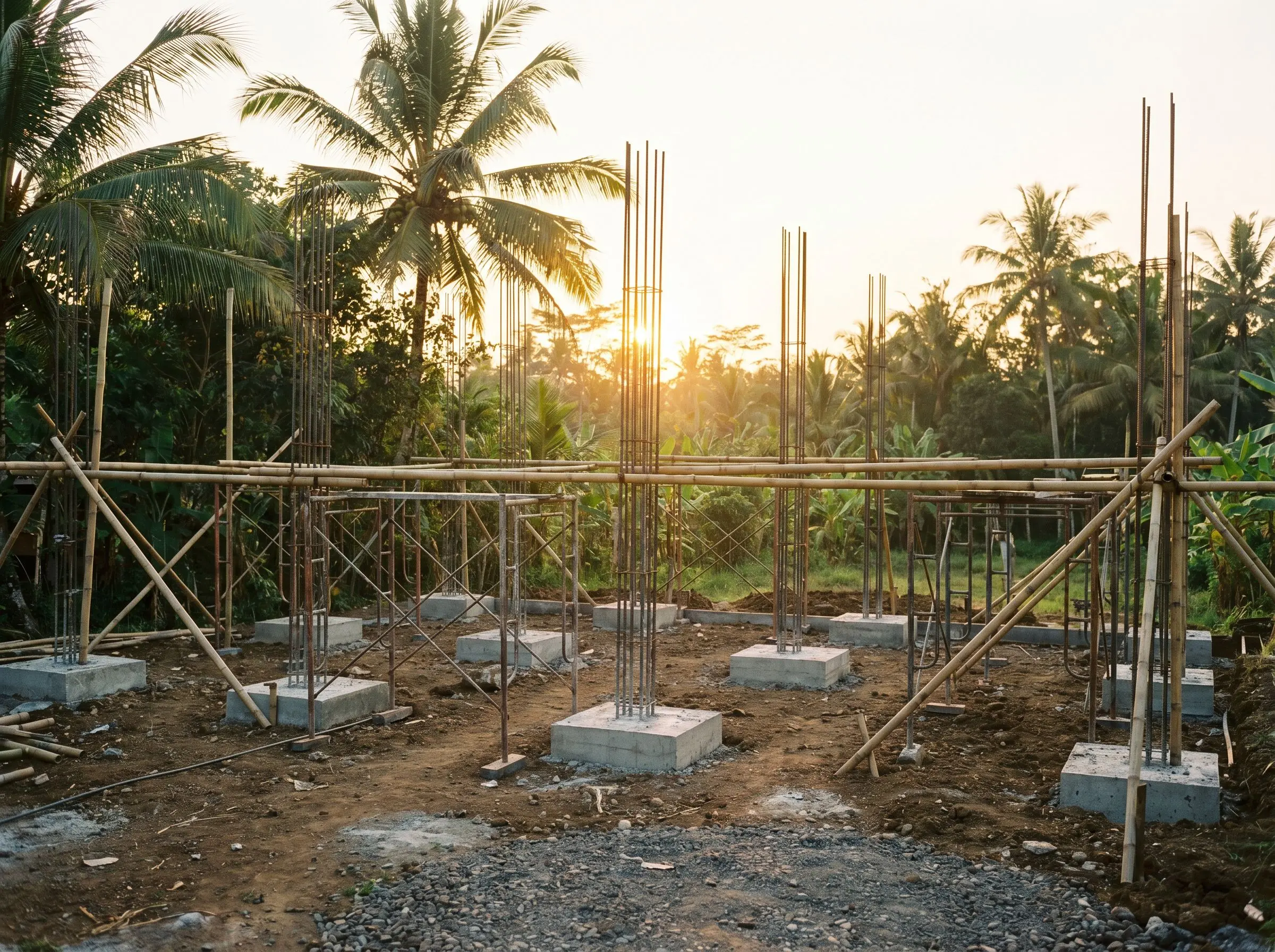
The "I'll just buy a plot and build my own villa" instinct is one of the most common opening positions in our buyer conversations, and one of the most underestimated. A ready 3BR villa in Berawa might list at USD 850,000. The same buyer, doing the math on land + build, arrives at USD 650,000-700,000 and reads the gap as "developer margin I can capture for myself". The gap is not the whole story. The build route absorbs 18-30 months of opportunity cost, exposes the buyer to contractor risk and IDR cost inflation, and requires a working knowledge of Indonesian permits, zoning, and banjar dynamics that most foreign first-time buyers do not have. This guide walks through the actual cost stack, the time-to-cashflow gap, and when the build route genuinely wins versus when buying ready or off-plan is the honest answer.
The build math, fully loaded
When a buyer says "I can save 20% by building it myself", they are almost always pricing the visible costs and missing the invisible stack. The full build cost layer in Bali by Q1 2026:
- Land acquisition. Direct freehold (Hak Milik) is reserved for Indonesian nationals. Foreign-buyer routes are Hak Sewa (leasehold over an Indonesian-held SHM or SHGB, the dominant route in Canggu and the Bukit), Hak Pakai (right-of-use in foreign individual name, which requires a KITAS or KITAP and is subject to area and value caps under PP 18/2021), or beneficial control via a PT PMA holding SHGB (right-to-build, 30+20+30 years). Lease premiums in Canggu sub-markets typically run USD 25,000-45,000 per are (100 m²) for 25-30 year leasehold land; in Seseh-Cemagi USD 12,000-25,000 per are; in Tabanan-edge sub-markets (Kedungu, Selemadeg, Kelating) USD 5,000-12,000 per are.
- Notary, due diligence, BPHTB. Land due-diligence by a notaris (notary) including Sertifikat validation, Tata Ruang (RDTR zoning) check, and banjar / desa adat (customary village) inquiry on any pending claims; BPHTB (Bea Perolehan Hak atas Tanah dan Bangunan, the 5% buyer-side acquisition tax on the NPOP acquisition value above the local NPOPTKP threshold); PPAT fees. Budget roughly 6-9% of land price.
- Soft costs. Architect, structural engineer, MEP design, interior design. Range USD 30,000-90,000 for a 200-300 m² villa, depending on whether you hire a Bali-local studio or a name-recognized practice.
- Permits. PBG (Persetujuan Bangunan Gedung) and SLF (Sertifikat Laik Fungsi) after handover, via the SIMBG online portal. Daily-rental operation typically routes through a PT PMA holding KBLI 55193 (villa classification); Pondok Wisata (KBLI 55130) is a separate homestay license reserved for Indonesian citizens and is not a foreign-buyer route. Permit consultant fees USD 4,000-15,000.
- Construction. Turnkey villa construction in Bali for a foreign-spec 2-3BR product typically lands at USD 700-1,200 per m² for shell-and-core, USD 1,500-2,200 per m² for mid-range turnkey including kitchen, bathrooms, and finishing (pool and landscaping costed separately below). A 250 m² mid-range turnkey villa is therefore USD 375,000-550,000; premium specification pushes to USD 625,000-875,000.
- Pool and landscaping. USD 30,000-70,000 for the pool depending on size and finishing; landscaping USD 15,000-40,000.
- FF&E. USD 30,000-80,000 for a 2-3BR product if you specify mid-range; double that for upper-tier specification.
- Contingency. A meaningful build budget needs 10-15% contingency. IDR cost inflation, scope creep, and supply chain delays are the reality, not the exception.
- Interest cost during build. Capital deployed to land + construction is not earning rental income; depending on what else you'd be doing with it, the opportunity cost is real.
Anteya observation: Across the 5,300 buyer conversations 2023-2026, build-route buyers consistently undershoot the total cost by a typical 15-25% versus what they actually deploy by handover. The miss concentrates in three areas: permits and consultant fees, FF&E and landscaping, and contingency draws against contractor change-orders.
A reasonable rule of thumb for a 250 m² turnkey villa in a mid-tier Canggu sub-market in 2026: land + build + soft costs + FF&E + contingency commonly lands at USD 650,000-950,000 all-in, versus a ready 250 m² villa at USD 750,000-1,100,000. The headline 15-25% gap exists, but it pays for time, certainty, and risk transfer, not pure developer profit.
"My friend in Sydney told me he saved 30% by building in Canggu. I want to do the same in Pererenan. Can you walk me through the realistic budget?"
Buyer inquiry, Anteya CRM, 2025
Land prices by sub-market
Land prices in Bali in Q1 2026 are quoted by are (100 m²), with leasehold premiums depending on lease length, zoning (Green, Yellow, Pink), and proximity to the coast. Directional ranges:
- Canggu (Batu Bolong, Berawa, Pererenan): USD 25,000-45,000 per are leasehold for 25-30 years; some pockets push to USD 60,000+ near beach access.
- Seseh, Cemagi, Nyanyi: USD 12,000-25,000 per are.
- Uluwatu / Pecatu / Ungasan: USD 18,000-40,000 per are; clifftop or cliff-edge plots can reach USD 80,000+ per are.
- Ubud (Penestanan, Tegallalang, Sayan): USD 10,000-25,000 per are; jungle and rice-paddy edge.
- Tabanan (Kedungu, Selemadeg, Kelating): USD 5,000-12,000 per are; lower zoning density.
- Sanur: USD 15,000-30,000 per are.
Freehold (Hak Milik) land, which only Indonesian nationals can hold, is commonly quoted at 4-6x the equivalent 25-30 year leasehold premium in Canggu and mid-tier sub-markets, compressing to roughly 2-3x in Uluwatu and Pecatu where freehold scarcity caps the discount spread, and stretching to 5-7x in emerging Tabanan and Cemagi. Foreign-buyer structures access this layer indirectly via PT PMA holding SHGB (right-to-build, 30+20+30 years under PP 18/2021) or via Hak Pakai in foreign individual name with KITAS or KITAP. The implied IRR for the foreign buyer choosing leasehold over a PT PMA + SHGB structure is typically positive on a 15-20 year hold, but the math is sensitive to assumptions about land appreciation, renewal terms, and entity-level tax flow.
"The agent quoted me USD 35,000 per are leasehold for the plot in Pererenan but freehold equivalent USD 200,000 per are. Is that ratio normal or are they marking up the freehold to push me into lease?"
Buyer inquiry, Anteya CRM, 2026
Construction cost in Bali by Q1 2026
Construction cost per m² in Bali has risen meaningfully since 2022. Drivers: imported material cost (steel, glass, premium tiles, kitchen appliances), wage inflation among skilled trades (tilers, joiners, pool specialists), and IDR weakness against the USD. Typical ranges for a foreign-spec 2-3BR villa in 2026:
- Shell-and-core only (structure, basic MEP, ready for interior finishing): USD 700-1,200 per m².
- Mid-range turnkey (full finishing, mid-tier kitchen and bathrooms, basic landscaping): USD 1,500-2,200 per m².
- Premium turnkey (high-end appliances, custom millwork, designer bathrooms, refined landscaping): USD 2,500-3,500 per m².
- Architecturally-led / ultra-premium (named architect, signature design, imported materials): USD 4,000-6,500+ per m².
Pool construction adds USD 30,000-70,000 for a typical residential villa size; landscaping USD 15,000-40,000 depending on hardscape and planting density. Generator, solar, and water-tank infrastructure can add another USD 8,000-25,000: PLN supply is reliable on the main grid but dry-season brownouts in west Canggu, Pererenan-edge, and parts of the Bukit are routine, and coastal Canggu groundwater is increasingly saline, pushing most foreign-spec villas onto bore plus filtration or PDAM supply.
Anteya observation: Build budgets typically come in 12-22% over original quote by handover. The contractor's initial number is rarely the final number unless the buyer locks scope hard at SPK (Surat Perintah Kerja, the work order) and refuses any change-order during build. Most foreign buyers do not lock that hard.
The 18-30 month build clock
Time-to-cashflow is where the build-versus-buy math gets uncomfortable. A typical build timeline:
- Land identification and DD: 1-3 months.
- Negotiation, contract, notary closing: 1-2 months.
- Design and permitting: 4-8 months (PBG via SIMBG, RDTR check, possibly Pertimbangan Teknis Pertanahan (PTP) if zoning is ambiguous).
- Tendering and contractor selection: 1-3 months.
- Construction: 9-14 months for a standard 2-3BR turnkey, longer for premium or complex sites.
- FF&E and handover: 1-2 months.
- SLF and operational permits: 1-2 months post-handover.
End-to-end is therefore typically 18-30 months from first land inquiry to first rental night. A ready villa, by contrast, transfers in 30-60 days from offer to handover. The opportunity cost of 18-30 months without rental income on USD 700,000-900,000 of deployed capital is material, especially if the buyer was otherwise planning a Bali villa as a cashflow asset rather than a passion project.
Off-plan: the middle-ground option
Off-plan purchases sit between buying ready and building from land. The buyer commits to a developer-built unit at a pre-handover stage, usually paying a deposit (typically 20-30%) and milestone payments through construction, with the remainder due at handover. Off-plan in Bali in 2026 typically delivers:
- Discount versus ready price: typically 8-18% versus equivalent ready stock, depending on construction stage at purchase and developer hunger to clear pre-sales.
- Customisation window: smaller than full build but real; buyers often choose finish package, kitchen layout, sometimes minor structural changes if early enough.
- Risk profile: developer completion risk replaces direct contractor risk; this concentrates risk in the developer's balance sheet, which is itself a thing to underwrite.
- Handover timing: typically 6-18 months from contract.
Off-plan works well for buyers who want a meaningful discount versus ready, are comfortable with some completion risk against an established developer, and don't need full design control. It fails for buyers who want a specific architectural vision or who can't tolerate developer-completion risk.
When build wins
The build route genuinely makes sense in a narrow set of cases:
- You have a specific architectural or lifestyle vision that no ready or off-plan product matches. You want a particular floorplan, kitchen layout, pool position, indoor-outdoor flow that you cannot buy off-the-shelf.
- You have time on your side. The 18-30 month clock is not a problem because the villa is for personal use, retirement, or long-hold investment, and the rental income lost during build is not the primary value driver.
- You have local presence or a strong local team. Either you're in Bali frequently or you have a project manager you trust running site supervision daily. Building from abroad with a contractor you've never personally vetted typically goes badly.
- The land arbitrage is genuinely large. You've found a plot in an emerging sub-market (Cemagi, Tabanan, Pererenan-edge) where land cost makes the build math compelling even after construction at 2026 prices.
- You're building two-or-more. Per-unit overhead amortizes much better on a 2-3 villa project than on a single villa, especially soft costs and permits.
When ready or off-plan wins
For most foreign buyers, ready or off-plan is the more honest choice:
- You're a first-time Bali buyer. The legal, permit, contractor, and zoning learning curve is steep; the first build is where most of the cost overruns happen.
- Time-to-cashflow matters. If the villa is a yield asset, the 18-30 month build delay is a hard cost that doesn't show up in the spreadsheet.
- You're managing from abroad. Without weekly or fortnightly site presence (yours or a trusted PM's), build quality typically slips and contractor change-orders multiply.
- The 15-25% headline savings doesn't survive a realistic cost stack. Once you load permits, soft costs, FF&E, contingency, and 18-30 months of opportunity cost, the gap often collapses to under 5-10%. That's not enough to justify the risk transfer for a single villa.
"If I'd known what I know now, I would have bought the ready villa in Berawa. The build took 28 months instead of 14, cost 35% more than the original quote, and we're still arguing with the contractor about pool tile."
Buyer inquiry, Anteya CRM, 2026
Practical due diligence before committing to build
If after the above the build route still makes sense for you, the pre-commit DD list:
- Land due diligence by an independent notaris. Verify chain of title, Sertifikat (SHM or SHGB), encumbrances, banjar land-use rules, Tata Ruang (RDTR) zoning, and any pending adat (customary law) claims surfaced through the local banjar and desa adat (customary village), not just the notaris's formal title search. Do not rely on the seller's notaris.
- Pre-PBG zoning check. Get the Pertimbangan Teknis Pertanahan (PTP) advisory before committing if zoning interpretation is ambiguous. Six regencies (Tabanan, Jembrana, Buleleng, Bangli, Karangasem and Klungkung) have tightened restrictions in 2026 on new hotels, villas and tourism-use buildings to protect agricultural land; check your plot is not within their footprint.
- Architect and engineer selection. Use Bali-based practices with track record on similar product. Verify the practice has delivered foreign-buyer villas in your target sub-market and ask for three references you can actually call.
- Contractor selection and SPK lock. Three-tender minimum, with site visits to current and recent builds. Lock scope hard in SPK and budget no more than 10% in change-orders.
- PM appointment. Either you commit to monthly minimum on-site presence or you appoint an independent project manager (not the contractor's PM) on a 1-2% of build budget engagement.
- Build-phase cash management. Milestone payments tied to inspected progress, not calendar dates. Retain 5-10% until SLF issuance.
- Foreign-exchange plan. IDR weakness against USD has run since 2022. Lock IDR purchases as you go, do not let a USD float against IDR carry through the entire build.
Where to take this next
Build-versus-buy is one of the most consequential framings in a Bali villa purchase, and one where buyer intuition diverges most from the actual math. The build route wins for a specific buyer profile (vision-led, time-rich, locally-present, multi-villa, or extreme land arbitrage). For everyone else, ready or off-plan is the lower-risk, lower-friction answer that the headline cost savings of building do not actually offset once the full stack is loaded.
The single biggest mistake we see at the inquiry stage is buyers committing to land before commissioning real cost-stack and timeline modeling. The second is buyers building from abroad without trusted weekly site presence. Both are knowable in advance; neither is detectable after handover.
This article is general market information, not legal, tax, or investment advice. Indonesian real-estate rules, construction practice, and brand-licensing arrangements vary by project, and individual situations differ. Consult a licensed Indonesian notaris (notary) and qualified tax adviser for your specific purchase.
FAQ
Is it cheaper to build a villa in Bali than to buy ready?
On a fully-loaded cost stack including land, permits, soft costs, construction, FF&E, contingency, and 18-30 months of opportunity cost, the gap to ready stock is typically 5-15% rather than the 20-30% buyers often estimate. The savings are real for a specific buyer profile but rarely the headline number.
How much does it cost to build a villa in Bali in 2026?
For a foreign-spec 2-3BR villa, turnkey construction in Bali typically runs USD 1,500-2,200 per m² for mid-range, USD 2,500-3,500 per m² for premium specification, and USD 4,000-6,500+ per m² for architecturally-led ultra-premium. A 250 m² mid-range turnkey villa is therefore commonly USD 375,000-550,000 in construction alone, before land, soft costs, FF&E, and contingency.
What's a realistic timeline from buying land to first rental night in Bali?
End-to-end build timelines typically run 18-30 months: 1-3 months land identification and DD, 1-2 months closing, 4-8 months design and permits, 1-3 months tendering, 9-14 months construction, 1-2 months handover and FF&E, 1-2 months SLF and operational permits. A ready villa, by contrast, transfers in 30-60 days.
Can foreigners buy land in Bali outright?
Direct freehold (Hak Milik) ownership of land is not available to foreign individuals. Foreigners can hold land via Hak Pakai (right-of-use, individual foreign-name title), Hak Sewa (lease right against an Indonesian-held SHM or SHGB), or beneficial ownership through a PT PMA structure holding SHGB. Each has different exit, tax, and succession implications.
How much should I budget for land in Canggu versus Cemagi or Tabanan?
Canggu sub-markets (Batu Bolong, Berawa, Pererenan) commonly run USD 25,000-45,000 per are (100 m²) leasehold for 25-30 years, with beach-edge pockets pushing higher. Seseh-Cemagi runs USD 12,000-25,000 per are. Tabanan-edge sub-markets run USD 5,000-12,000 per are. Freehold equivalents typically run 4-6x leasehold for the same plot.
What's the off-plan discount versus ready stock in Bali?
Off-plan in Bali in 2026 typically delivers an 8-18% discount versus equivalent ready stock, depending on construction stage at purchase, developer pre-sale targets, and how hungry the developer is to clear inventory. The discount comes with developer-completion risk, which sits in the developer's balance sheet and which the buyer should underwrite.
What goes wrong most often when foreigners build in Bali?
The three most common failure modes are: (1) commissioning land without real zoning DD and discovering downstream that Tata Ruang (RDTR) doesn't allow the planned use, (2) signing with a contractor without a hard SPK lock and watching change-orders compound to 20-35% over original quote, and (3) managing from abroad without weekly local site presence and ending up with quality slippage that's expensive to remediate at handover.